
Idealized Urban Sentiment on Social Media Predicts Higher Depression Risk
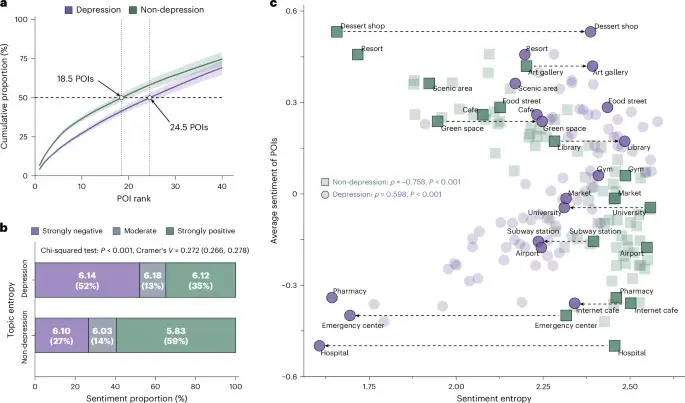
A new study in Nature Cities finds that positive sentiment toward cultural and residential areas on Sina Weibo correlates with higher depression risk, challenging the assumption that positive online engagement indicates mental well-being.
Key points
- Researchers analyzed the Sina Weibo Depression Dataset to link subjective environmental perception with depression.
- They developed an index called LooM to measure place-based sentiment intensity across 88 urban place types.
- Depressed individuals showed more emotionally mixed expressions in their posts.
- Positive sentiment toward cultural and residential places was associated with higher depression risk, suggesting a longing for idealized lifestyles.
- Risk signals varied across Chinese cities and followed scaling laws related to population size.
Background
Previous research has extensively studied the link between physical built environments and depression, but large-scale associations between subjective environmental perceptions and mental health remained uncharacterized. This study builds on earlier findings regarding urban living environments and mental health, as well as the growing concern over social media's impact on youth and public sentiment, as seen in recent Meta settlements and platform regulation debates.
Why it matters
The findings challenge the common assumption that positive sentiment equates to good mental health, suggesting that idealized views of urban spaces may reflect unmet emotional needs. This could inform urban design to better address residents' subjective emotional experiences and improve mental health outcomes in cities.
What to watch
Urban planners and policymakers may need to reconsider how they measure and respond to public sentiment in city design, focusing not just on physical infrastructure but also on the emotional and psychological needs of residents. Further research may explore how these patterns apply to other cities and social media platforms globally.
Want the full story? Read the original reporting
Read on Nature