
Large-Scale Study Finds No Shared Neural Signature for Emotion Regulation Capacity
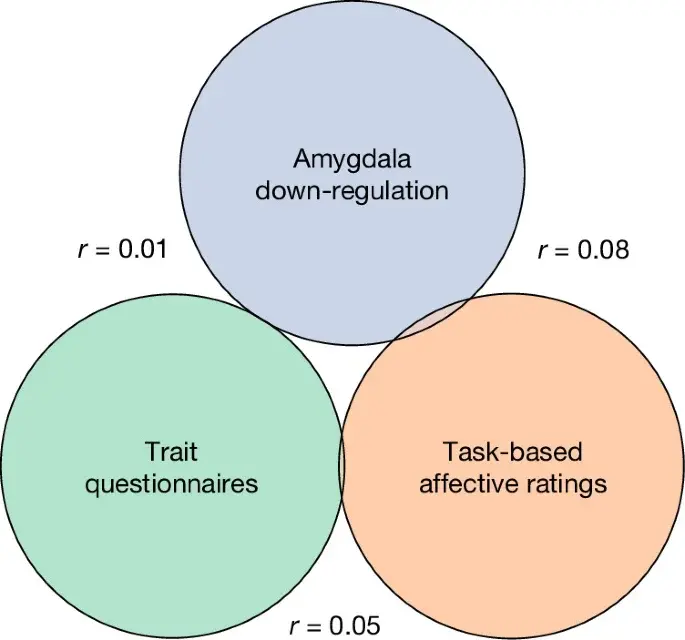
A massive meta-analysis of 40 fMRI datasets involving 2,175 participants challenges the assumption that prefrontal cortex activity predicts an individual's ability to regulate emotions. The study found that common measures of emotional regulation capacity—trait questionnaires, task-based affective ratings, and amygdala down-regulation—do not converge on a shared neural core. None of these indicators showed the expected association with canonical prefrontal regulatory circuits. Instead, task-based ratings correlated weakly with amygdala and sensorimotor regions, while trait questionnaires showed no detectable neural associations. The findings suggest that different individuals may use distinct neural pathways to achieve similar emotional outcomes, complicating the use of specific brain regions as biomarkers for emotion regulation deficits.
Key points
- The NIDER consortium analyzed 40 fMRI datasets with 2,175 participants, a sample size 20 times larger than previous reviews.
- Three standard indices of reappraisal capacity (trait questionnaires, task-based affective ratings, amygdala down-regulation) failed to show significant convergence.
- None of the three indices correlated with activity in canonical prefrontal emotion regulation circuits.
- Task-based affective ratings showed a small, significant correlation with amygdala down-regulation (r = 0.08), but this effect size requires over 1,000 participants to detect reliably.
- Trait questionnaires showed no significant association with either task-based ratings or amygdala activity, with Bayes factors favoring the null hypothesis.
- Canonical control circuits were engaged during both emotion generation and reappraisal, challenging their presumed specificity for regulation.
Background
Prior research in affective neuroscience has extensively mapped the neural basis of cognitive reappraisal, consistently implicating lateral and medial prefrontal regions and reduced amygdala activation. These findings have informed neuromodulatory interventions and clinical models linking emotion regulation deficits to specific regional brain abnormalities. However, previous studies were primarily within-person designs and often underpowered (median n = 25), limiting their ability to detect between-person individual differences. The current study addresses this gap by conducting a preregistered, large-scale consortium analysis to test whether prefrontal activation reflects individual differences in regulatory capacity.
How outlets are covering it
The primary source, Nature, emphasizes the lack of convergence among three widely used indices of reappraisal capacity and the absence of expected associations with canonical prefrontal circuits. It highlights the methodological challenge of whole-brain vascular responsivity confounding between-person comparisons. Secondary source 1, Neuroscience News, frames the findings as overturning a 'core dogma' in affective neuroscience, stressing that prefrontal activation offers no predictive power for individual emotional control. It also notes that different brains may deploy distinct neural pathways to regulate distress. Secondary source 2, News-Medical, focuses on the practical implications for clinical research, warning that reduced prefrontal activity should not be interpreted as a sign of impaired emotional regulation. It also highlights the role of sensorimotor circuits and the importance of personally relevant tasks in future research. All sources agree on the central finding that prefrontal activation does not predict individual emotion regulation capacity, but they differ in emphasis: Nature focuses on the methodological and theoretical implications, while the secondary sources highlight the clinical and practical consequences for biomarker development and intervention design.
Why it matters
The findings challenge a foundational assumption in affective neuroscience and clinical psychology: that brain activity during reappraisal reflects individual differences in regulatory capacity. This has direct implications for the development of neural biomarkers, neuromodulatory interventions, and psychoeducation that link emotion regulation difficulties to specific regional brain deficits. The study suggests that future research must move away from isolated regional brain markers and toward more realistic, personally relevant tasks and whole-brain network models that account for individual vascular physiology. This shift could improve the accuracy of clinical assessments and the effectiveness of interventions targeting emotion regulation deficits.
What to watch
The NIDER consortium plans to further test connectivity and gradient-based approaches to identify neural correlates of emotion regulation capacity. Future studies will need to develop tasks that specifically induce individual differences while accounting for whole-brain responsivity. Additionally, transdiagnostic samples covering the full range of clinical dimensions may reveal meaningful individual-difference associations that are absent in non-clinical populations. The consortium also aims to explore person-specific decoding models to better understand neural heterogeneity in emotion regulation.
Want the full story? Read the original reporting
Read on Nature