
TenK10K Study Maps 150,000 Genetic Effects Across 28 Immune Cell Types
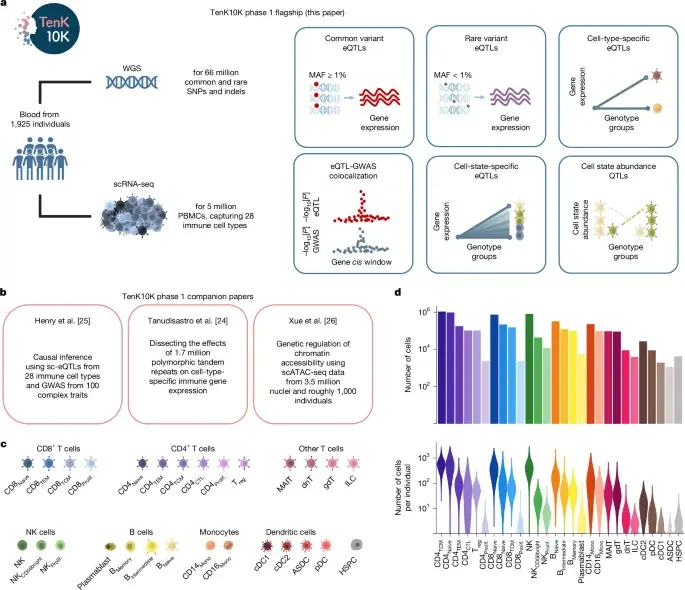
A new study published in Nature, known as TenK10K phase 1, analyzes 5.4 million immune cells from 1,925 individuals to map how genetic variants regulate gene expression. The research identifies over 150,000 common and 30,000 rare variant effects across 28 immune cell types, revealing that half of these effects are specific to only one or a few cell types. By linking these genetic signals to 60 disease phenotypes, the study uncovers potential molecular mechanisms for conditions like inflammatory bowel disease and Alzheimer's, highlighting the value of single-cell resolution in precision medicine.
Key points
- The TenK10K phase 1 study utilized single-cell RNA sequencing and whole-genome sequencing from 1,925 individuals of European ancestry, analyzing 5.4 million cells across 28 distinct immune cell types.
- Researchers identified 154,932 common-variant expression quantitative trait loci (eQTLs) and over 30,000 rare-variant effects, covering 83% of the 21,404 genes tested.
- Approximately 50% of the identified genetic effects were specific to only one or a few cell types, demonstrating that genetic regulation is highly context-dependent rather than ubiquitous across all immune cells.
- Statistical colocalization with 60 disease phenotypes revealed over 60,000 events, identifying potential molecular mechanisms for nearly 900 genes, including links between OSM expression in NK cells and inflammatory bowel disease risk.
- The study found that 893 genes associated with diseases or blood traits had not been previously identified as eGenes in larger bulk blood studies, emphasizing the unique insights provided by single-cell analysis.
Background
This study follows a trend of large-scale immune atlases, such as the Finnish Immune Atlas covered in September 2026, which linked non-coding variants to disease mechanisms. While previous studies like eQTLGen focused on bulk blood samples, TenK10K advances the field by using single-cell resolution to detect cell-type-specific effects that are often invisible in aggregated data. It complements recent findings on somatic mosaicism and epimutations, which highlight how non-genetic changes also influence gene regulation, but TenK10K focuses specifically on germline genetic variation's impact on immune cell states.
How outlets are covering it
The primary source, Nature, emphasizes the technical methodology and the discovery of rare variant effects, noting that rare variant signals were found for 47% of genes tested. It highlights the development of the SAIGE-QTL method and the scDeepID deep learning tool for mapping dynamic cell states. The secondary source, Inside Precision Medicine, focuses on the translational potential, quoting Joseph Powell to stress that these findings shift the field from knowing 'very few' to 'thousands' of causal mechanisms, enabling targeted treatments. UW Medicine's secondary source, while covering a different study on somatic mosaicism, provides a contrasting perspective on genetic variation by discussing epimutations that are invisible to standard sequencing, suggesting that DNA sequence alone may not fully explain gene regulation, a limitation that TenK10K's focus on germline variants does not address.
Why it matters
This research provides a detailed map of how genetic variation influences immune cell function, which is critical for understanding the molecular basis of autoimmune and inflammatory diseases. By identifying cell-type-specific genetic effects, the study enables more precise drug targeting and patient stratification. The discovery of new disease-gene links, such as the OSM-NK cell connection to inflammatory bowel disease, offers new therapeutic targets that were previously unknown, potentially accelerating the development of precision medicines for conditions like multiple sclerosis, Alzheimer's, and cancer.
What to watch
Future research will likely expand the TenK10K dataset to include more diverse ancestries and additional tissue types beyond peripheral blood. Researchers will also integrate the single-cell eQTL data with chromatin accessibility and tandem repeat variation studies from the same cohort to build a more comprehensive model of gene regulation. The identified cell-type-specific mechanisms will be tested in clinical trials to determine their utility in predicting treatment response and developing new therapies for immune-mediated diseases.
- Rare and common genetic variants shape single-cell immune gene expression Nature
- Three studies reveal the hidden layers between DNA and disease Medical Xpress
- Invisible changes in our cells may shape health and disease UW Medicine | Newsroom
- Genetic Differences Impact Immune Cells to Affect Disease Risk Inside Precision Medicine
- NEWS BRIEFING: Mapping the missing links between genes and disease Scimex
Want the full story? Read the original reporting
Read on Nature