
New 'Molecular Brace' Drug Rewires Protein Complexes to Target Prostate Cancer
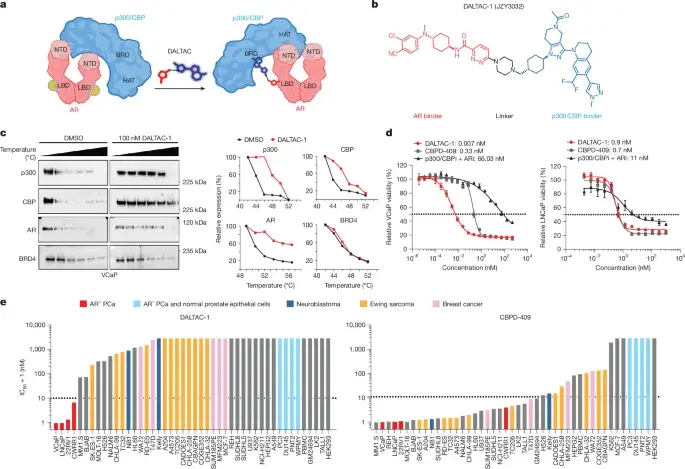
Researchers at the University of Michigan have developed a new preclinical therapeutic strategy called domain-alteration chimeras (DALTACs) to treat metastatic castration-resistant prostate cancer. The lead compound, DALTAC-1, functions as a bifunctional molecule that physically links the androgen receptor (AR) and the coactivator p300/CBP into an unnatural configuration. This 'molecular brace' locks the proteins in an inactive state, disrupting oncogenic transcription more effectively than standard inhibitors. In preclinical tests, DALTAC-1 demonstrated approximately 1,000 times greater potency in tumor cells compared to separate inhibitors, while sparing healthy cells. The study, published in Nature, highlights the potential for oral formulations and durable tumor regression in animal models, though human trials have not yet begun.
Key points
- DALTAC-1 is a first-in-class heterobifunctional molecule that tethers the ligand-binding domain of the androgen receptor to the bromodomain of p300/CBP.
- The compound induces a 'super-inhibitory' effect by misconfiguring the native protein interface, suppressing AR-driven transcription and proliferation more potently than combined AR and p300/CBP inhibition.
- Preclinical testing in cell lines, organoids, and mouse models showed durable tumor regression and high lineage selectivity, sparing AR-negative cells.
- The optimized molecule achieved 18.5% oral bioavailability in mice, a key step toward developing a pill formulation for patients.
- The research remains at the preclinical stage, with teams working to identify a candidate for human clinical trials.
Background
Metastatic castration-resistant prostate cancer (mCRPC) is driven by transcriptional addiction to the androgen receptor (AR), which relies on interactions with acetyltransferases p300 and CBP. Previous therapies targeting these proteins often caused toxicity in normal tissues. This study builds on earlier work by the same research group, including a 2025 study on targeting H2B acetylated enhanceosomes and a July 2026 study identifying a druggable pocket in the ERG protein, which is fused with TMPRSS2 in many prostate cancers. The current research expands the field of chemically induced proximity, which includes PROTACs and RIPTACs, by introducing a modality that alters domain topology rather than degrading proteins.
How outlets are covering it
The primary source, Nature, provides detailed mechanistic data, including chromatin profiling and specific IC50 values (0.26 nM in LNCaP cells), emphasizing the 'super-inhibitory' effect and lineage selectivity. Secondary sources, such as Bioengineer.org and Tomorrow's World Today, focus on the translational potential, highlighting the 1,000-fold potency advantage over separate inhibitors and the optimization for oral bioavailability. SciTechDaily covers a related but distinct study on ERG targeting (PBITE-1) by the same senior author, Arul Chinnaiyan, illustrating the broader strategy of personalizing therapy for prostate cancer subtypes. While all sources agree on the promise of the DALTAC approach, the Nature article provides the rigorous preclinical evidence, whereas the secondary outlets emphasize the clinical implications and the shift from single-target to complex-rewiring therapies.
Why it matters
This research offers a potential new treatment avenue for advanced prostate cancer, which often develops resistance to current hormone therapies. By targeting the interaction between AR and p300/CBP rather than individual proteins, DALTACs may overcome resistance mechanisms and reduce toxicity. The high selectivity for cancer cells and the potential for oral administration could improve patient outcomes and quality of life. If successful in human trials, this approach could be generalized to other cancers driven by similar protein complexes.
What to watch
The research teams are actively working to refine DALTAC-1 and other candidates for human clinical trials. The next steps involve further preclinical safety and efficacy studies, including toxicity assessments in non-human primates, before initiating Phase 1 trials. The University of Michigan has filed patent applications related to the technology, which have been licensed to Medsyn Biopharma, a company co-founded by the senior authors.
- Domain-alteration chimeras rewire oncogenic complexes in prostate cancer Nature
- Scientists Discover a Hidden Weakness in Prostate Cancer That Could Transform Treatment SciTechDaily
- Molecular brace traps two cancer-driving proteins to suppress prostate cancer growth in preclinical tests Medical Xpress
- Domain-Alteration Chimera Strategy Suppresses Prostate Tumor Growth in Preclinical Tests Bioengineer.org
- New Anti-Cancer Therapeutic Strategy Shows Promise Tomorrow's World Today
Want the full story? Read the original reporting
Read on Nature