
New Study Links Microglia Genetics to Neurodegenerative Risk via Stem Cell Screening
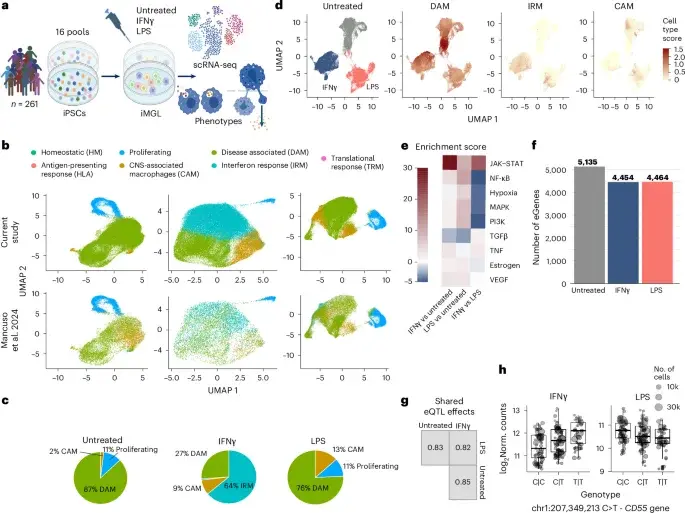
Researchers have developed a new framework to link genetic variants to cellular functions in microglia, the brain’s immune cells, which are implicated in neurodegenerative diseases. By differentiating 261 human induced pluripotent stem cell lines into microglia-like cells, the study identified 36 genes influencing microglial phenotypes and 7,121 expression quantitative trait loci. The research highlights how common genetic variations, such as those in LRRK2 and TREM2, affect microglial phagocytosis and migration, providing a mechanistic link between genetic risk and cellular behavior in conditions like Alzheimer’s and Parkinson’s disease.
Key points
- The study utilized 261 human induced pluripotent stem cell lines to create microglia-like cells, allowing for the analysis of genetic effects on cellular phenotypes.
- Burden analysis of deleterious variants identified 36 genes that influence microglial phenotypes, including differentiation, phagocytosis, and migration.
- Expression quantitative trait locus analysis identified 7,121 associated genes and 79 colocalizations across genome-wide association studies for Alzheimer’s, Parkinson’s, ALS, and multiple sclerosis.
- The research demonstrated that LRRK2 and TREM2 variants act through microglial phagocytosis, with increased TREM2 expression potentially reducing Alzheimer’s risk.
- A coupled CRISPR screen confirmed the role of TREM2 in phagocytosis and highlighted that the direction of phenotypic effects depends on the specific cell type and inflammatory state.
Background
This study builds on recent findings, including a massive international study involving 2.8 million people that identified 48 new genetic risk factors for Alzheimer’s disease and emphasized the central role of microglia. While previous research highlighted microglia’s importance in disease progression, this new work provides a scalable system to model human microglial biology and link specific genetic variants to functional outcomes in live cells.
Why it matters
This research offers a comprehensive framework for interpreting the function of risk loci in neurodegenerative disorders by contextualizing variant effects within different microglial states. By linking common genetic variations to specific cellular behaviors like phagocytosis, the study provides potential new drug targets and a deeper understanding of how genetic background influences disease progression in conditions such as Alzheimer’s and Parkinson’s.
What to watch
The findings suggest that future research will focus on leveraging these microglia-specific genetic insights to develop targeted therapies. The study’s framework may also be applied to other cell types and diseases to further understand the relationship between genetic variation and cellular phenotypes in complex disorders.
Want the full story? Read the original reporting
Read on Nature