
Mass Photometry Reveals Real-Time Molecular Pathways of Virus-Like Particle Assembly
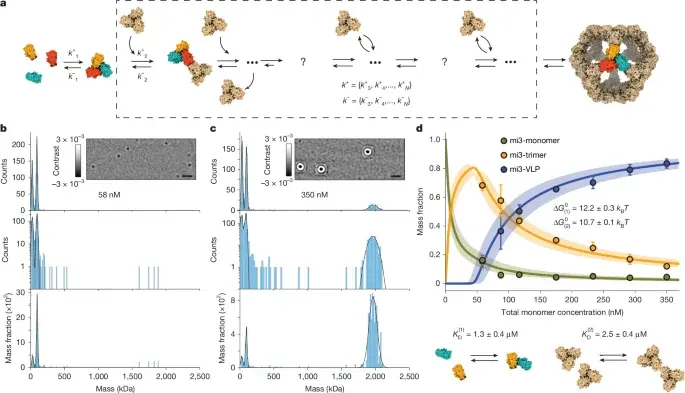
Researchers have achieved the first real-time, molecular-level observation of virus-like particle (VLP) self-assembly by combining mass photometry with single-molecule trapping. The study demonstrates that assembly is driven by weak, reversible interactions that stochastically select specific topological intermediates, resolving a decades-long gap in understanding viral capsid dynamics.
Key points
- A new experimental framework combines mass photometry (MP) with single-molecule trapping to monitor VLP assembly in real-time with molecular resolution.
- The study focuses on the mi3-VLP, a dodecahedral particle composed of 60 identical monomers, which serves as a model for T=1 icosahedral viral capsids.
- Assembly is governed by weak pairwise interactions (KD approx 2.5 microM) that allow for reversible encounters, facilitating the stochastic selection of stable, topologically closed intermediates.
- The process follows a nucleation-and-growth mechanism where the formation of a pentagonal ring is the critical rate-limiting step, followed by irreversible first-passage events.
- Despite the overall irreversibility of the assembly steps, the system reaches an equilibrium distribution consistent with the law of mass action, coexisting with free subunits.
Background
This research builds on prior efforts to understand biomolecular self-assembly, which is fundamental to cellular organization and disease mechanisms. While earlier studies, such as those on self-assembled contacts in molecular electronics (August 2026) or the theoretical framing of life as a dynamic state of matter (September 2026), highlighted the importance of self-organization, they lacked the temporal and molecular resolution to capture the dynamic pathways of complex viral structures. This study addresses the long-standing challenge of visualizing the molecular mechanism underlying capsid assembly, which had remained elusive despite decades of experimental efforts due to the heterogeneity and transient nature of assembly intermediates.
Why it matters
Understanding the precise kinetics and thermodynamics of viral capsid assembly is critical for the rational design of artificial protein nanocages and the development of antiviral therapeutics. The ability to visualize and quantify these dynamics at the molecular level provides a general framework for studying other multimeric biological machines, potentially leading to new biomaterials and interventions for diseases involving misassembly.
What to watch
Future work will apply this mass photometry framework to investigate how conformational regulation and shell elasticity influence assembly pathways in native capsids. Researchers also plan to explore how small-molecule modulators affect assembly outcomes and how these factors contribute to capsid polymorphism, expanding the application of this method to a broader range of multimolecular systems.
Want the full story? Read the original reporting
Read on Nature