Tag

Biophysics

All articles tagged with #biophysics

Mouse Embryo Nuclei Soften Temporarily to Activate Genes
science12 days ago

Mouse Embryo Nuclei Soften Temporarily to Activate Genes

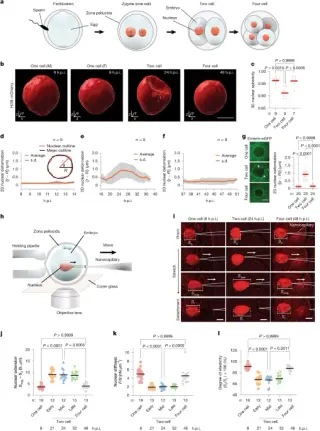
Researchers at Kyushu University and the National Institute of Genetics discovered that mouse embryo nuclei become physically softer and more deformable during the two-cell stage. This transient softening, driven by the autophagic clearance of the protein Lamin B1, is essential for major zygotic gene activation. Stiff nuclei impair development, while soft nuclei allow chromatin to reorganize near the nuclear envelope, facilitating transcription.
Live-cell imaging reveals nuclear pore barrier remains liquid, stabilized by importin-beta and glycosylation
science12 days ago

Live-cell imaging reveals nuclear pore barrier remains liquid, stabilized by importin-beta and glycosylation

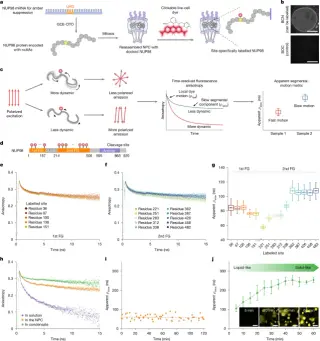
Researchers have resolved a long-standing debate about the physical state of the nuclear pore complex (NPC) barrier by demonstrating that its phenylalanine-glycine-rich nucleoporins (FG-NUPs) maintain liquid-like, nanosecond-scale segmental motion in living cells. Using site-specific labeling and time-resolved fluorescence anisotropy, the study shows that while isolated FG-NUPs in vitro transition from liquid to solid over time, cellular factors prevent this aging. Importin-beta and O-linked beta-N-acetylglucosamine (O-GlcNAc) modifications are identified as key regulators that stabilize this dynamic state. The findings indicate that importin-beta accumulates near the pore periphery while FG domains extend into the central channel, creating a radial organization that facilitates selective and rapid molecular transport between the nucleus and cytoplasm.

Real-time tracking reveals the step-by-step assembly of virus-like particle shells
science2 months ago

Real-time tracking reveals the step-by-step assembly of virus-like particle shells

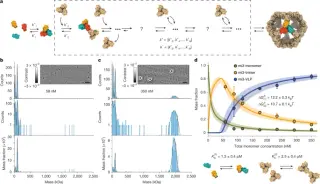
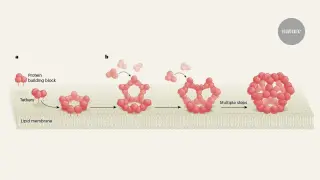
Researchers have successfully observed the real-time self-assembly of virus-like particles (VLPs), a long-standing goal in virology. Published in Nature, the study by Asor et al. utilizes advanced techniques to track the kinetics and energetics of protein shell formation. This breakthrough allows scientists to analyze how identical protein blocks interact to form stable, rigid structures that can later disassemble to release viral genomes. The findings provide a detailed molecular view of the assembly process, moving beyond static snapshots to dynamic observation.

Mass Photometry Reveals Real-Time Molecular Pathways of Virus-Like Particle Assembly
science2 months ago

Mass Photometry Reveals Real-Time Molecular Pathways of Virus-Like Particle Assembly

Researchers have achieved the first real-time, molecular-level observation of virus-like particle (VLP) self-assembly by combining mass photometry with single-molecule trapping. The study demonstrates that assembly is driven by weak, reversible interactions that stochastically select specific topological intermediates, resolving a decades-long gap in understanding viral capsid dynamics.

Beijing Team Builds 23-Gram Goggles That Render Infrared as Full Color
science-and-technology3 months ago

Beijing Team Builds 23-Gram Goggles That Render Infrared as Full Color

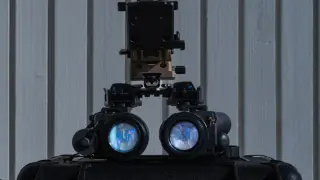
Researchers at the Beijing Institute of Technology have developed a lightweight, semi-transparent eyeglass that converts infrared light into a full-color visible image. Unlike standard night-vision devices that display monochrome green brightness, this prototype uses mercury telluride colloidal quantum dots and a dual-layer OLED to map infrared wavelength and intensity to distinct hues. The 23-gram device, published in Science Advances, demonstrated the ability to trigger visual responses in mice and human volunteers, though it currently requires external power and has not been tested in complex real-world environments.

Ancient bristle worm jaws redefine metal in biology as a new class of bio-metals
discoveries4 months ago

Ancient bristle worm jaws redefine metal in biology as a new class of bio-metals

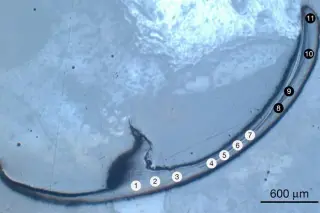
Microscopic tests of Perinereis cultrifera jaws show ion‑coordinated proteins that harden toward the tips and display metal‑like, size‑dependent elasticity, supporting a new category called bio-metals that blend polymeric structure with metal‑like hardness; researchers used nanoindentation and manifold micromechanics to define bio-metals by hardness, strain behavior, and ion‑protein structure and plan to study more species and potential genetic links to material design.

When Pulled, the Cell’s Spindle Gets Stronger
science4 months ago

When Pulled, the Cell’s Spindle Gets Stronger

Researchers used microneedles to stress the mammalian mitotic spindle during cell division and found the spindle self-stabilizes under force: damaged midsections are reinforced by more stable microtubule segments, with EB1 tagging marking repair sites. This mechanism helps the spindle withstand the forces of chromosome separation and could inspire resilient designs in engineering.

Protons on a Spin: The Proton Motive Force Powers Bacteria’s Tiny Engine
science7 months ago

Protons on a Spin: The Proton Motive Force Powers Bacteria’s Tiny Engine

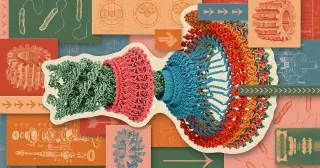
The article describes how bacteria run on a proton motive force that powers the flagellar motor, a nanoscale engine at the base of the flagellum. Recent cryo-EM studies mapped the motor’s components—especially the C ring and its stators—revealing how protons drive rotation and how phosphorylation of CheY flips the motor to switch between running and tumbling, illustrating how proton energetics power core cellular processes and life’s physics-driven machinery.

Discover the Hidden Clam Cathedrals Around You
science1 year ago

Discover the Hidden Clam Cathedrals Around You

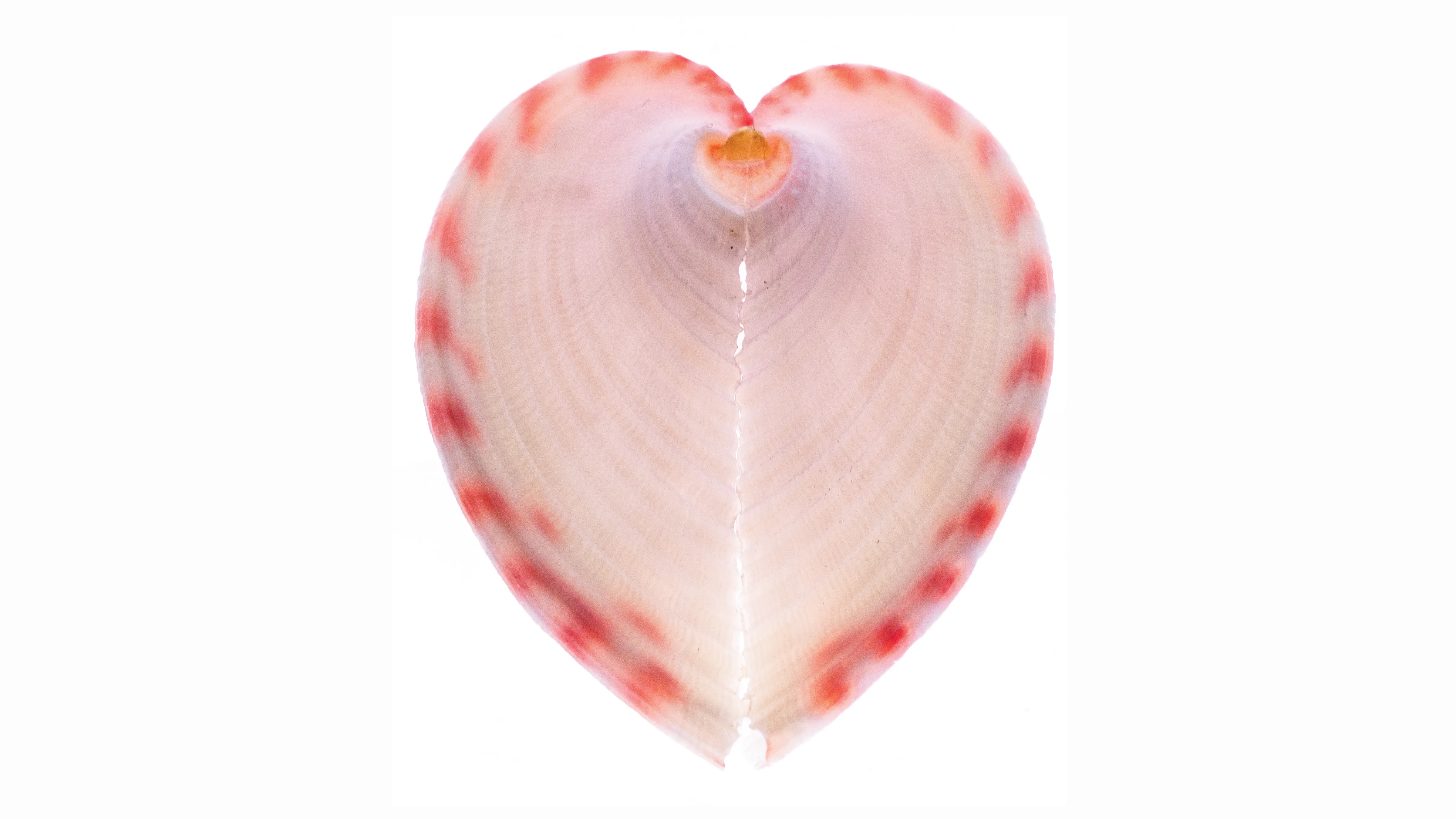
Biophysicist Dakota McCoy and her team have discovered that the heart cockle clam, Corculum cardissa, has shell structures that function like fiber optic cables, allowing beneficial sunlight to penetrate and sustain algae living inside. This natural phenomenon, reminiscent of stained glass windows, was detailed in a recent Nature Communications paper, highlighting the clam's unique adaptation long before human engineering achieved similar results.

"Unveiling the Origin of Life: Decoding Early Earth's RNA Puzzle"
science2 years ago

"Unveiling the Origin of Life: Decoding Early Earth's RNA Puzzle"

Biophysicists have discovered that simple heat flows in primordial times could have fostered the first prebiotic reactions, leading to the selective accumulation and up-concentration of prebiotic building blocks in rock fissures. This process could have created a "molecular kitchen" in large geological network systems, providing the necessary conditions for the emergence of life's ingredients. The researchers aim to further investigate the potential of this system in preparing the "dishes" of life as part of the Collaborative Research Centre "Molecular Evolution in Prebiotic Environments."

"Revealing the Hidden Symmetries of Living Tissue: Biophysicists' Groundbreaking Discovery"
science2 years ago

"Revealing the Hidden Symmetries of Living Tissue: Biophysicists' Groundbreaking Discovery"

Biophysicists at Leiden University have discovered that sheets of epithelial tissue, which make up skin and internal organs, exhibit two distinct symmetries that coexist at different scales, similar to liquid crystals. By using mathematical tools and experimental data, the researchers were able to demonstrate the presence of both sixfold and twofold rotational symmetries in the tissue. This finding could allow for the application of fluid dynamical simulations to predict the movement and deformation of living tissues, potentially aiding in understanding processes such as wound healing and cancer metastasis.

"Revealing the Hidden Symmetries of Living Tissue: Biophysicists' Groundbreaking Discovery"
science3 years ago

"Revealing the Hidden Symmetries of Living Tissue: Biophysicists' Groundbreaking Discovery"

Biophysicists have discovered that living tissues exhibit both sixfold and twofold symmetries simultaneously, resolving a long-standing contradiction between experimental and theoretical observations. By studying thin layers of epithelial tissue, researchers were able to distinguish the nested symmetries using a mathematical object called a shape tensor. The findings have implications for understanding the behavior of tissues and could help shed light on processes such as cancer metastasis and embryogenesis. The study highlights the importance of structure in determining the forces and functions of tissues, offering new insights into the complex world of biology.