
Rare Brain Neurons Found to Drive Sleep via Long-Range Inhibition
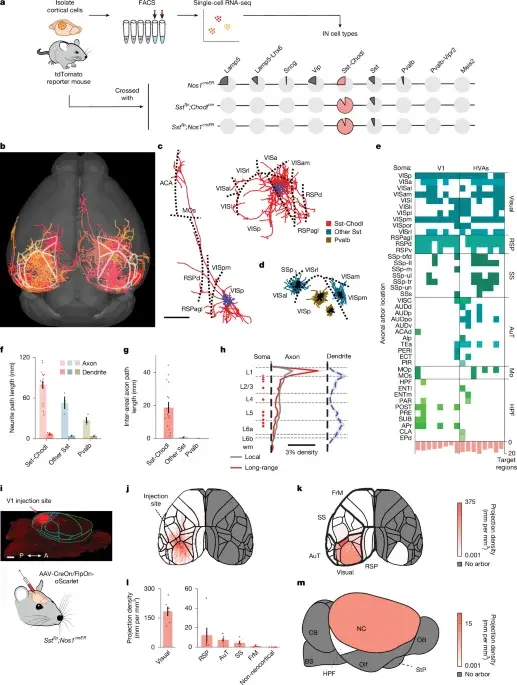
Researchers identified a rare class of inhibitory neurons in the mouse neocortex that actively promotes sleep and cortical synchrony. These cells, characterized by co-expression of somatostatin and chondrolectin, are sparse but possess long-range axons that connect multiple brain regions. Their activation during low-arousal states correlates with slow-wave sleep, suggesting they play a direct role in regulating sleep beyond subcortical mechanisms.
Key points
- Sst-Chodl neurons are a genetically distinct, sparse class of GABAergic inhibitory neurons comprising less than 1% of cortical inhibitory cells.
- These neurons possess long-range axons that project across millimeters in the mouse cortex, targeting nearly all neocortical areas ipsilaterally.
- Activity of Sst-Chodl cells is high during low-arousal states like slow-wave sleep and quiet wakefulness, but low during active movement.
- Chemogenetic activation of these cells induces sleep, reduces wakefulness, and increases low-frequency cortical power even when mice are awake.
- The findings suggest cortical circuits, not just subcortical ones, actively regulate the transition to synchronized sleep states.
Background
This study builds on prior research indicating that sleep duration varies significantly among individuals and is influenced by biological factors, as noted in recent reviews of ancestral sleep patterns. While previous studies identified fast-spiking parvalbumin neurons as regulators of alertness, the role of inhibitory neurons in promoting sleep remained unclear. This new research fills that gap by identifying a specific cortical mechanism for sleep induction.
Why it matters
Understanding the cortical mechanisms of sleep could lead to new treatments for insomnia and sleep disorders. Identifying specific neurons that promote sleep offers a potential target for therapeutic interventions, moving beyond traditional approaches that focus solely on subcortical sleep centers.
What to watch
Future research will likely focus on translating these findings to human brains, given the evolutionary conservation of Sst-Chodl neurons. Researchers may also investigate whether targeting these neurons can help treat sleep disorders or improve sleep quality in clinical settings.
Want the full story? Read the original reporting
Read on Nature