
Study Maps Coronary Artery Disease Variants to Genes and Cell Types
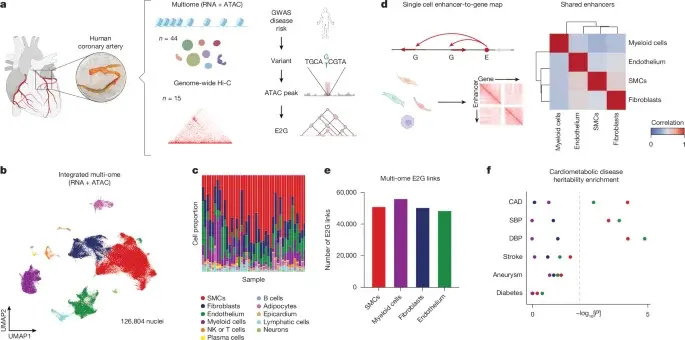
Researchers have published a comprehensive map linking non-coding genetic variants associated with coronary artery disease to specific genes and cell types in human coronary arteries. The study, led by Washington University School of Medicine, used multi-omic profiling of 44 human samples to identify how genetic changes affect smooth muscle cells and other vascular cells, potentially opening new avenues for drug development beyond lipid-lowering therapies.
Key points
- The study analyzed 44 human coronary artery samples using single-nucleus multi-omic sequencing to profile gene expression and chromatin accessibility.
- Researchers identified 11,269 chromatin accessibility quantitative trait loci (caQTLs) across vascular cell types, with a focus on smooth muscle cells (SMCs).
- The map links non-coding genetic variants to distal genes, such as AMOTL2, whose loss promotes cell proliferation and suppresses contractile identity in SMCs.
- Findings suggest that extracellular matrix remodeling is a core disease program in SMCs, driven by genetic variants in non-coding regions.
- The approach provides a framework for translating genome-wide association study (GWAS) findings into potential therapeutic targets for coronary artery disease.
Background
Coronary artery disease (CAD) is the leading cause of death globally, with hundreds of genetic variants identified through GWAS, but most lie in non-coding regions, making causal mechanisms unclear. Previous studies have mapped genetic variants in other tissues, such as skeletal muscle, but this is the first comprehensive map for coronary arteries. The study builds on earlier efforts to link genetic variants to cell-specific regulation, aiming to address the residual risk of CAD independent of lipid levels.
How outlets are covering it
The primary source (Nature) emphasizes the technical methodology, including single-nucleus multi-omic profiling, Hi-C, and CRISPRi, to link variants to genes and cell states. The secondary source from Genetic Engineering and Biotechnology News highlights the broader applicability of the approach to other complex diseases and the potential for new therapeutics. Stanford Medicine’s secondary source, while not directly about this study, discusses a related effort to link genetic variants to disease severity in cardiomyopathy, underscoring the growing focus on functional genomics in cardiovascular disease.
Why it matters
This study provides a detailed map of how genetic variants in non-coding regions affect gene expression and cell function in coronary arteries, potentially leading to new drug targets for CAD. It addresses the unmet need for therapies that target disease mechanisms in the vessel wall, beyond lipid-lowering drugs, and could inform the development of more precise treatments for heart disease.
What to watch
Researchers are studying several genes identified in the study to pursue new therapeutics for CAD and are analyzing more samples of diseased arteries to expand the genomic map. The approach may be applied to other complex diseases, and larger patient studies will be needed to validate the findings and develop a database linking genetic variants to functional effects and clinical presentations.
- Single-cell variant-to-enhancer-to-gene map for coronary artery disease Nature
- Genetic study of heart disease reveals new routes to therapies EurekAlert!
- Connecting Genetic Changes to Severity of Heart Disease Stanford Medicine
- Coronary Artery Disease Genetics Map Links Risk Variants to Genes and Cell Types Genetic Engineering and Biotechnology News
Want the full story? Read the original reporting
Read on Nature