
Record-Breaking El Niño Drives Warmer, Wetter 2026-27 Winter Outlook for New York
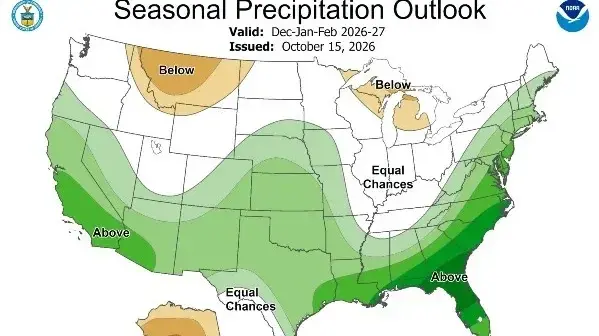
NOAA declares the current El Niño 'very strong,' the highest intensity category, with a 60% chance of becoming the strongest on record. For New York, this signals a 50-60% probability of above-normal temperatures from December 2026 to February 2027. While eastern New York faces increased precipitation risks, western and central regions show equal chances for normal rainfall. Experts warn that warmer conditions may reduce snowpack in the Pacific Northwest but could still allow for significant snowstorms in the Northeast.
Key points
- NOAA's Climate Prediction Center classifies the current El Niño as 'very strong,' matching only 1982-83, 1997-98, and 2015-16 in intensity.
- Sea-surface temperatures in the central Pacific are 2.5 degrees Celsius above normal, with a 60% chance of exceeding the 1997-98 record.
- New York has a 50-60% chance of above-normal temperatures for the meteorological winter (December 2026-February 2027).
- Eastern New York, including the Capital Region and NYC, faces a 33-50% chance of above-normal precipitation, while western and central areas have equal odds for normal rainfall.
- The El Niño is expected to peak between October-December 2026 and November-January 2027, potentially lasting into spring 2027.
- A strong El Niño favors a stable polar vortex, reducing the likelihood of sustained Arctic cold outbreaks, though individual snowstorms remain possible.
Background
Recent early-season storms in November 2026 brought limited snow to New York high elevations, with rain dominating lower areas. Prior to the current El Niño peak, forecasters noted a strong polar vortex and record-breaking El Niño conditions shaping the 2026 winter outlook, predicting milder temperatures but volatile weather patterns.
How outlets are covering it
NOAA and the World Meteorological Organization emphasize the historic strength of the current El Niño, with sea-surface temperatures 2.5 degrees Celsius above normal and a 60% chance of breaking records. AccuWeather projects a warmer, less snowy winter for the northern tier, including New York, while highlighting increased flooding risks in the southern and western US. KCRA focuses on Northern California's preparedness, noting improved levees and forecasting since the 1997-98 floods, while acknowledging that infrastructure cannot fully mitigate flood risks. The Rogue Valley Times highlights concerns in the Pacific Northwest, where warming from El Niño could significantly reduce snowpack, raising the snow line by 500 to 1,000 feet. While all sources agree on the El Niño's strength, they differ in regional impacts: NOAA and AccuWeather focus on temperature and precipitation probabilities, KCRA on flood mitigation, and the Rogue Valley Times on snowpack depletion.
Why it matters
The 'very strong' El Niño will drive weather patterns across the US for months, influencing temperatures, precipitation, and snowpack. For New York, warmer temperatures and increased precipitation in the east could impact infrastructure, agriculture, and emergency preparedness. Globally, the El Niño may raise temperatures to near-record levels and increase risks of extreme heat, drought, and heavy rainfall well into 2027. Understanding these patterns is crucial for communities to prepare for potential floods, mudslides, and other weather-related hazards.
What to watch
The El Niño is expected to peak between October-December 2026 and November-January 2027, with a 61% chance of returning to ENSO-neutral by April-June 2027. NOAA will continue monitoring sea-surface temperatures and weather patterns, while communities in flood-prone areas should review evacuation plans and infrastructure readiness. Forecasters will update winter outlooks as the El Niño evolves, with potential shifts to La Niña in late 2027.
- El Niño winter forecast 2026-27: What it means for New York Democrat and Chronicle
- Super El Niño declared as forecasters warn of major shifts in weather during winter season FOX Weather
- A historic El Niño is taking shape. Water managers say NorCal is prepared KCRA
- El Niño ramps up; warming could be big hit to PNW snowpack Rogue Valley Times
- El Niño still growing stronger. Here's what could happen next USA Today
Want the full story? Read the original reporting
Read on Democrat and Chronicle