
125,000-Year-Old Poisoned Stone Points Found at Ancient Saudi Lakeshore
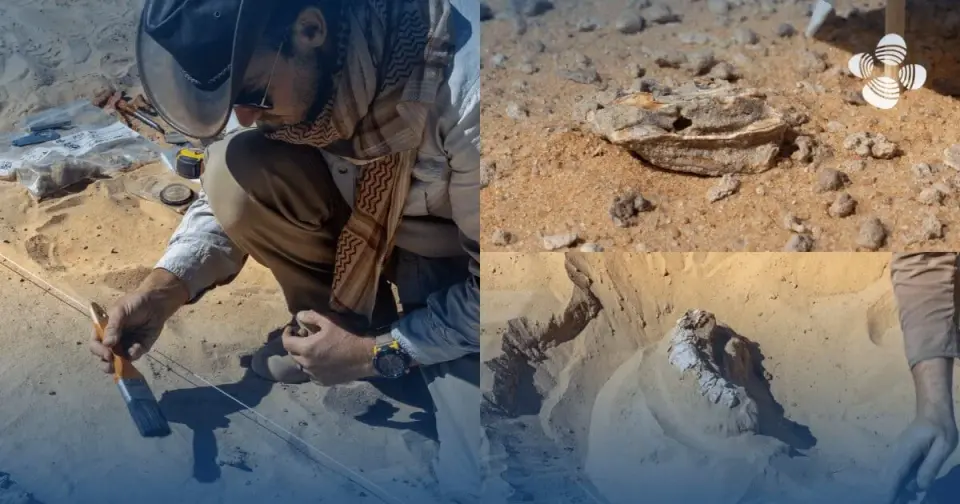
Researchers at the 'Uruq Aljelibah site in Saudi Arabia discovered 125,000-year-old stone points with chemical traces of the arrow poison tree, Acokanthera schimperi. Found beside an ancient freshwater lake in the Empty Quarter, these artifacts suggest early humans used complex, composite hunting weapons to hunt large animals like hippos and buffalo. The discovery, published in Science, indicates that Arabia supported settled human populations during humid periods, challenging the view of the region as merely a migration corridor.
Key points
- Over 5,500 stone artifacts were recovered from the 'Uruq Aljelibah site, located on the shore of the ancient Mundafan lake in southern Saudi Arabia.
- Chemical analysis detected biomarkers from Acokanthera schimperi, a plant known for its toxic cardiac glycosides, on several stone points.
- Microscopic analysis revealed animal tissue near the tips and plant resin and fibers at the base of the points, indicating they were hafted onto handles as composite weapons.
- The site dates to approximately 125,000 years ago, predating similar poisoned weapon finds in South Africa by roughly 65,000 years.
- The discovery supports the theory that early Homo sapiens settled in Arabia during humid 'Green Arabia' periods, utilizing complex technologies for hunting and plant processing.
Background
Recent studies have highlighted the role of climate and resource availability in human settlement patterns across Arabia. A 2025 study in Nature documented recurrent humid periods over the past 8 million years, providing a broader environmental context for the 'Uruq Aljelibah findings. Additionally, earlier research noted that the lack of suitable stone for toolmaking, rather than just water scarcity, limited human occupation in the interior of the Rub' al Khali desert. The 'Uruq Aljelibah site offers a rare snapshot of life during Marine Isotope Stage 5e, a period when freshwater lakes and grasslands supported diverse wildlife and human populations.
How outlets are covering it
Archaeology News Online and The National Tribune emphasize the significance of the site as evidence of complex, settled human life in Arabia during humid periods, challenging the notion of the region as a mere transit corridor. IFLScience highlights the role of poison arrows in enabling humans to hunt large herbivores, suggesting that such technologies were crucial for survival in the Arabian environment. All sources agree on the importance of the chemical traces from Acokanthera schimperi, but IFLScience places greater emphasis on the practical implications of poison-assisted hunting for early human survival, while Archaeology News Online and The National Tribune focus more on the broader implications for understanding human settlement and technological development in the region.
Why it matters
The discovery of 125,000-year-old poisoned stone points at 'Uruq Aljelibah provides critical evidence of early human technological sophistication and adaptability in the Arabian Peninsula. It challenges existing models of human migration and settlement, suggesting that Arabia was not just a corridor but a region where humans could thrive during humid periods. The findings also highlight the importance of preserving and studying ancient sites to understand the full scope of human history and the development of complex technologies.
What to watch
Researchers plan to return to the 'Uruq Aljelibah site to collect more fossils, including human remains, and to conduct further chemical analyses to identify additional toxic plants used in hunting. The team aims to refine the dating of the artifacts and to better understand the preparation and use of the poison, which could provide deeper insights into the hunting strategies and survival techniques of early humans in Arabia.
- 125,000-year-old poisoned stone points found beside an ancient lake in the Saudi Arabian desert Archaeology News Online Magazine
- When the Saudi desert was green: A 125,000-year-old lakeside reveals how early humans lived Phys.org
- Discoveries from a 125,000-year-old lakeshore reveal life in a greener Arabia The Conversation
- Poison Arrowheads In Saudi Arabia Reveal How Humans Survived At A Desert Oasis 125,000 Years Ago IFLScience
- Ancient lakeshore reveals how early humans lived in Arabia The National Tribune
Want the full story? Read the original reporting
Read on Archaeology News Online Magazine