
Southern China Cave Teeth Reveal Denisovans and Unknown Archaic Lineage
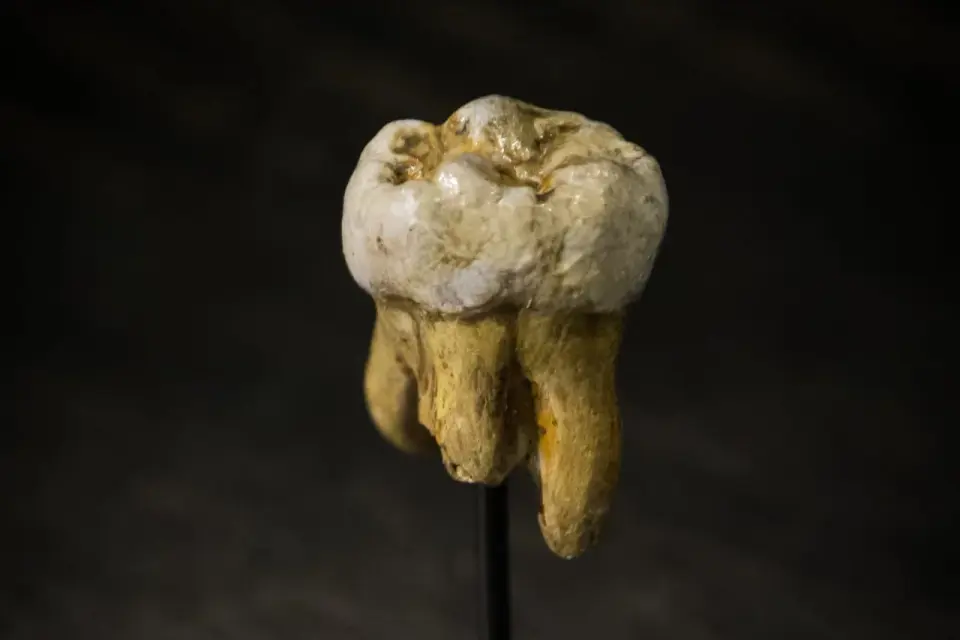
A new study in Nature identifies four hominin teeth from two caves in Guangxi, southern China, as belonging to two distinct archaic human lineages. One group matches Denisovans, while the other represents an unresolved archaic Homo distinct from known species. The findings, based on protein analysis due to poor DNA preservation in the region, suggest diverse human populations coexisted in subtropical Asia during the Middle and Late Pleistocene.
Key points
- Researchers at the Chinese Academy of Sciences analyzed four teeth from Chuanshandong and Longchuandong caves in Guangxi, dating between 42,600 and 104,500 years ago.
- Teeth from Longchuandong carry the AMBN 273V protein variant, linking them to Denisovans from Harbin, Penghu, and the Altai Mountains.
- Teeth from Chuanshandong lack the Denisovan variant but carry AMBN 253G, a marker associated with Homo erectus, and AMELY 179M, shared with Homo antecessor and great apes.
- The Chuanshandong specimen is classified as an 'unresolved archaic Homo,' distinct from Denisovans, Neanderthals, and modern humans, with dental traits mixing primitive and derived features.
- The study uses paleoproteomics because warm, humid conditions in southern China degrade DNA, making protein analysis essential for identifying ancient hominins.
Background
This discovery extends the known geographic range of Denisovans into subtropical southern China, complementing earlier finds in northern China, Tibet, and Taiwan. It follows recent identifications of Denisovans in the Harbin cranium and Bianfu Cave, which used similar protein-based methods. The unresolved lineage adds to ongoing debates about the diversity of archaic humans in East Asia, where fossils like those from Xujiayao were previously classified as Homo juluensis but are now linked to Denisovans.
How outlets are covering it
Archaeology News Online and Nature emphasize the discovery of two distinct lineages in southern China, highlighting the diversity of archaic humans in the region. Sci.News focuses on the broader implication that Denisovans were widespread across East Asia, including northern China, and that their range may have extended from 300,000 to 45,000 years ago. All sources agree on the use of paleoproteomics due to poor DNA preservation in southern China, but Sci.News places more emphasis on the rejection of the Homo juluensis classification in favor of Denisovan affinity.
Why it matters
The findings challenge the assumption that Denisovans were limited to northern and central Asia, showing their presence in subtropical southern China. The identification of an unresolved archaic lineage suggests that multiple human groups coexisted in the region, complicating the narrative of human evolution in East Asia. The reliance on protein analysis highlights the need for new methods to study ancient humans in regions where DNA preservation is poor.
What to watch
Researchers plan to seek ancient DNA and additional fossils from southern China to test the hypothesis of the unresolved lineage. Further studies may clarify whether the Chuanshandong specimen represents a distinct species or a population that mixed with other archaic groups. The findings may also prompt re-evaluation of other East Asian fossils previously classified as Homo juluensis or Neanderthal-related.
- Teeth from two caves point to Denisovans and an unresolved human lineage in southern China Archaeology News Online Magazine
- Homo Erectus Lived in Rainforests, Upending Ideas About Their Adaptability The New York Times
- Ancient Proteins Tie Chinese Fossil Site to Denisovans Sci.News
- Middle–Late Pleistocene Denisovans and unresolved Homo in southern China Nature
- Denisovan remains and an unknown archaic human lineage discovered in southern China Phys.org
Want the full story? Read the original reporting
Read on Archaeology News Online Magazine