
Virtual Face Reveals Identity of Headless Roman-Era Man Buried in Scotland
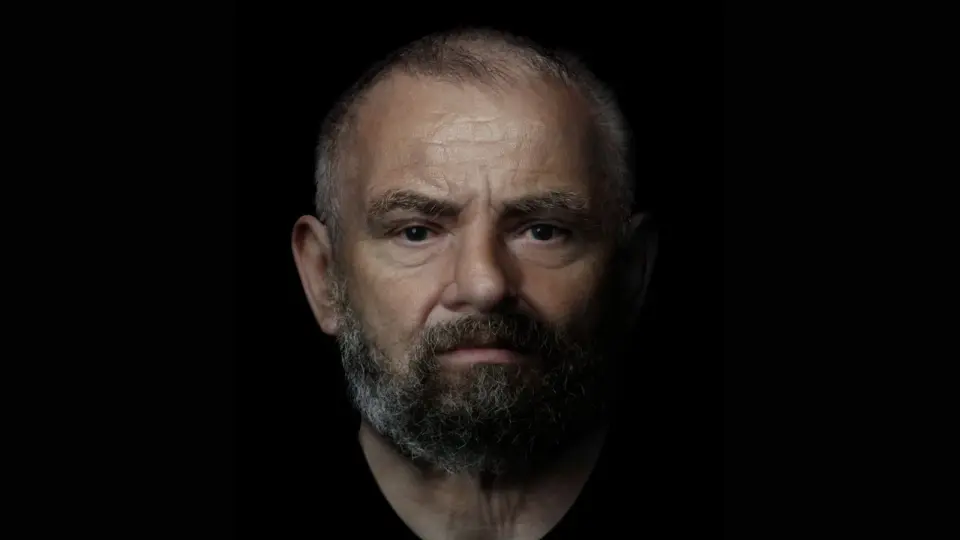
Researchers at National Museums Scotland and forensic anthropologist Christopher Rynn have digitally reconstructed the face of a man buried without his head near the Roman fort at Inveresk, Scotland, approximately 2,000 years ago. Isotopic analysis indicates the man likely grew up in southern Britain, while skeletal evidence suggests he suffered from a severe right-arm injury that prevented him from wielding a sword, implying he held a non-combat role within the Roman army. The burial, dated between A.D. 142 and 165, appears to have been dignified rather than punitive, suggesting post-mortem decapitation may have been a specific cultural ritual for some southern Britons. The reconstruction, which depicts the man with dark hair and eyes and no beard, will be displayed alongside the original remains in a new exhibition at the museum starting November 14, 2026.
Key points
- The facial reconstruction was created by forensic anthropologist Christopher Rynn using the man's skull, isotopic data, and ancient DNA analysis.
- The man died between A.D. 142 and 165, likely around age 50, and was buried near the Inveresk fort, which served as a supply hub for the Antonine Wall.
- Skeletal analysis revealed a broken nose and extensive bone growth in the right elbow, possibly from arthritis or injury, which would have hindered sword use.
- Four of the six Roman-era burials found at the Inveresk site involved decapitated bodies, marking the first such discovery in Scotland.
- The exhibition featuring the face and skeletons opens at National Museums Scotland on November 14, 2026.
Background
This discovery adds to the growing body of evidence regarding Roman military presence in Scotland, following recent finds such as a 934-coin hoard in Germany and a Roman-era tomb in Egypt. While previous archive items focused on broader Roman trade and cultural synthesis, this case highlights the specific human experiences and potential rituals of individuals serving in the Roman frontier forces in Britain.
How outlets are covering it
Live Science and The Daily Galaxy emphasize the mystery of the man's origin and role, noting that while he likely served the Roman army, his physical disability suggests he was not a frontline soldier. John H. Reid, an archaeologist not involved in the excavation, suggests he may have been left-handed or held a 'desk job.' Gizmodo highlights the emotional impact of the reconstruction, quoting curator Jess Thompson on how interdisciplinary analysis reveals 'life stories.' The Daily Galaxy and Live Science agree that the burial was likely dignified, distinguishing it from the decapitation of executed criminals, though the exact reason for the ritual remains unclear. All sources agree on the isotopic evidence pointing to southern Britain, though Reid notes the Netherlands could also match the profile.
Why it matters
This reconstruction provides a rare, tangible connection to an individual from the Roman period in Scotland, a region where skeletal preservation is uncommon. It challenges assumptions about the composition of Roman forces in Britain, suggesting that non-combat roles and diverse origins were prevalent. Furthermore, it offers insight into potential post-mortem rituals that may have been specific to certain groups within the Roman Empire, adding nuance to our understanding of cultural practices in the frontier zones.
What to watch
The public can view the facial reconstruction and the original skeletons at National Museums Scotland starting November 14, 2026. Researchers continue to analyze the isotopic and genetic data to refine the man's geographic origin and life history, potentially uncovering more about the movement of people within the Roman Empire during the second century A.D.
- Decapitated man buried near fort in Roman-era Scotland gets a new virtual face Live Science
- This Is What a Roman Scotland Man Buried in Odd Grave Looked Like Gizmodo
- Researchers Reconstructed the Face of a Man Buried Without His Head Nearly 2,000 Years Ago Near a Roman Fort in Scotland The Daily Galaxy
- The Restored Face of a Man Who Lived 2000 Years Ago to Be Displayed at the National Museum of Scotland Aurora News
- Face of a Roman-era man reconstructed in Scotland — Live Science UA.NEWS
Want the full story? Read the original reporting
Read on Live Science