
3D Maps Reveal Interstellar Space Is Dynamic, Not Static
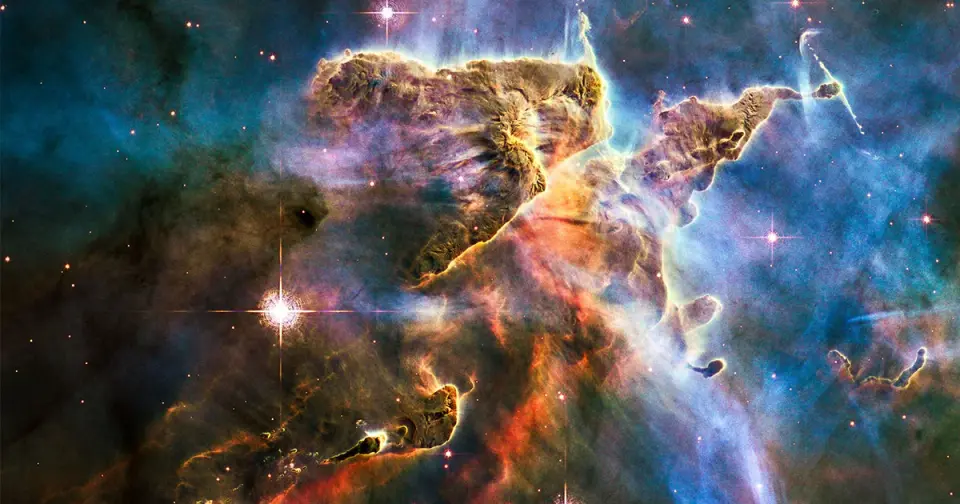
New three-dimensional maps of the interstellar medium (ISM) reveal that the space between stars is not a static backdrop but a dynamic, unstable environment. By combining data from the Gaia telescope and ultraviolet radiation surveys, researchers found that 41% of the local ISM exists in an unstable state, contradicting decades-old models that predicted only stable hot or cold phases. This discovery suggests that constant heating and cooling cycles suppress star formation, explaining why galaxies are inefficient at converting gas into stars.
Key points
- A new 3D map of the ISM, spanning over 4,000 light-years, shows that 41% of the local interstellar medium is in an unstable state, challenging the 1969 model that predicted only stable cold or warm phases.
- The map was created by combining dust density data from the Gaia telescope with ultraviolet radiation maps, allowing researchers to analyze temperature and density across a three-dimensional grid.
- The finding suggests that the ISM is in a constant state of flux, with material being stirred up and forced to change states, which contradicts the traditional view of a tranquil, pressure-balanced medium.
- This dynamic behavior may explain the inefficiency of star formation, as constant heating and cooling cycles prevent gas from collapsing into stars as predicted by static models.
- Researchers caution that the results may be affected by limited resolution and smoothing methods, but tests with lower-resolution data showed only a 5% shift in the unstable fraction, supporting the findings.
Background
For decades, astronomers treated the interstellar medium as a static backdrop, with models from 1969 and 1977 predicting stable cold, warm, and hot phases. Recent advances in 3D mapping, enabled by the Gaia telescope's parallax measurements and new statistical frameworks, have allowed researchers to probe the ISM in greater detail. This work builds on earlier efforts to map the universe, such as the DESI survey, but focuses specifically on the local galactic neighborhood.
Why it matters
The discovery that the interstellar medium is dynamic and unstable challenges fundamental models of how stars form and how the universe evolves. If the ISM is in a constant state of flux, it could explain why star formation is so inefficient, a long-standing puzzle in astrophysics. This finding may lead to revised models of galaxy evolution and a better understanding of the processes that shape the universe.
What to watch
Researchers are currently undergoing peer review of their findings and are collaborating with other astronomers to verify the results. Future studies will likely focus on refining the 3D maps and testing the dynamic model against other datasets to confirm the prevalence of unstable ISM. The findings may also lead to new simulations that incorporate the constant heating and cooling cycles observed in the ISM.
Want the full story? Read the original reporting
Read on Quanta Magazine