
Why Andromeda's Glow Hides Its Planets: The Physics of Extragalactic Detection
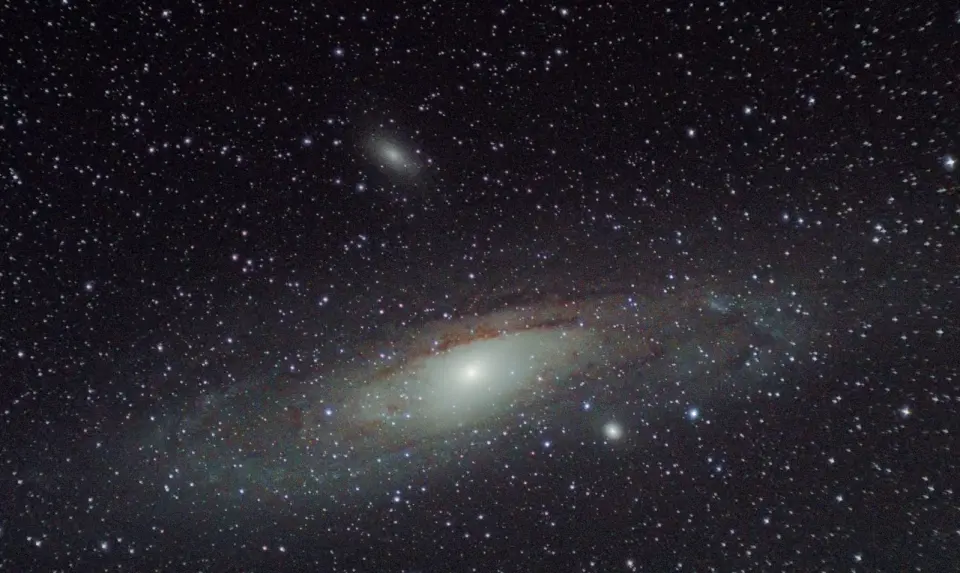
While the Andromeda galaxy is visible to the naked eye due to the combined light of over a trillion stars, detecting an Earth-like planet within it remains impossible with current technology. The planet would appear 10 billion times fainter than its host star and separated by only 1.3 microarcseconds, a gap far smaller than the resolution limits of the James Webb Space Telescope. Direct imaging requires a hypothetical 100-kilometer aperture, while indirect methods like microlensing offer limited statistical insights but no atmospheric data.
Key points
- Andromeda is visible to the unaided eye because the light from its vast stellar population blends into a single hazy patch, primarily driven by its bright central bulge.
- An Earth-Sun analogue in Andromeda would be approximately 10 billion times fainter than its star in visible light, corresponding to a 25-magnitude difference.
- The maximum angular separation between such a planet and its star would be roughly 1.3 microarcseconds, a scale far beyond the capabilities of existing telescopes.
- The James Webb Space Telescope’s inner working angles start at 0.089 arcseconds, which is nearly 70,000 times wider than the required 1.3 microarcsecond separation.
- Resolving this separation with green light would require a filled optical aperture of approximately 96 kilometers, a scale impractical for current or near-future observatories.
- Indirect methods like gravitational microlensing can detect planetary masses without resolving them, but they do not provide the atmospheric or spectral data that direct imaging would offer.
Background
Recent studies have highlighted the complexity of galactic structures, such as the slowing star formation rate in Andromeda potentially linked to its neighbor M32, and the discovery of trillions of rogue planets in the Milky Way. These developments underscore the challenges of mapping stellar populations across vast distances. Additionally, advancements in photonic integrated circuits and fiber-like light paths on silicon chips suggest future improvements in optical precision, though these technologies do not yet bridge the gap required for extragalactic direct imaging. The contrast between the visibility of a galaxy as a whole and the invisibility of its individual planetary systems illustrates the fundamental limits of current observational astronomy.
How outlets are covering it
Space Daily provides a detailed technical analysis of the physical constraints preventing the direct imaging of planets in Andromeda, emphasizing the geometric and photometric challenges. It highlights the specific angular and brightness limitations that make such detection impossible with current instruments. In contrast, DiscoverHumboldt offers a general overview of September stargazing opportunities, mentioning distant galaxies and star clusters without delving into the technical specifics of exoplanet detection. The two sources differ significantly in depth and focus, with Space Daily providing a rigorous scientific explanation while DiscoverHumboldt serves as a broad, accessible guide for amateur astronomers. There is no direct disagreement between the sources, but they address the topic from vastly different angles, with Space Daily focusing on the impossibility of detection and DiscoverHumboldt on the visibility of celestial objects in general.
Why it matters
Understanding the limits of direct imaging helps set realistic expectations for future space missions and technological developments. It highlights the need for advanced instruments like the Habitable Worlds Observatory and the importance of focusing on nearby stars for detailed exoplanet studies. This knowledge also informs the development of indirect detection methods, which, while limited, can still provide valuable statistical data about planetary populations in distant galaxies. Ultimately, it underscores the vast scale of the universe and the challenges of observing objects at extreme distances.
What to watch
Future missions like the Habitable Worlds Observatory will focus on detecting and imaging potentially habitable planets in nearby star systems, where angular separations and photon budgets are more favorable. Advances in optical precision and interferometry may eventually improve angular resolution, but detecting planets in Andromeda remains a distant goal. Indirect methods like microlensing will continue to provide statistical insights into planetary populations, though they will not offer the detailed atmospheric data that direct imaging provides. The development of new technologies, such as photonic integrated circuits, may contribute to future improvements in optical precision, but significant breakthroughs are needed to bridge the gap for extragalactic direct imaging.
- Andromeda is visible from 2.5 million light-years because the light of hundreds of billions of stars blends together. But an Earth-like planet there would be roughly ten billion times fainter than its own star and separated from it by only about 1.3 microarcseconds Space Daily
- September offers stargazers a look at distant galaxies and star clusters DiscoverHumboldt
Want the full story? Read the original reporting
Read on Space Daily