
Astronomers Confirm First Galactic Microblazar, Solving a 30-Year Cosmic Mystery
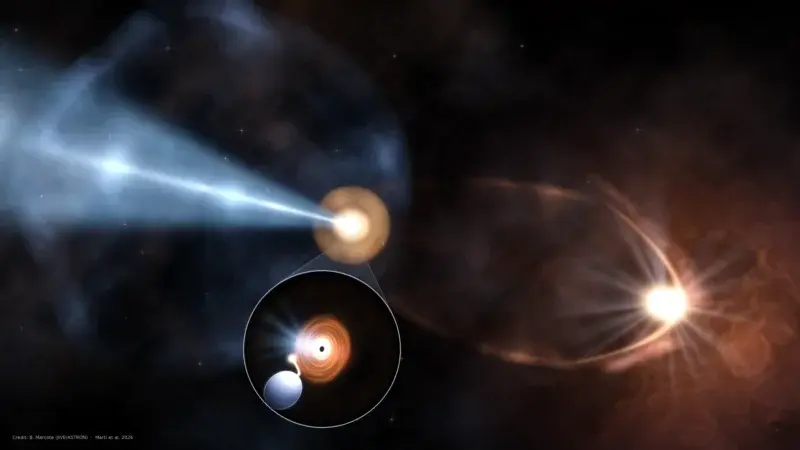
Astronomers have identified the first confirmed microblazar in the Milky Way, a stellar-mass black hole system named IRAS 18293-0941. Located 12,000 light-years away, this system features a black hole feeding on a companion star and launching jets at 75% the speed of light. One jet points directly at Earth, while the other impacts a molecular cloud, potentially accelerating particles to ultra-high energies. This discovery validates a 30-year-old theoretical prediction and offers a nearby laboratory for studying cosmic ray origins.
Key points
- IRAS 18293-0941 is the first confirmed microblazar, a scaled-down version of distant blazars powered by a stellar-mass black hole rather than a supermassive one.
- The system consists of a black hole and a companion star orbiting every 11.38 days, with the black hole expelling material in jets traveling at three-quarters the speed of light.
- The object was catalogued in 1983 but remained hidden by dust until radio and optical observations confirmed its nature.
- The opposing jet impacts a molecular cloud, creating a 100-light-year bubble that may accelerate particles to petaelectronvolt energies, helping explain the origin of high-energy cosmic rays.
- The discovery was confirmed using the European VLBI Network and Gaia satellite data to match the jet's position with the stellar system.
Background
Recent studies have focused on supermassive black holes in distant galaxies, such as the triple black hole system in J0148-4214 and early 'little red dots' observed by JWST. While those discoveries highlight rapid black hole growth in the early universe, the microblazar discovery shifts focus to stellar-mass black holes within our own galaxy. This complements earlier findings on tidal disruption events, which showed predictable jet bursts, by providing a steady, nearby source for studying jet dynamics and particle acceleration in detail.
How outlets are covering it
EarthSky and Scientific American emphasize the historical significance of confirming a 30-year-old theory, highlighting that the object was 'hiding in plain sight' due to dust obscuration. ZME Science focuses on the physical mechanism, explaining how relativistic beaming makes the Earth-facing jet appear brighter, and details the use of the European VLBI Network and Gaia data to confirm the jet's origin. All sources agree on the system's distance (12,000 light-years) and the jet speed (75% of light speed), but ZME Science provides more detail on the 100-light-year bubble created by the opposing jet. No significant disagreements exist, though EarthSky notes the 'no danger' aspect for public reassurance, while ZME Science focuses on the scientific utility for studying cosmic rays.
Why it matters
This discovery provides a nearby laboratory for studying extreme particle acceleration, potentially solving the mystery of ultra-high-energy cosmic rays. It validates theoretical models of microblazars and allows astronomers to observe jet-cloud interactions in detail, which is difficult with distant supermassive black holes. The findings could impact our understanding of galactic evolution and the origins of high-energy particles in the Milky Way.
What to watch
Researchers plan to conduct deeper observations to track the jet's evolution and its interaction with the molecular cloud. They aim to determine if the collision site accelerates particles to petaelectronvolt energies and hope to discover additional microblazars within the galaxy. Further studies will test how energy transfers from the jet into the interstellar medium.
- A black hole jet is aimed at us … and it’s in our galaxy EarthSky
- Scientists just found a bizarre cosmic object ‘hiding in plain sight’ Scientific American
- Astronomers discover the 1st black hole powered 'microquasar' in the Milky Way Space
- Astronomers Find a Black Hole Pointing a Jet Towards Earth — And It May Solve a Cosmic Mystery ZME Science
- A black hole in the Milky Way aims its jet at us South African Radio Astronomy Observatory
Want the full story? Read the original reporting
Read on EarthSky