
Tag

Iras 18293 0941

All articles tagged with #iras 18293 0941

Astronomers Identify First Candidate for a 'Microblazar' in the Milky Way
space1 day ago

Astronomers Identify First Candidate for a 'Microblazar' in the Milky Way

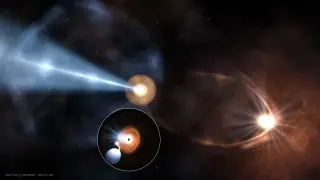
An international team of astronomers has identified IRAS 18293-0941 as the first strong candidate for a 'microblazar,' a long-theorized cosmic object. Located about 12,000 light-years from Earth in the Milky Way, this binary system features a black hole orbiting a giant star. The black hole ejects matter in powerful jets, one of which is pointed directly at Earth, offering a rare opportunity to study these energetic phenomena up close.
Astronomers Confirm First Galactic Microblazar, Solving a 30-Year Cosmic Mystery
astronomy10 days ago

Astronomers Confirm First Galactic Microblazar, Solving a 30-Year Cosmic Mystery

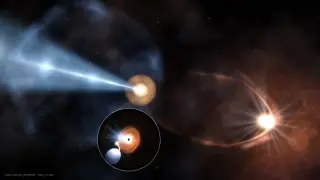
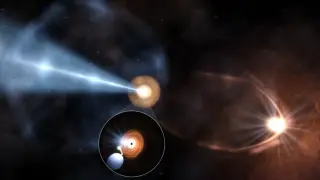
Astronomers have identified the first confirmed microblazar in the Milky Way, a stellar-mass black hole system named IRAS 18293-0941. Located 12,000 light-years away, this system features a black hole feeding on a companion star and launching jets at 75% the speed of light. One jet points directly at Earth, while the other impacts a molecular cloud, potentially accelerating particles to ultra-high energies. This discovery validates a 30-year-old theoretical prediction and offers a nearby laboratory for studying cosmic ray origins.

First Milky Way Microblazar Found: Black Hole Jet Accelerates Particles to Extreme Energies
astronomy13 days ago

First Milky Way Microblazar Found: Black Hole Jet Accelerates Particles to Extreme Energies

Astronomers have identified IRAS 18293-0941 as the first confirmed microblazar in the Milky Way, a stellar-mass black hole system emitting jets at near-light speed. Located 12,000 light-years away, the system consists of a black hole roughly 10 times the mass of the Sun orbiting a companion star every 11 days. The discovery, published in Astronomy & Astrophysics, resolves a 30-year search for a galactic analog to distant blazars. The system’s jets, one pointing directly at Earth and the other impacting a dense gas cloud, may explain the origin of ultra-high-energy cosmic rays, acting as a natural particle accelerator 100 times more powerful than the Large Hadron Collider.