
Arizona astrophotographer captures rare side-on view of solar plasma loops
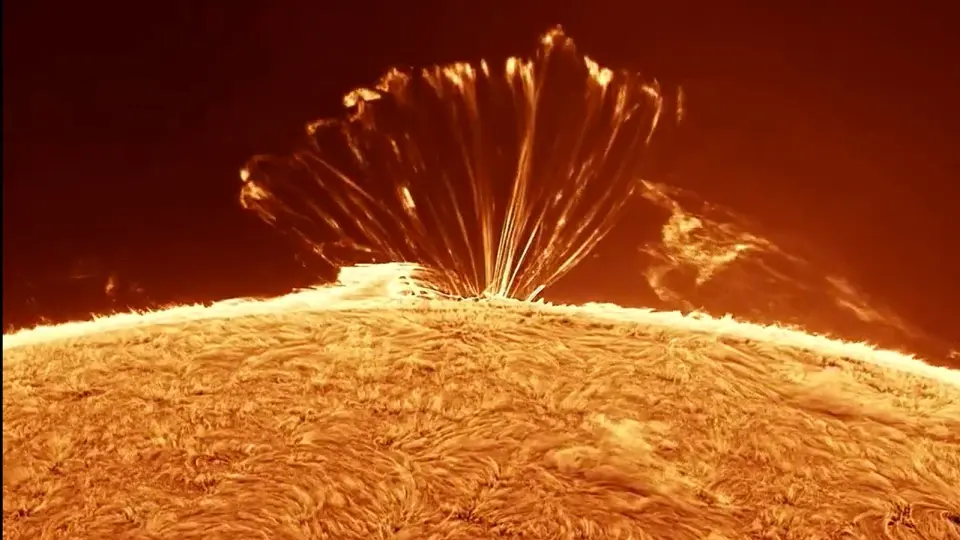
Astrophotographer Mark Johnston captured a rare, high-resolution timelapse of a coronal loop arcade extending above the sun's limb from Scottsdale, Arizona, on August 21, 2026. Using a TEC160FL refractor with hydrogen-alpha equipment, Johnston recorded the magnetic structures for over two hours, revealing 'coronal rain' as plasma cools and falls back toward the solar surface. The image highlights the intricate shape of these magnetic field lines, which are typically difficult to observe in such detail from Earth.
Key points
- Mark Johnston recorded the event from Scottsdale, Arizona, between 7:56 a.m. and 10:12 a.m. local time on August 21, 2026.
- The footage shows a coronal loop arcade, a series of arching hot plasma loops shaped by the sun's magnetic field.
- Johnston used a TEC160FL refractor with specialized hydrogen-alpha (H-alpha) solar imaging equipment to capture the structures.
- The timelapse reveals 'coronal rain,' where plasma cools and falls back toward the lower solar atmosphere along magnetic field lines.
- Johnston described the capture as a 'real treat' due to the rarity of seeing such loops side-on at the solar limb on a clear day.
Background
Recent high-resolution observations from the Daniel K. Inouye Solar Telescope have revealed tiny plasma vortices and whirlpools on the sun's surface, linked to Kelvin-Helmholtz instability and the coronal heating mystery. While those studies focused on surface-level turbulence, Johnston's observation highlights large-scale magnetic structures extending into the corona, offering a complementary view of solar magnetic dynamics.
Why it matters
Capturing coronal loop arcades in such detail provides valuable insights into how the sun's magnetic field shapes its atmosphere. These structures are key to understanding solar activity, including the mechanisms behind coronal rain and the transport of energy from the surface to the corona, which influences space weather conditions.
What to watch
Astronomers and astrophotographers will continue to monitor solar activity for similar magnetic structures. Further analysis of such timelapses may help refine models of solar magnetic fields and their role in heating the corona, potentially contributing to better space weather forecasting.
Want the full story? Read the original reporting
Read on Space