
New Study Reveals Black Holes May Spark Star Formation via Shock Waves
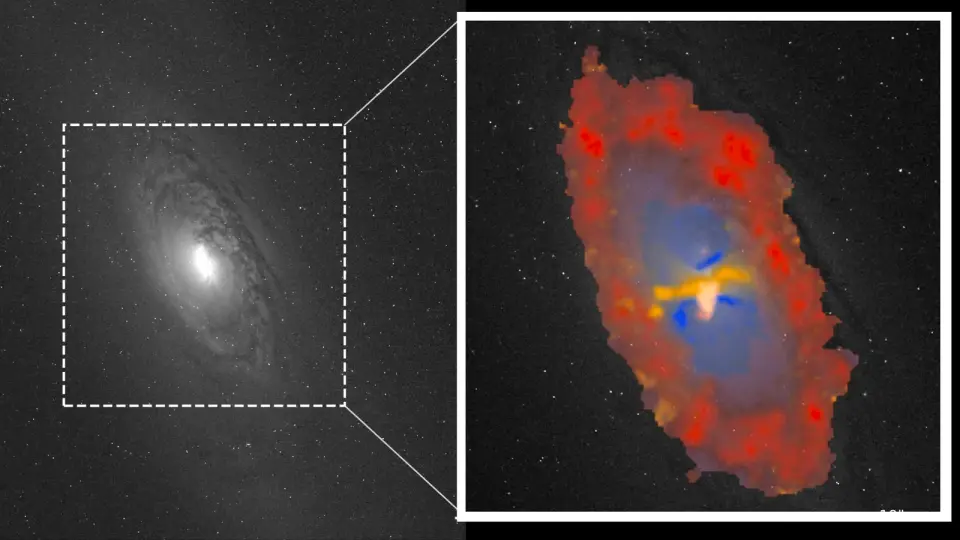
A new study of nine nearby galaxies suggests that supermassive black holes do not just suppress star formation but can actively trigger it. By analyzing data from the Very Large Telescope, researchers found that shock waves from black hole outflows compress gas, leading to new star birth rings. This challenges the traditional view that black holes only consume material, revealing a complex feedback cycle that shapes galaxy evolution.
Key points
- Researchers studied nine nearby galaxies with active galactic nuclei (AGN) using the MUSE instrument on the Very Large Telescope in Chile.
- The study found that star-forming rings or arcs are located 0.8 to 6 kiloparsecs from the galactic center, coinciding with regions of shocked gas.
- A new three-dimensional diagnostic technique allowed scientists to separate light from star formation, black hole radiation, and shock excitation, which previously overlapped in measurements.
- Shock waves from black hole outflows were observed to extend perpendicular to the main outflow cones, a pattern consistent across all nine galaxies.
- NASA’s Chandra X-ray Observatory independently corroborated the findings, confirming the presence of hot gas in the predicted shock regions.
- The research suggests that black holes actively reshape their surroundings through a cycle of accretion and outflow, influencing galaxy growth and evolution.
Background
This finding builds on earlier research, such as the August 2026 study using JWST data that identified 'little red dots' as early supermassive black holes in compact galaxies, highlighting the co-evolution of black holes and their hosts. Additionally, previous work on the Milky Way’s Sagittarius A* showed that material can survive near supermassive black holes, suggesting complex interactions in galactic centers. The current study expands on these insights by demonstrating how active black holes can influence star formation in nearby galaxies, rather than just suppressing it.
How outlets are covering it
Space.com and AZoQuantum emphasize the novelty of the three-dimensional diagnostic technique that separates star formation, black hole radiation, and shock excitation, highlighting the clarity it brings to understanding AGN feedback. Earth.com focuses on the practical implications of the findings, noting that the consistent pattern across nine galaxies suggests a universal mechanism for black hole-driven star formation. Starlust.org underscores the broader implications for galaxy evolution, framing the study as a shift in understanding how black holes shape their host galaxies. All sources agree on the significance of the perpendicular shock pattern and the role of Chandra X-ray observations in validating the results, but they differ in emphasis: Space.com and AZoQuantum focus on the technical innovation, while Earth.com and Starlust.org highlight the broader astrophysical implications.
Why it matters
This study challenges the long-held assumption that supermassive black holes primarily suppress star formation by heating or expelling gas. By demonstrating that shock waves from black hole outflows can compress gas and trigger new star birth, it provides a new mechanism for galaxy growth and evolution. This has implications for understanding how galaxies develop over time and how black holes interact with their host environments, potentially reshaping models of galactic evolution and the role of AGN feedback in the universe.
What to watch
Future research will focus on measuring the motion of stars in the newly formed rings to determine whether they were shaped by black hole shocks or other mechanisms, such as galactic bars. Additionally, further studies will explore the role of black hole winds in galaxies with weaker jets, such as NGC 1386 and NGC 3081, to refine the understanding of how different outflow mechanisms contribute to star formation. The findings may also guide future observations with telescopes like the James Webb Space Telescope to study similar phenomena in more distant galaxies.
- How supermassive black holes are the architects of entire galaxies Space
- How black holes can fuel star formation instead of shutting it down Earth.com
- Active Supermassive Black Holes Seen Creating Star-Forming Rings In Blow To Conventional Models IFLScience
- Active Supermassive Black Holes Actually Trigger Star Formation in Nearby Galaxies AZoQuantum
- Actively feeding black holes can facilitate star formation instead of preventing it, finds new study starlust.org
Want the full story? Read the original reporting
Read on Space