
Blazar OP 313 Identified as Most Distant Black Hole Beacon from Cosmic Dawn
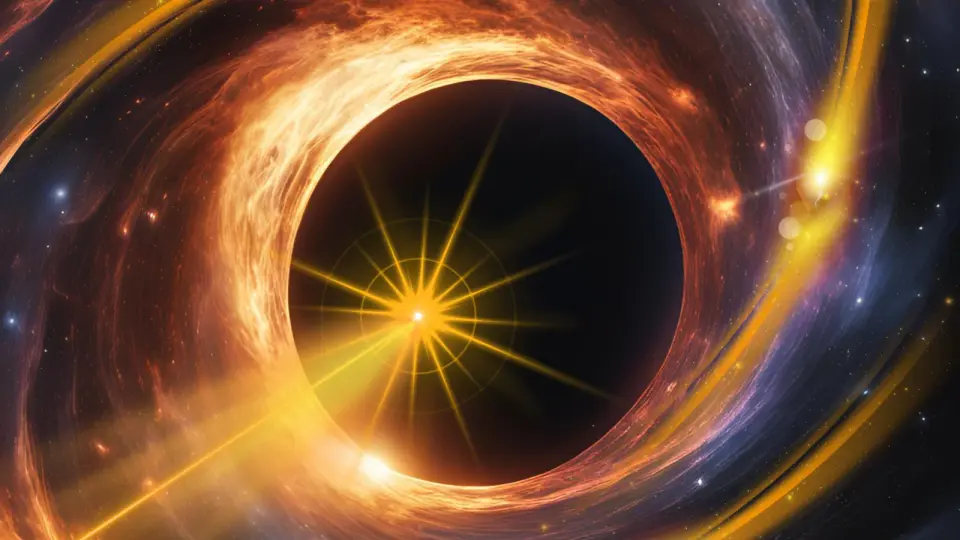
Astronomers have identified Blazar OP 313 as the most distant and earliest blazar ever detected, providing a rare glimpse into the universe's high-activity phase. This object features a supermassive black hole emitting plasma jets directly toward Earth, with light that has traveled for 8 billion years. The discovery offers critical insights into the 'cosmic noon' era, a period of intense galaxy formation that occurred roughly 5 billion years after the Big Bang.
Key points
- Blazar OP 313 is the most distant blazar ever detected, with light traveling for 8 billion years to reach Earth.
- The object is a supermassive black hole surrounded by gas and dust, emitting twin plasma jets at near-light speed.
- Its classification as a blazar is due to its jets being directed precisely along our line of sight.
- The discovery illuminates the 'cosmic noon' era, a period of peak star and galaxy formation that began around 11 billion years ago.
- The finding helps scientists understand the transitional phase where the universe shifted from intense activity to a calmer state.
Background
This discovery adds to a growing body of evidence regarding the early universe's black hole activity. Recent findings, such as the 'black hole star' MoM-BH*-1 and the 'little red dots' observed by the James Webb Space Telescope, have highlighted the presence of massive black holes in the first few hundred million years after the Big Bang. Additionally, the identification of the first Milky Way microblazar, IRAS 18293-0941, has provided a local analog for these distant, high-energy phenomena. Blazar OP 313 extends this timeline, offering a snapshot of the 'cosmic noon' period, which is distinct from the earlier 'cosmic dawn' but still represents a critical era of galactic evolution.
Why it matters
The detection of Blazar OP 313 provides a crucial data point for understanding the evolution of supermassive black holes and the history of the universe. By observing a source from just 5 billion years after the Big Bang, scientists can better map the timeline of the 'cosmic noon' and the subsequent transition to a calmer cosmic era. This helps resolve debates about how black holes and galaxies co-evolved during the universe's most active period.
What to watch
Researchers will likely continue to analyze the gamma-ray emissions from Blazar OP 313 to refine models of black hole accretion and jet formation. This discovery may also prompt further searches for similar high-energy sources from the 'cosmic noon' era, potentially using next-generation telescopes to probe the early universe's activity levels.
Want the full story? Read the original reporting
Read on Space