Tag

Supermassive Black Holes

All articles tagged with #supermassive black holes

Triple black holes in a distant galaxy reveal rapid early-universe growth
space-and-astronomy6 days ago

Triple black holes in a distant galaxy reveal rapid early-universe growth

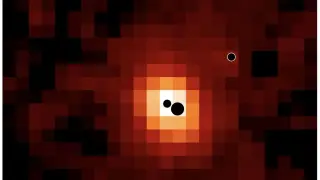
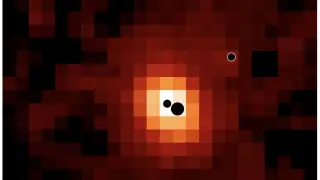
Astronomers using the JWST have identified three active black holes in the distant galaxy J0148-4214, about 12.5 billion light-years away. Two lie at the core (80 million and 600,000 solar masses) and are 620 light-years apart, while a third, ~2 million solar masses, sits ~5,500 light-years away and may merge with the pair or escape. The system supports rapid black-hole growth in the early universe via mergers and foreshadows future low-frequency gravitational-wave detections by space-based observatories like LISA.

Cosmic trio of supermassive black holes spotted in a distant galaxy
space8 days ago

Cosmic trio of supermassive black holes spotted in a distant galaxy

Using JWST/NIRSpec, astronomers found three active supermassive black holes in the distant galaxy J0148-4214—a central 80‑million-solar-mass hole, a 600,000-solar-mass companion, and a ~2‑million-solar-mass third hole—suggesting rapid early‑universe black‑hole growth via mergers; the third hole’s fate is uncertain, but such systems could emit long‑wavelength gravitational waves detectable by future space‑based observatories like LISA.

Webb's Saguaro image reframes the little red dots puzzle
space16 days ago

Webb's Saguaro image reframes the little red dots puzzle

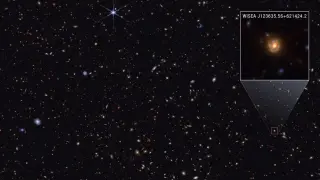
A new JWST view of the nearby Saguaro galaxy helps explain the universe’s enigmatic “little red dots”: rather than vanishing, these sources may be ordinary, distant galaxies whose bright centers dominate when observed at great distances, implying LRDs are a short-lived phase in early supermassive-black-hole growth rather than a new class of objects.

Webb spots colossal early black holes that dwarf their host galaxies, upending growth theories
space24 days ago

Webb spots colossal early black holes that dwarf their host galaxies, upending growth theories

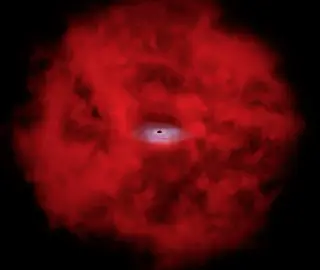
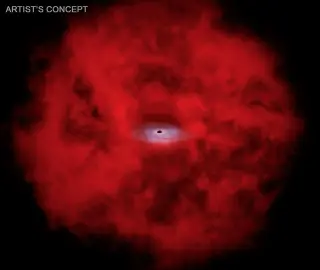
Webb observations of the early universe reveal a population of compact red objects hosting actively accreting black holes that, in some cases, rival or exceed the host galaxy’s stellar mass, challenging the standard coevolution picture; proposed explanations include unusually heavy seed black holes and bursts of rapid accretion, with spectroscopy and time-lapse imaging of the gas around these black holes planned to help determine how these giants formed.

Wandering Black Hole Destroys a Star, Brightening a Galaxy's Edge
space28 days ago

Wandering Black Hole Destroys a Star, Brightening a Galaxy's Edge

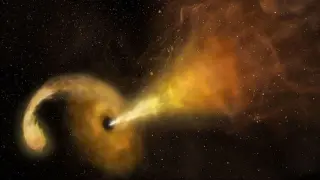
An orphaned supermassive black hole drifting at the edge of its galaxy tore apart a star in a tidal disruption event, producing a brilliant ultraviolet flare that outshone the host for months. Detected by the Zwicky Transient Facility and followed up with SOAR and Swift, the event occurred about 750 million light-years away and involved a black hole roughly 30,000 light-years from the galaxy's center, similar in mass to Sagittarius A*. The finding, likely from past galaxy mergers, suggests wandering black holes may be more common and can illuminate how galaxies and their black holes grow.

Euclid Discovers 31 Ancient Quasars, Revealing Fast-Growing Black Holes in the Early Cosmos
space1 month ago

Euclid Discovers 31 Ancient Quasars, Revealing Fast-Growing Black Holes in the Early Cosmos

ESA’s Euclid space telescope found 31 ancient quasars dating to redshift 6.6–7.8, including two record-holders at z=7.77 and z=7.69, making them the oldest seen. Each hosts a billion-solar-mass black hole, existing when the universe was under a billion years old. The haul doubles the known number of such quasars and demonstrates Euclid’s unexpected capability to census the early cosmos, though how these enormous black holes formed so quickly remains a major puzzle. This is just the first major result from a six-year survey that could uncover many more distant quasars.

Planets Could Form in Turbulent Edges of Active Galactic Nuclei
space2 months ago

Planets Could Form in Turbulent Edges of Active Galactic Nuclei

New simulations suggest the outer edges of gas-rich accretion disks around active supermassive black holes could resemble planet-forming disks, allowing dust to clump via streaming instability and form millions of Jupiter-mass planets tens of parsecs (a few tens of light-years) from the black hole; these planets would likely migrate outward, and gravitational lensing could help detect them, though observations are still in early stages.

X-Ray Little Red Dot Hints at a Bridge in Early Black Hole Growth
science3 months ago

X-Ray Little Red Dot Hints at a Bridge in Early Black Hole Growth

Astronomers using JWST and Chandra found an unusual X-ray-bright “little red dot” (3DHST-AEGIS-12014) about 11.8 billion light-years away, suggesting it may be a transitional object linking black hole stars to the growth of early supermassive black holes. Its X-ray emission could escape through holes in surrounding gas clouds, explaining variability and offering a potential link between LRDs and SMBHs in the young universe, though further observations are needed to confirm the scenario and its implications for black hole formation.

Twin supermassive black holes in Markarian 501 head toward a century-scale collision
science4 months ago

Twin supermassive black holes in Markarian 501 head toward a century-scale collision

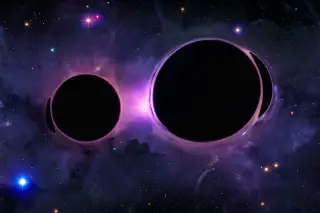
Astronomers have spotted two supermassive black holes at the center of the distant galaxy Markarian 501, each powering its own jet and orbiting roughly every 121 days with a separation of about 250–540 AU. The system’s light-bending Einstein ring supports the binary interpretation. If they merge, the resulting gravitational waves would dwarf those from stellar-mass mergers, leaving a single remnant black hole; the collision could occur in as little as 100 years.

Unprecedented Low-Frequency Radio Sky Map Reveals 13.7 Million Cosmic Sources
science6 months ago

Unprecedented Low-Frequency Radio Sky Map Reveals 13.7 Million Cosmic Sources

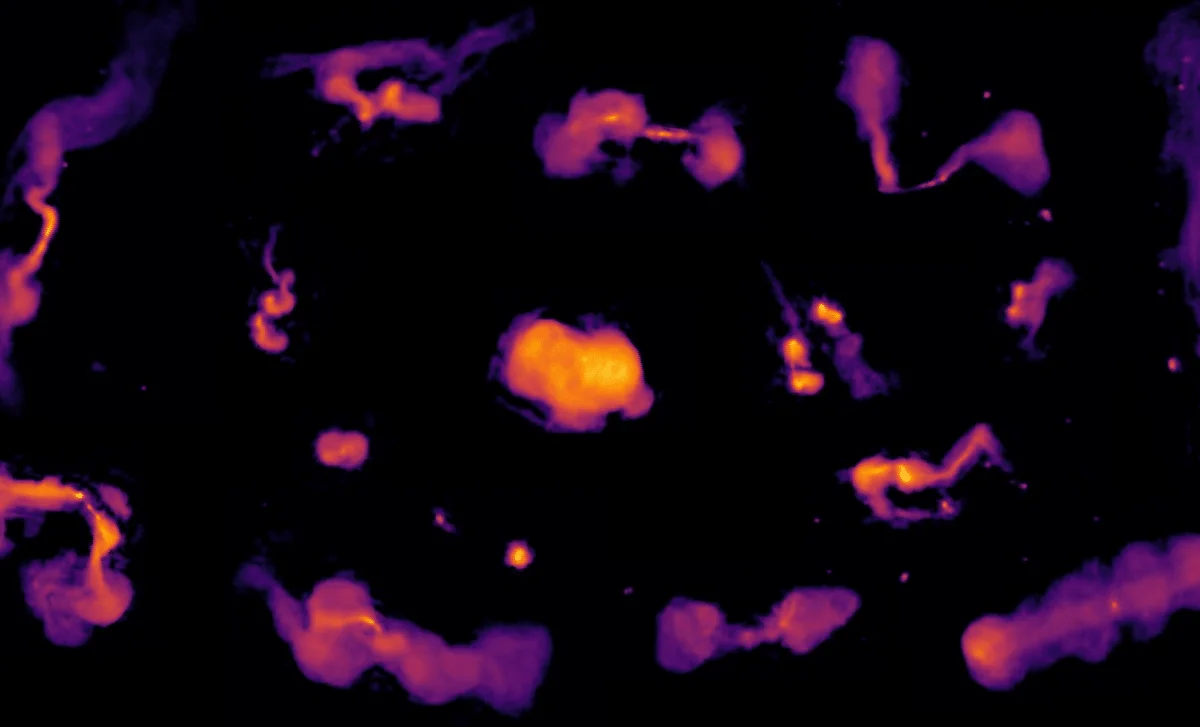
Astronomers released LoTSS-DR3, the most detailed low-frequency radio sky map from the LOFAR network, cataloging 13.7 million cosmic sources and offering new insights into supermassive black holes, their jets, and galaxy clusters, while tackling ionospheric distortions with advanced data-processing techniques on ~18.6 petabytes of data.

Dark stars could tie JWST’s three cosmic puzzles together
space7 months ago

Dark stars could tie JWST’s three cosmic puzzles together

Dark stars—hypothetical early-universe objects powered by annihilating dark matter—could explain three JWST-era mysteries: the overabundance of supermassive black holes in the first billion years, the existence of ultrabright blue ‘monster’ galaxies, and the compact ‘little red dots’. If dark stars exhausted their dark matter and collapsed, they could seed rapid SMBH formation, aligning with JWST observations. The idea remains speculative but is supported by emerging hints, with a December 2025 paper proposing it as a single mechanism to address multiple puzzles.

2025 Black Hole Breakthroughs
science8 months ago

2025 Black Hole Breakthroughs

2025 was a groundbreaking year for black hole research, featuring discoveries such as a rapidly feeding black hole in the early universe, a runaway supermassive black hole moving at incredible speeds, space tornadoes around the Milky Way's core, energetic flares from our galaxy's black hole, and the detection of the universe's most distant and possibly most massive black holes, all facilitated by advanced telescopes like JWST and ALMA.