Tag

Cosmic Noon

All articles tagged with #cosmic noon

Webb Telescope Reveals Record-Breaking Radio Burst Originated in a Tiny, Young Galaxy
science5 days ago

Webb Telescope Reveals Record-Breaking Radio Burst Originated in a Tiny, Young Galaxy

Astronomers have identified the host galaxy of FRB 20240304B, the most distant fast radio burst ever detected. The signal originated when the universe was just 3 billion years old, traveling through 80% of cosmic history. Detected by the MeerKAT telescope in March 2024 and confirmed by the James Webb Space Telescope (JWST), the burst emerged from a surprisingly small, young dwarf galaxy. This finding challenges previous assumptions that FRBs originate from massive, older galaxies, instead supporting theories that they are produced by young magnetars.
Blazar OP 313 Identified as Most Distant Black Hole Beacon from Cosmic Dawn
astronomy10 days ago

Blazar OP 313 Identified as Most Distant Black Hole Beacon from Cosmic Dawn

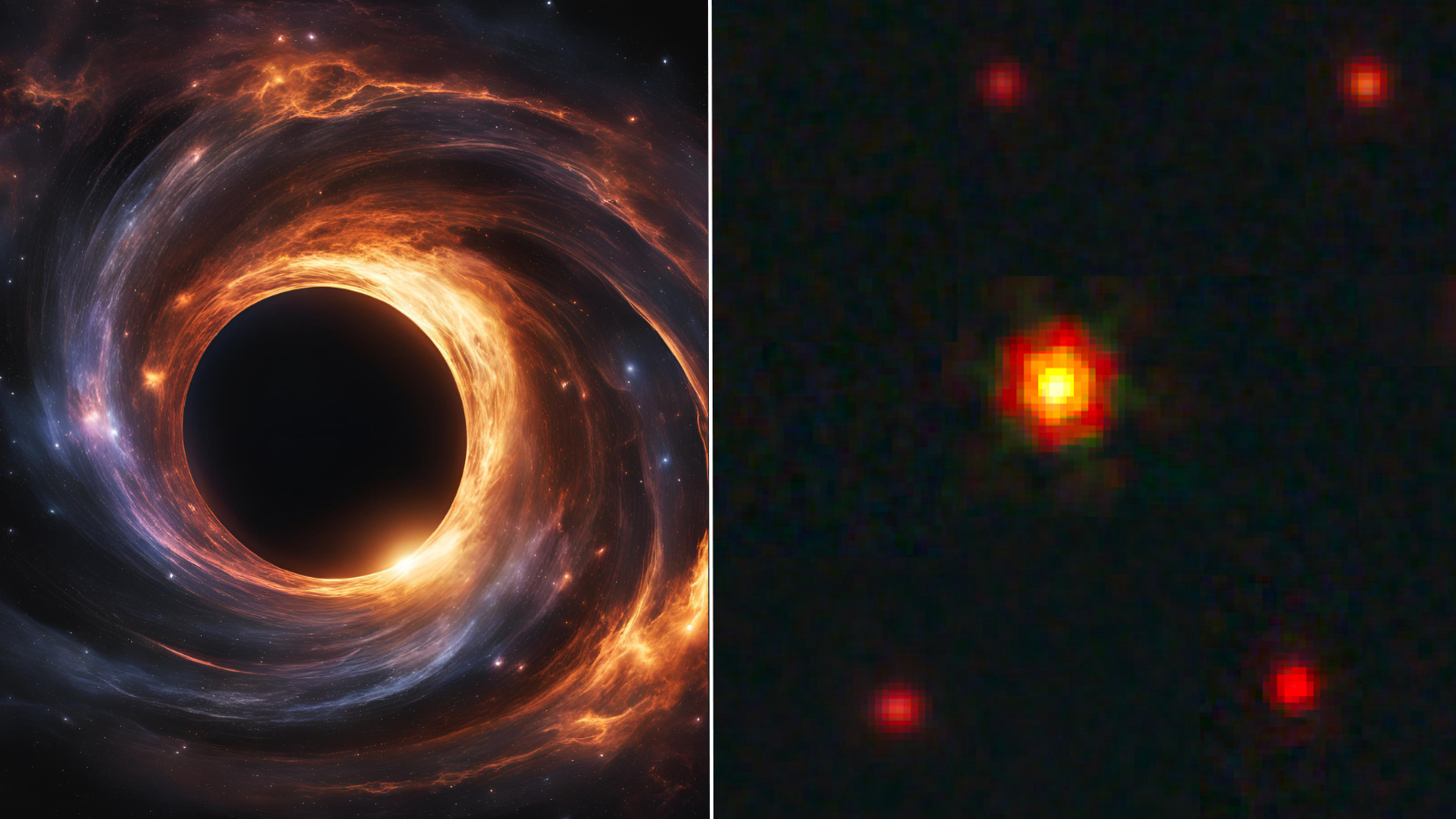
Astronomers have identified Blazar OP 313 as the most distant and earliest blazar ever detected, providing a rare glimpse into the universe's high-activity phase. This object features a supermassive black hole emitting plasma jets directly toward Earth, with light that has traveled for 8 billion years. The discovery offers critical insights into the 'cosmic noon' era, a period of intense galaxy formation that occurred roughly 5 billion years after the Big Bang.

JWST Reveals Dense Dark-Matter Core in Distant Galaxy Cluster XLSSC 122
science3 months ago

JWST Reveals Dense Dark-Matter Core in Distant Galaxy Cluster XLSSC 122

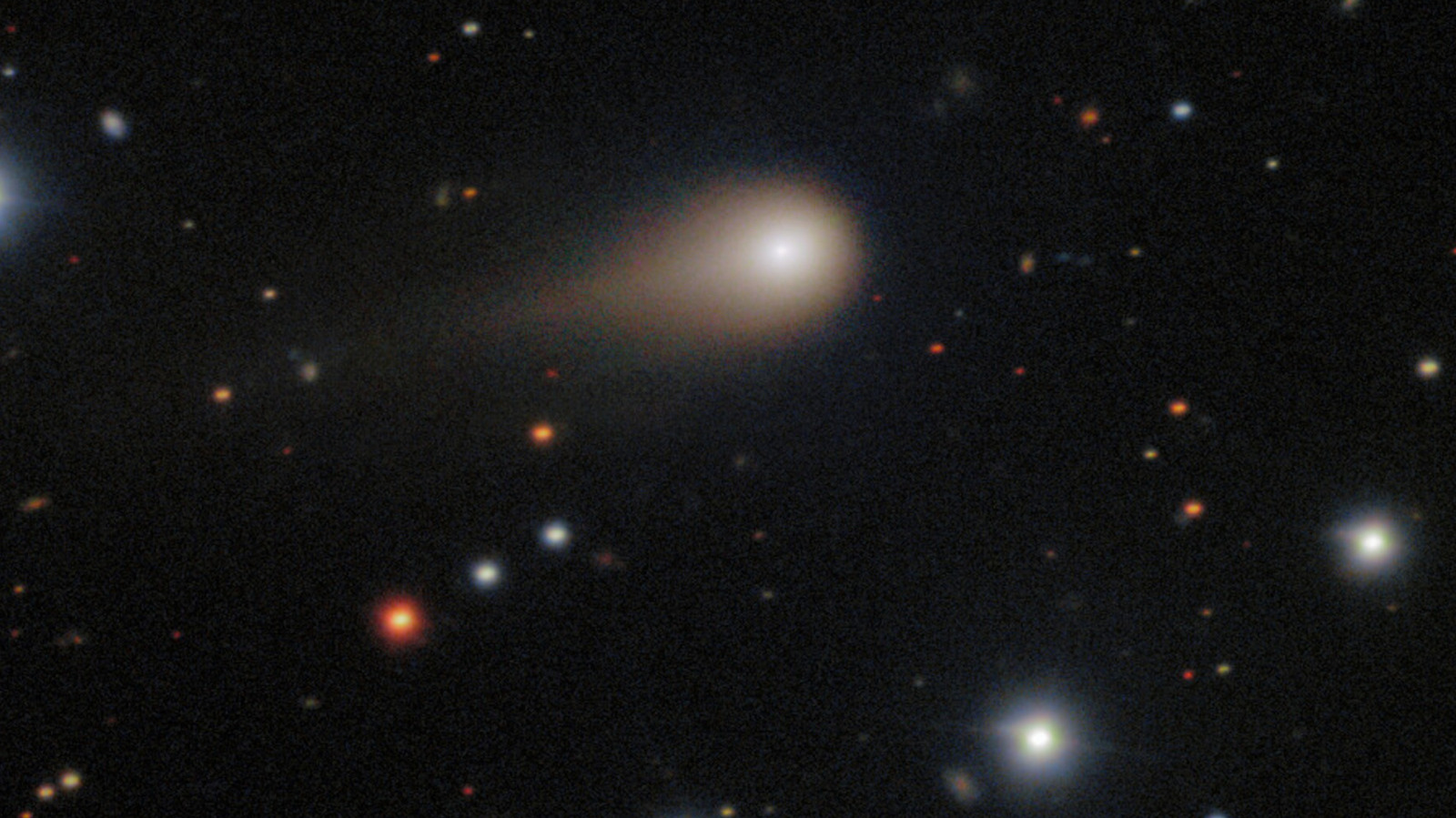
JWST’s view of XLSSC 122, a galaxy cluster at z=1.98 (~10.4 billion light-years away), shows background galaxies lensed into arcs, enabling a map of the cluster’s dense inner mass. The unusually concentrated core for its cosmic noon era points to merger-driven growth, and XLSSC 122 also acts as a natural telescope, magnifying even more distant galaxies to probe dark matter and structure formation.

Hidden hydrogen halos reveal thousands more gas reservoirs around galaxies
science6 months ago

Hidden hydrogen halos reveal thousands more gas reservoirs around galaxies

Astronomers using the Hobby-Eberly Telescope analyzed about half a petabyte of data and found more than 33,000 hydrogen gas halos surrounding galaxies from 10–12 billion years ago (the cosmic noon), up from roughly 3,000 previously detected, suggesting hydrogen is far more widespread than understood and enabling deeper study of early galaxy formation and star formation processes.

NASA's Chandra Detects Unexpectedly Powerful Black Hole Jet During Cosmic 'Noon'
science1 year ago

NASA's Chandra Detects Unexpectedly Powerful Black Hole Jet During Cosmic 'Noon'

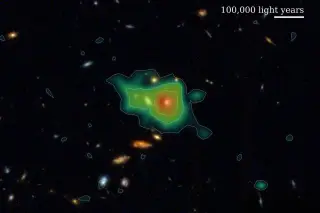
NASA's Chandra X-ray Observatory has detected a surprisingly powerful black hole jet from about 11.6 billion light-years away, during the universe's 'cosmic noon' when galaxy and black hole growth was at its peak. The study identified two black holes with jets over 300,000 light-years long, moving at nearly the speed of light, with their brightness influenced by relativistic effects and viewing angles. This discovery enhances understanding of black hole activity in the early universe.

astronomy2 years ago

Cosmic Noon: Supermassive Black Holes Stifle Star Formation

The James Webb Space Telescope (JWST) has provided new insights into the Cosmic Noon epoch, 2 to 3 billion years after the Big Bang, when galaxies grew and supermassive black holes (SMBHs) became luminous quasars. Using near-infrared data from JWST, astronomers observed over 100 galaxies from this period and found evidence that SMBH-driven outflows can rapidly remove cool gas from galaxies, starving them of fuel for star formation. This suggests that AGNs are responsible for shutting down star formation in massive galaxies, providing a better understanding of galaxy evolution.

The Intricate Dance of Galactic Mergers and Black Hole Collisions
astronomy3 years ago

The Intricate Dance of Galactic Mergers and Black Hole Collisions

New research led by Newcastle University reveals that supermassive black holes obscured by dust are more likely to grow and release tremendous amounts of energy when they are inside galaxies that are expected to collide with a neighboring galaxy. The study used a statistical approach to determine the likelihood of galaxies being close together and on a collision course. By analyzing data from various telescopes, including the Hubble and Spitzer Space Telescopes, the researchers were able to detect the growing black holes using infrared light. This research provides insights into the growth of supermassive black holes during the cosmic noon, a crucial period in galactic evolution, and paves the way for future discoveries with the James Webb Space Telescope.

"New Study Reveals Surprising Planetary Formation Potential in Nearby Galaxy"
astronomy3 years ago

"New Study Reveals Surprising Planetary Formation Potential in Nearby Galaxy"

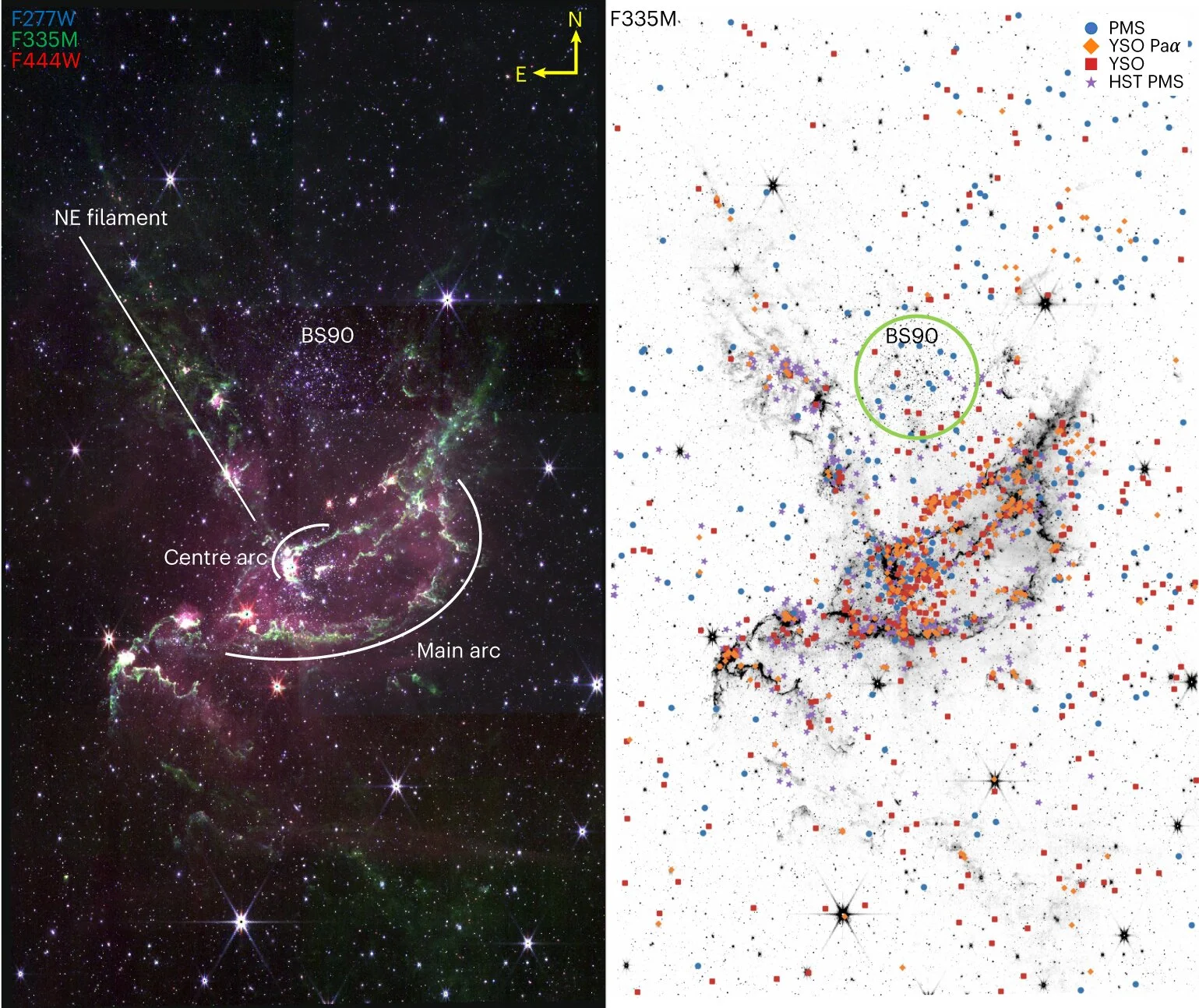
An international team of space scientists has used data from the James Webb Space Telescope to study a part of the Small Magellanic Cloud and found evidence suggesting that planets could have formed during the "cosmic noon." The team focused on a part of the SMC called NGC 346, which is made up of hundreds of young, low-mass stars, and found evidence of rock-forming elements in the SMC, despite the lack of metals, suggesting that many planets may have been forming around them at that time.

"Rare Quasar Triplet: Universe's Most Massive Object"
astronomy3 years ago

"Rare Quasar Triplet: Universe's Most Massive Object"

Astrophysicists have gained insight into the origin of ultra-massive black holes, the heaviest entities in the cosmos, through simulations run on TACC’s Frontera supercomputer. The simulations show that one possible formation channel for ultra-massive black holes is from the extreme merger of massive galaxies that are most likely to happen in the epoch of the ‘cosmic noon’. The largest cosmological simulation to date, called Astrid, co-developed by Yueying Ni, is aiding in the investigation of ultra-massive black holes. The findings from the Astrid simulations show the formation of black holes can reach a theoretical upper limit of 10 billion solar masses.