
Astronomers Capture First Direct Evidence of Massive Stars Forming a Binary System After Birth
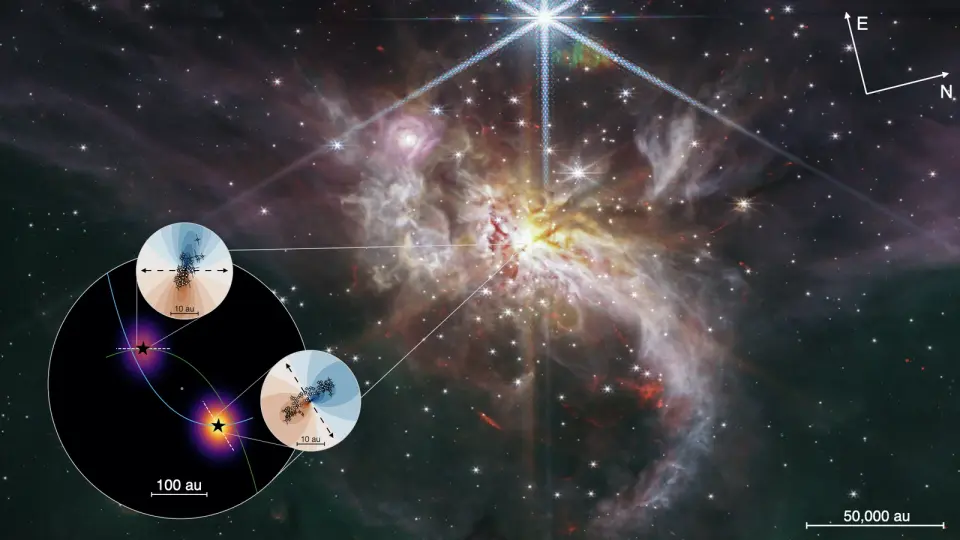
Astronomers have observed the binary star system IRAS 07299-1651, located 5,300 light-years away, to confirm that its two massive stars did not form from the same collapsing gas cloud. Instead, the stars formed separately and later merged into a binary system approximately 60 years ago. This finding challenges the prevailing assumption that most binary stars originate from a single fragmented disk. The discovery was made using data from the ALMA radio telescope, the Very Large Array, and the James Webb Space Telescope over an eight-year observation period. The misalignment of the material disks surrounding the protostars provided the initial clue that their formation history differed from standard models.
Key points
- The binary system IRAS 07299-1651 is located 5,300 light-years away and consists of two massive stars.
- Observations indicate the stars formed separately and joined together about 60 years ago, rather than forming from a single collapsing cloud.
- The discovery was made using ALMA, the Very Large Array, and the James Webb Space Telescope over eight years of observation.
- Misaligned disks of material surrounding the protostars were the key indicator that the stars did not form from the same disk.
- This is the first time astronomers have directly observed two massive stars moving around one another while still in the birth phase.
Background
This discovery adds to recent findings on stellar and black hole systems, such as the identification of Gaia BH1 as Earth's nearest known black hole, which also challenged standard binary evolution models. It follows other JWST-based discoveries, including the detection of a solar-system-sized black hole candidate in Cetus and the clarification of false Dyson-sphere candidates, highlighting the telescope's role in resolving complex astronomical structures.
Why it matters
Understanding how massive binary stars form is critical for modeling the evolution of galaxies and the supernovae that shape cosmic surroundings. Since about 90% of massive stars are in binary systems, this finding refines our understanding of stellar lifecycles and the mechanisms that lead to the formation of such systems, which are prevalent in the Milky Way.
What to watch
Astronomers will continue to analyze the orbital trajectories and disk alignments of similar systems to determine if this late-stage merging process is common among massive stars. Further observations with ALMA and JWST may reveal more examples of binary systems that formed through this mechanism, potentially altering standard models of stellar formation.
Want the full story? Read the original reporting
Read on Space