
Comet McNaught’s Rare Double Outburst Offers Final Viewing Window Before October Fade
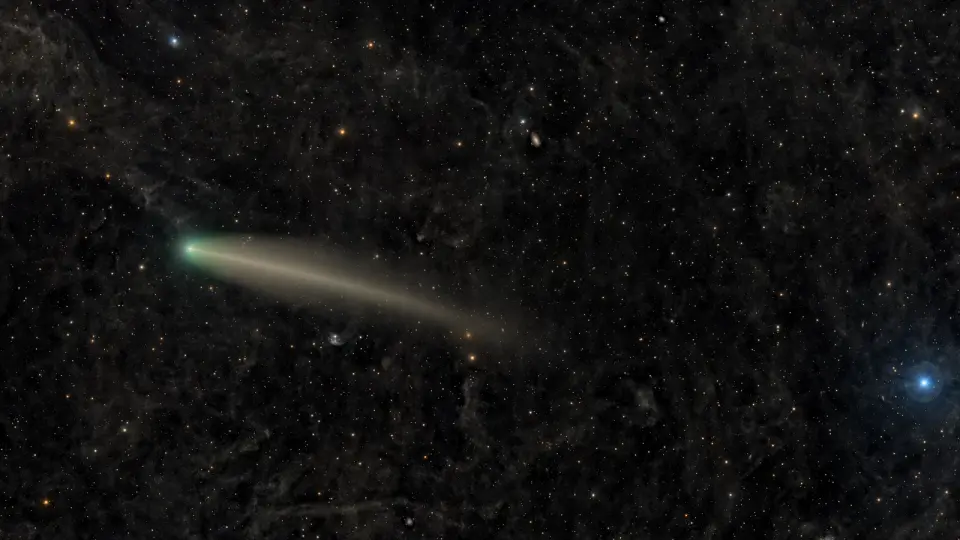
Comet 220P/McNaught, a Jupiter-family comet with a 5.5-year orbit, experienced two unexpected brightness spikes in 2026. The first occurred in late May, and the second in early August, reaching magnitude 6. Currently at magnitude +9.2, the comet is visible in the constellation Cetus before dawn. It will pass near Earth in October before fading as it recedes into the outer solar system.
Key points
- Discovered in 2004 by Robert H. McNaught, the comet orbits the Sun every 5.5 years and reached perihelion on June 14, 2026.
- The first outburst, detected by the Zwicky Transient Facility in late May, caused a 600-fold brightness increase, peaking near magnitude 8.2.
- A second outburst began around August 5, brightening the comet to magnitude 6, making it visible to binoculars and small telescopes.
- Current observations show the comet at magnitude +9.2, appearing as a faint, diffuse patch with a green-tinted coma and short dust tail.
- The comet is expected to pass approximately one astronomical unit from Earth in October, after which it will rapidly fade as it moves away from the Sun.
Background
Previous coverage in August 2026 highlighted the comet’s green appearance over Namibia and its visibility during the Perseid meteor shower. Earlier reports also noted a shock-wave-like debris shell associated with the outbursts, though the specific chemical composition remained under analysis.
How outlets are covering it
Space.com emphasizes the practical viewing window, noting the comet’s current magnitude of +9.2 and the possibility of further outbursts. Futura focuses on the scientific rarity of two major flare-ups within three months, detailing the first outburst’s 600-fold increase and the second’s rise to magnitude 6. Futura also highlights the TRAPPIST-North telescope’s finding of enriched dicarbon relative to cyanogen, a detail not mentioned in Space.com’s report. Both sources agree on the comet’s origin in the Kuiper Belt and its Jupiter-family classification, but Futura provides more specific data on the outburst magnitudes and chemical composition.
Why it matters
The rare double outburst of Comet 220P/McNaught offers a unique opportunity for astronomers to study the physical mechanisms behind sudden cometary activity, such as subsurface disruptions or structural fracturing. The brief viewing window before the comet fades in October makes it a significant event for both professional and amateur observers, while the chemical analysis of its dust cloud may reveal insights into the comet’s composition and the dynamics of volatile release.
What to watch
Astronomers will continue to monitor Comet 220P/McNaught’s brightness and chemical makeup to determine the cause of the outbursts. The comet is expected to pass near Earth in October, after which it will fade rapidly as it recedes into the outer solar system. Further observations may reveal whether additional outbursts occur or if the comet returns to its usual dim state.
- Comet McNaught put on a surprise show this summer: Here's how to spot it before it fades Space
- This comet was nearly invisible—its sudden explosion now stuns astronomers worldwide Futura, le média qui explore le monde
Want the full story? Read the original reporting
Read on Space