
Hawaiian Students Name Merging Galaxies in New Gemini Telescope Image
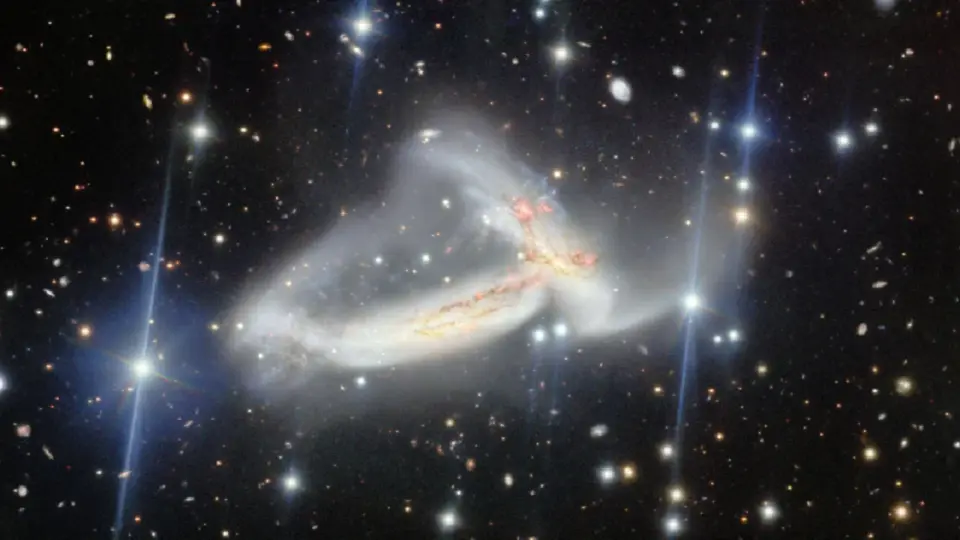
High school students in Hawaii have named a pair of merging spiral galaxies, NGC 7253, using a Hawaiian phrase that translates to 'The Twin Spirits Pulling Together Creating Life.' The image, captured by the Gemini North telescope on Maunakea, was selected and named through the Project Hōkūlani internship, linking astronomical discovery with local cultural significance.
Key points
- NGC 7253, also known as Arp 278, is a pair of spiral galaxies located approximately 200 million light-years away in the constellation Pegasus.
- The galaxies are separated by roughly four million light-years and are in the process of merging, a process that will take billions of years.
- The image was captured by the 8.1-meter Gemini North telescope on Maunakea, Hawaii, as part of the NOIRLab Legacy Imaging Program.
- Students from Waiākea High School and the Volcano School of Arts and Sciences selected the target and named it through the Project Hōkūlani internship.
- The name 'Nā ʻUhane Māhoe Huki Pū i ke Ola' reflects both the gravitational pull of the galaxies and the collaborative spirit of the student project.
Background
This discovery follows a series of public astronomy initiatives in 2026, including a global photo gallery of the August solar eclipse and a July compilation of galactic shapes using data from Chandra, Webb, and Hubble. The Project Hōkūlani internship continues a trend of engaging local communities in astronomical research, particularly on Maunakea, a site that has been the subject of ongoing cultural and scientific debate.
How outlets are covering it
Space.com and NASA's APOD emphasize the cultural and spiritual significance of the name, highlighting the students' connection to Maunakea and Hawaiian traditions. Sci.News focuses on the scientific aspects, noting the image's sharp detail and the star formation triggered by the merger. FreeYork provides a detailed breakdown of the student participants and the specific components of the Hawaiian name, while also noting the historical discovery of the galaxies by Albert Marth in 1863.
Why it matters
This event demonstrates the integration of indigenous knowledge and modern astronomy, providing a model for community-based scientific engagement. It also highlights the ongoing use of Maunakea for research, a site that remains controversial due to its cultural significance to Native Hawaiians.
What to watch
The image will be used for public outreach and educational purposes, and the students involved may continue their involvement in astronomical projects. Further observations of NGC 7253 may provide insights into the mechanics of galaxy mergers and star formation.
- Galaxies tangled in science and spirit photo of the day for Sept. 7, 2026 Space
- APOD: 2026 September 4 - Na Uhane Mahoe Huki Pu i ke Ola NASA Science (.gov)
- Hawai‘i Students Name Image of Glittering Galaxy Pair Nā ʻUhane Māhoe Huki Pū i ke Ola NOIRLab
- High School Students Name 200-Million-Light-Year Galactic Dance Captured by Gemini Telescope freeyork
- Gemini North Telescope Captures Stunning Portrait of Merging Spiral Galaxies Sci.News
Want the full story? Read the original reporting
Read on Space