
"Discovery: Supermassive Red-Ringed Black Hole Defies Cosmic Theories"
TL;DR Summary
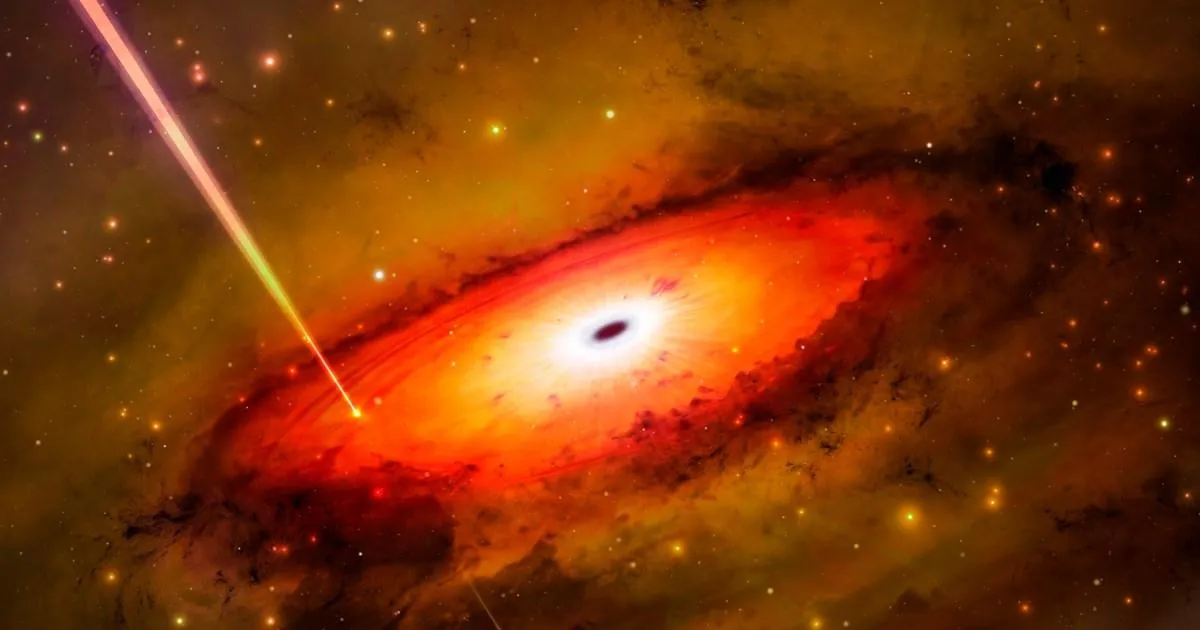
Astronomers using NASA's James Webb Space Telescope have discovered an "extremely red" supermassive black hole, A2744-QSO1, surrounded by plumes of dust and gas in the ancient and shadowy part of the universe, about 12.9 billion light-years away. This black hole, located in the central core of Pandora’s Cluster, is unusually large compared to its host galaxy, raising questions about the relationship between black holes and galaxies. The discovery sheds light on the early universe and the growth of supermassive black holes, challenging existing theories about their formation and evolution.
Topics:science#astronomy#black-hole#galaxy#james-webb-space-telescope#red-ring#supermassive-black-hole
- Gaping black hole with flaming red ring spotted in night sky Metro.co.uk
- James Webb Space Telescope finds 'extremely red' supermassive black hole growing in the early universe Space.com
- Astronomers detect an extremely red supermassive black hole in the early universe growing in the shadows Phys.org
- Red Shrouded Supermassive Black Hole Is Also Too Big For Its Galaxy IFLScience
- Supermassive Black Hole Challenges Cosmic Theories – “The Spectra Were Just Mind-Blowing” SciTechDaily
Reading Insights
Total Reads
0
Unique Readers
9
Time Saved
3 min
vs 4 min read
Condensed
88%
751 → 89 words
Want the full story? Read the original article
Read on Metro.co.uk