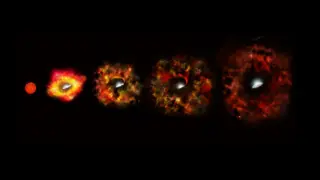
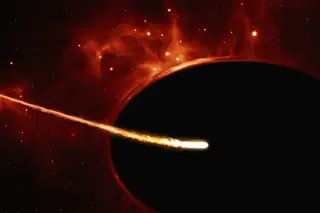
New simulations show neutrinos that change flavor during a dying star’s core collapse can suppress explosions, biasing outcomes toward black holes; this could help explain why fewer supernovas are observed than predicted and why some massive stars yield low‑mass neutron stars, with future work to model neutrino behavior in 3-D.
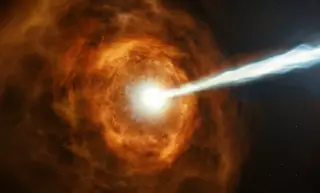
Astronomers detected GRB 250702B, a record-breaking gamma-ray burst lasting about 25,000 seconds (roughly seven hours). While most GRBs come from collapsing stars or merging neutron stars, this unusually long event may be caused by a rare helium-merger: a stellar-mass black hole consuming a stripped helium star. Such extreme bursts are hard to spot with conventional telescopes, but the upcoming COSI telescope, planned to launch in 2027, aims to find and study more long-duration bursts.
AI model Kine merged roughly 100 VLBA images of the blazar 3C 345 from 1995–2022 into a high‑resolution movie, four times sharper than any single frame. The video enables precise mapping of the jet’s motion, showing components racing at about 10–13 times the speed of light while surrounding gas moves at roughly 9–12c, offering fresh insights into jet dynamics across a 27‑year baseline.
New analyses of faint red dots in JWST deep-field images suggest they may be black holes cloaked in a dense, star-like gas cocoon about the size of the solar system—the so-called “black hole star,” with a best-fit mass around 100,000 solar masses. If borne out, this challenges existing ideas about how the universe’s first massive black holes and stars form. Spectral clues like a deep Balmer break and numerous lines support the model, but no direct image exists and alternative explanations (dust geometry, dense star clusters) can’t yet be ruled out. Additional Webb observations are planned to test this emerging picture.
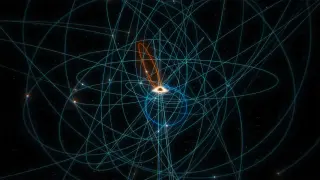
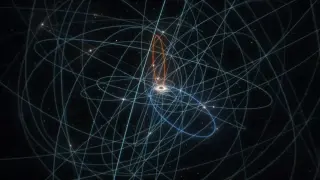
Astronomers have identified S301, a faint main‑sequence star on an 8.7‑year, highly eccentric orbit around the Milky Way’s supermassive black hole Sagittarius A*, reaching speeds up to 25,000 km/s (about 0.08c) at pericenter. This motion probes relativistic effects and could reveal the spin of Sgr A*, with S301 likely a captured binary via the Hills mechanism.
Astronomers have identified S301, a star orbiting extremely close to the Milky Way's central black hole, Sagittarius A*, reaching about 15,500 miles per second (roughly 55.8 million mph)—the fastest speed ever observed and the closest approach to the black hole to date. Its extreme proximity allows direct tests of relativistic effects, such as frame-dragging (Lense-Thirring), with upcoming measurements from facilities like the Gravity instrument on the VLT and MICADO on the ELT over the next decade.
Astronomers using the GRAVITY+ instrument have tracked star S301 in an ultra-tight, 8.7-year orbit around the Milky Way’s supermassive black hole Sgr A*, reaching peak speeds over 25,000 km/s (about 15,500 miles/s, ~8% of light speed). The extreme motion near pericenter exposes frame-dragging and spacetime curvature, offering a path to measure Sgr A*’s spin and test the no-hair theorem of black holes, with continued observations through 2031 and future ELT instruments like MICADO.
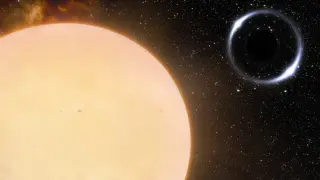
Astronomers have identified Gaia BH1 as the closest known black hole to Earth (about 1,600 light-years away), detected through the Gaia mission by tracking a Sun-like star’s unusual motion around an unseen 10-solar-mass companion in a wide orbit—an arrangement that challenges standard binary evolution models and raises questions about how such systems form.
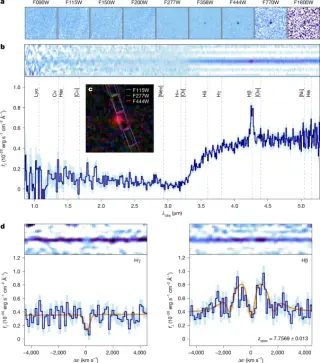
New JWST observations reveal MoM-BH*-1, a z≈7.76 source with an extreme Balmer break, broad Hβ emission, and strong Balmer absorption best explained by a supermassive black hole enshrouded in an extremely dense, nearly dust-free gas envelope. The envelope (nH ~10^11 cm−3, NH ~10^25.8 cm−2, turbulence ~500 km/s) produces a UV-weak, Balmer-break-dominated spectral energy distribution with little host-galaxy light, suggesting possible super-Eddington accretion. This implies rapid black-hole growth in the early universe and cautions that Balmer-line widths under such conditions may overestimate BH masses by up to ~2 dex; the host is a faint, low-mass dwarf galaxy. The finding links to the broader population of “little red dots” and challenges conventional SMBH growth models at cosmic dawn.
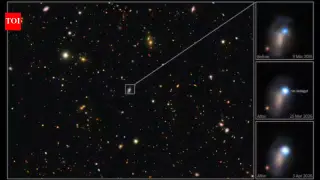
Astronomers detected an X-ray shock breakout signaling the core collapse of a star about 30 times the Sun’s mass, then watched the resulting broad-lined Type Ic supernova SN 2026gzf for nearly three months across multiple wavelengths. Located ~500 million light-years away, it produced no gamma-ray burst, suggesting jets were choked and the star likely left a black hole, providing a rare, detailed look at the end stages of massive-star evolution.
A forthcoming Physical Review D paper argues that Schwarzschild (and likely Kerr) singularities are better described as flat, three-dimensional spacelike surfaces rather than points. This means two observers falling in from opposite directions cannot converge on the same spacetime event, a result that could reshape how general relativity breaks down inside black holes and redefine the starting point for quantum gravity research.
For nearly 30 years, astronomers tracked the star S2 as it orbits the Milky Way’s center around Sagittarius A*, a supermassive black hole about 4 million solar masses. At its closest approach it reaches ~7,650 km/s (~0.025c), enabling precise tests of general relativity in strong gravity via relativistic effects like gravitational redshift, transverse Doppler shift, and Schwarzschild precession. The findings—made with ESO's GRAVITY and Keck, by Genzel and Ghez’s teams—helped secure the Nobel Prize in Physics 2020 and complement the Event Horizon Telescope’s 2022 image of the black hole’s shadow.
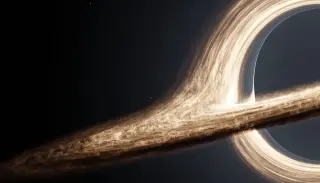
Black holes warp time as well as space: near the event horizon, a distant observer sees infalling matter slow and freeze at the edge due to gravitational time dilation, while the object itself experiences finite proper time to cross the horizon. This freezing is a coordinate effect, not a literal halt in the falling object’s reality. Gravitational time dilation has been measured on Earth and in GPS systems, confirming relativity beyond black holes. Observations like the Event Horizon Telescope and LIGO support horizon physics but do not show a literal frozen image, and quantum-gravity effects (e.g., Hawking radiation) remain unobserved and unresolved.
Astronomers have found star S301, a Sun-like star in the highly elliptical 8.7-year orbit around the Milky Way’s central supermassive black hole Sag A*, approaching within about 24 AU at closest approach and reaching speeds near 0.08c. The orbit shows relativistic precession of about 2° per pass, along with gravitational redshift and transverse Doppler effects, enabling tests of general relativity and potential constraints on alternative gravity theories. While dust and faintness hinder spectral data today, future observatories like the Giant Magellan Telescope could measure higher-order relativistic effects, further probing gravity near a black hole.
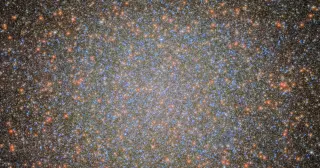
Astronomers using two decades of Hubble imagery and JWST data have identified the first stellar-mass black hole in the globular cluster Omega Centauri, designated oMEGACat BH-2, weighing about 4.46 solar masses and in a 94-year orbit around a sun-like star — the longest-period black hole binary yet found. The discovery, based on precise astrometry of stellar wobble, supports the existence of a hidden population of black holes in metal-poor clusters, though the period and mass have uncertainties due to partial orbital coverage; further observations with JWST and upcoming missions will refine the parameters and reveal more such systems.