
Astrophotographer Kevin Boardman Reveals Filaments of the Crescent Nebula
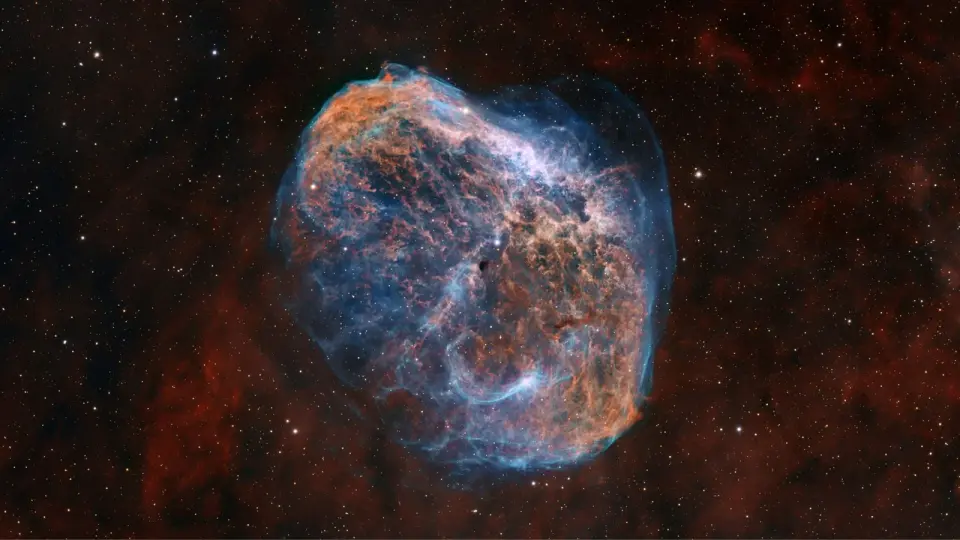
Astrophotographer Kevin Boardman captured a detailed image of the Crescent Nebula (NGC 6888) in Cygnus, revealing intricate gas filaments surrounding the Wolf-Rayet star WR 136. The 25-light-year-wide nebula, located 4,700 light-years from Earth, is formed by stellar material ejected during the star's transformation into a red giant. Boardman used narrowband filters over 16 hours and 18 minutes across five nights in late July to isolate specific wavelengths, highlighting orange-red hydrogen and blue-cyan oxygen emissions. The central star is expected to explode as a supernova in approximately 100,000 years.
Key points
- Kevin Boardman spent 16 hours and 18 minutes imaging the Crescent Nebula across five nights in late July.
- The nebula surrounds the Wolf-Rayet star WR 136, which is 4,700 light-years away in the constellation Cygnus.
- The 25-light-year-wide structure is created by stellar winds and shockwaves from material cast off during the star's evolution.
- Narrowband filters were used to distinguish between H-alpha (orange-red) and O III (blue-cyan) emissions.
- WR 136 is predicted to end its life in a supernova explosion in roughly 100,000 years.
Background
Recent astronomical imaging has highlighted various nebular structures, such as the Hubble Space Telescope's capture of a superbubble in the Large Magellanic Cloud in September 2026. The Crescent Nebula, catalogued as Caldwell 27, is distinct for its crescent-moon appearance in certain wavelengths and its association with a massive, dying star.
Why it matters
This image provides a high-resolution view of the complex filaments created by stellar winds, offering insight into the final stages of massive star evolution and the formation of nebular structures before a supernova event.
What to watch
Astronomers will continue to study the dynamics of the Crescent Nebula's filaments and the eventual supernova of WR 136, which will contribute to the interstellar medium of the Milky Way.
Want the full story? Read the original reporting
Read on Space