
First Milky Way Microblazar Found: Black Hole Jet Accelerates Particles to Extreme Energies
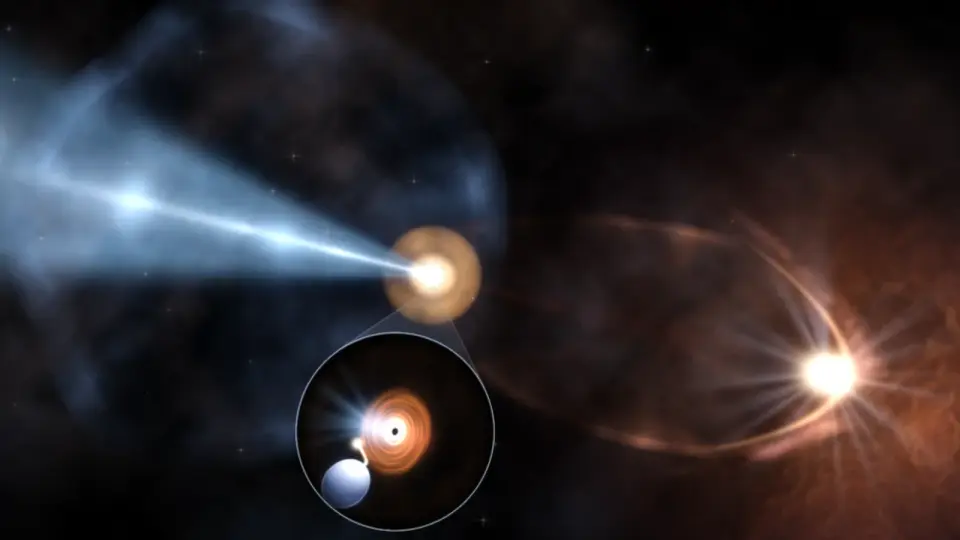
Astronomers have identified IRAS 18293-0941 as the first confirmed microblazar in the Milky Way, a stellar-mass black hole system emitting jets at near-light speed. Located 12,000 light-years away, the system consists of a black hole roughly 10 times the mass of the Sun orbiting a companion star every 11 days. The discovery, published in Astronomy & Astrophysics, resolves a 30-year search for a galactic analog to distant blazars. The system’s jets, one pointing directly at Earth and the other impacting a dense gas cloud, may explain the origin of ultra-high-energy cosmic rays, acting as a natural particle accelerator 100 times more powerful than the Large Hadron Collider.
Key points
- IRAS 18293-0941 is the first confirmed microblazar in the Milky Way, powered by a stellar-mass black hole.
- The black hole has a mass of approximately 10 solar masses and orbits a companion star every 11 days.
- The system is located 12,000 light-years from Earth and was previously hidden by interstellar dust.
- One jet points toward Earth, while the other impacts a dense gas cloud, creating a 100-light-year bubble.
- The system may explain the origin of ultra-high-energy cosmic rays, accelerating particles to peta-electronvolt energies.
Background
This discovery follows recent advancements in mapping the Milky Way’s central black hole, such as the identification of star S301, which orbits Sagittarius A* at extreme speeds. While S301 helps test general relativity near the galactic center, IRAS 18293-0941 provides a new laboratory for studying particle acceleration in stellar-mass black holes, complementing earlier findings on primordial black holes and dark matter candidates like Phoebe.
How outlets are covering it
Space.com emphasizes the historical significance of the discovery, noting that microquasars were theorized three decades ago but remained undetected due to obscuring dust. ZME Science highlights the potential for solving the cosmic ray mystery, detailing how the jet’s impact with a gas cloud creates shock waves that accelerate particles. Tech Explorist focuses on the comparative power of the system, stating it is 100 times stronger than the Large Hadron Collider, and notes the collaborative effort involving ASTRON, JIVE, and the University of Amsterdam. All sources agree on the system’s location and orbital period but differ in emphasis: Space.com focuses on the 'hiding in plain sight' aspect, ZME Science on the 'cosmic mystery' of particle origins, and Tech Explorist on the 'laboratory' potential for studying distant blazars.
Why it matters
The discovery of IRAS 18293-0941 provides a nearby analog for studying the physics of distant blazars, which are too far to resolve in detail. It offers a direct way to investigate how stellar-mass black holes accelerate particles to extreme energies, potentially solving the long-standing mystery of the origin of ultra-high-energy cosmic rays in the Milky Way. This finding also aids in understanding star formation processes affected by jet interactions with molecular clouds.
What to watch
Researchers plan further observations of the jet and its collision site to better understand energy transfer into interstellar gas and particle acceleration. The team aims to confirm whether the system produces the gamma rays detected nearby, using multi-waveband data to refine models of microblazar physics and their role in the galactic ecosystem.
- Astronomers discover the 1st black hole powered 'microquasar' in the Milky Way Space
- Astronomers Find a Black Hole Pointing a Jet Towards Earth — And It May Solve a Cosmic Mystery ZME Science
- Milky Way's first microblazar may produce fastest particles in the galaxy Phys.org
- Astronomers Discover the Milky Way’s First Microblazar Tech Explorist
- First Microblazar Discovered In The Milky Way – It Might Be The Source Of The Fastest Particles In The Galaxy IFLScience
Want the full story? Read the original reporting
Read on Space