
Hidden Icebergs Behind JWST’s Little Red Dots
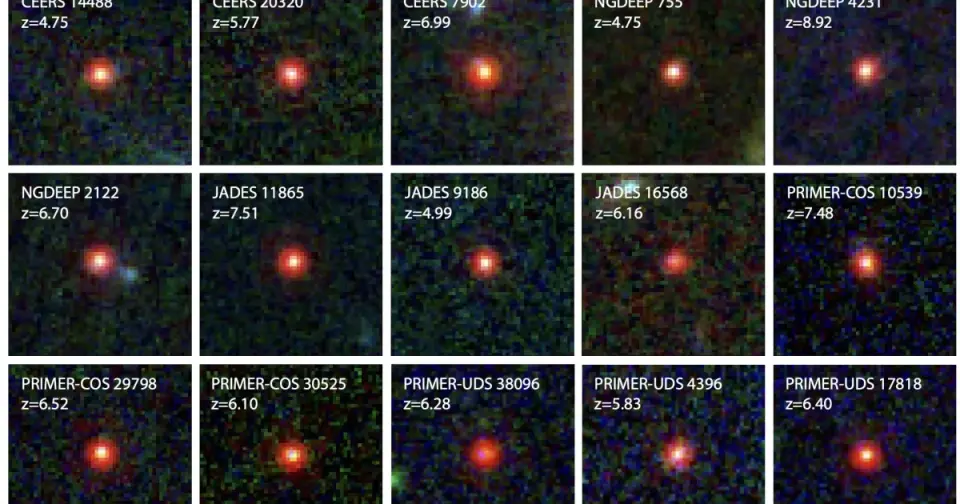
JWST’s Little Red Dots appear far brighter and more common at early cosmic times than simple star-formation models would allow. Explanations span instrumental effects (JWST’s higher throughput), high-resolution simulations revealing rare overdense regions, bursty star formation that can exceed steady-state limits, and possible contributions from active galactic nuclei or exotic energy sources. A hotter, denser early universe could shift the stellar mass distribution toward fewer low-mass stars (a bottom-light IMF), potentially lowering inferred masses; yet observations of ancient globular clusters challenge extreme bottom-light IMF scenarios. No single explanation fits all observations, so the true nature likely involves a mix of stars, black holes, and other processes, awaiting further study.
- The most overlooked fact about JWST’s Little Red Dots Big Think
- James Webb Space Telescope finds evidence the mysterious 'little red dots' are black hole stars Space
- Webb Delivers Strongest-Ever Case for ‘Black Hole Stars’ Lurking in Early Universe Sci.News
- Evidence of a ‘Black Hole Star’ NASA Science (.gov)
- Strange 'little red dots' may be growing supermassive black holes Earth.com
Want the full story? Read the original reporting
Read on Big Think