
Hubble Reveals 'Cat's Tail' in Beta Pictoris, Confirming Violent Dwarf Planet Collision
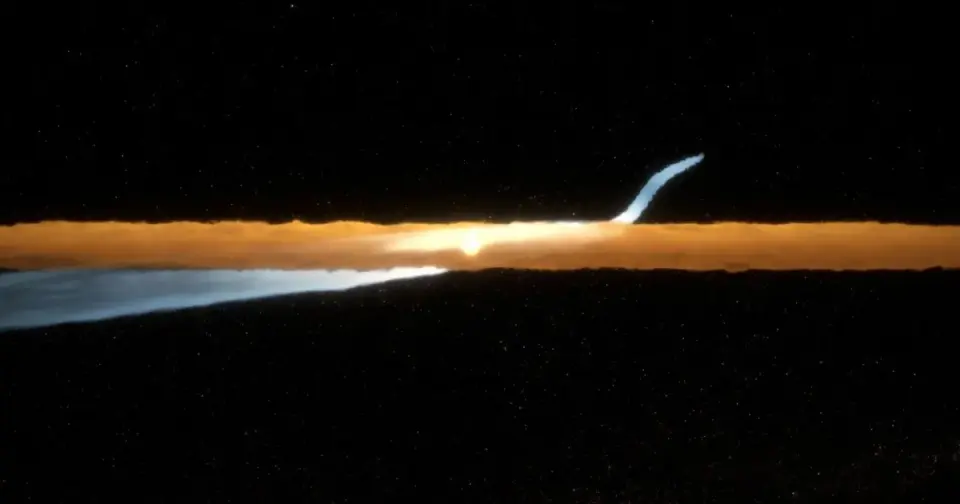
Astronomers have identified the composition and geometry of the 'Cat's Tail,' a massive dust structure in the Beta Pictoris system. New Hubble Space Telescope images, combined with prior James Webb Space Telescope data, show the feature is made of porous, carbon-rich dust resulting from a collision between Pluto-sized bodies. The structure extends 1,000 astronomical units and lies in the same plane as the star, offering insights into early solar system dynamics.
Key points
- The 'Cat's Tail' in the Beta Pictoris system, located 63 light-years away, spans approximately 1,000 astronomical units (93 billion miles).
- Hubble Space Telescope observations in visible light, combined with James Webb Space Telescope infrared data, revealed the structure's 3D geometry and composition.
- The tail consists of micron-sized, highly porous organic refractory material, likely created when carbon vaporized and recondensed during a high-velocity collision.
- The colliding bodies are estimated to have masses between 1 and 3 times that of the dwarf planet Ceres, with radii of 600 to 800 kilometers.
- A newly discovered warp in the surrounding dust halo is attributed to the gravitational influence of Beta Pictoris b, a gas giant ten times the mass of Jupiter.
Background
The Beta Pictoris system is a young star, approximately 23 million years old, compared to our 4.6 billion-year-old solar system. It serves as a laboratory for studying the chaotic early stages of planetary formation. In 2024, the James Webb Space Telescope first detected the 'Cat's Tail' in infrared light, but it remained invisible in visible light until recent Hubble observations. This system provides a direct analogue for the violent collisional environment that likely existed in our own solar system's infancy, particularly within the Kuiper Belt.
How outlets are covering it
Futurism and Space emphasize the visual contrast between the infrared and visible light observations, highlighting how the carbon-based composition absorbs visible light, making the tail appear 'black' and previously invisible. Universe Today provides detailed quantitative analysis, estimating the mass and radius of the colliding bodies based on organic refractory material found in comets and dwarf planets. The University of Arizona News focuses on the broader implications for understanding solar system evolution, noting that the warp in the dust halo demonstrates how giant planets like Beta Pictoris b influence surrounding debris. All sources agree on the collisional origin but differ in emphasis: Futurism and Space focus on the 'fluffy' nature of the dust, while Universe Today focuses on the mass calculations of the parent bodies.
Why it matters
This discovery resolves a two-year mystery regarding the visibility of the Cat's Tail in different wavelengths. It confirms that high-velocity collisions between dwarf planets can produce highly porous, carbon-rich dust, a process that may have shaped the early solar system. The findings also demonstrate the gravitational influence of giant planets on distant debris, providing a model for how planetary systems evolve from chaotic disks to ordered orbits.
What to watch
Researchers plan to use upcoming telescopes, such as the Extremely Large Telescope and the Giant Magellan Telescope, to further analyze the Beta Pictoris system. These instruments will provide higher-resolution images to better understand the formation of porous dust grains and the dynamic interactions between planets and debris disks. Continued monitoring of the system will help confirm the gravitational influence of Beta Pictoris b on the dust halo.
- Scientists Intrigued by Incredibly Long Structure Lurking in Nearby Star System Futurism
- Hubble Telescope sees cosmic 'cat's tail' that could wrap around Earth and the sun 500 times Space
- Colliding Dwarf Planets Created a 'Cat's Tail' 1,000 Astronomical Units Long Universe Today
- An enormous 'Cat's Tail' tells of cosmic collision 63 light-years away University of Arizona News
- Hubble Uncovers a Mysterious 93-Billion-Mile Structure Hiding in a Nearby Star System SciTechDaily
Want the full story? Read the original reporting
Read on Futurism