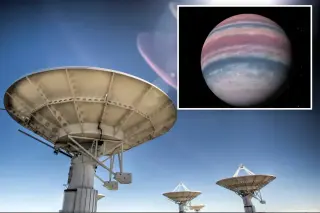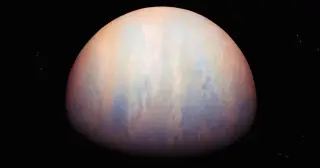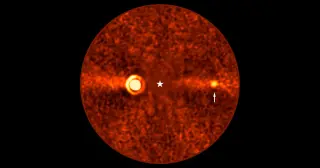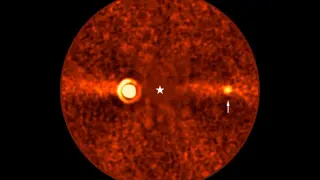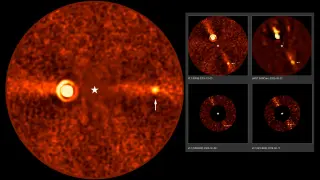
Using JWST’s NIRSpec and follow-up imaging from ESO’s VLT, astronomers detected Beta Pictoris d by its atmospheric spectrum, a third planet in the bright Beta Pictoris system—discovered via spectroscopy rather than direct imaging and independently confirmed, highlighting a new way to find worlds hidden in dusty disks.
Using ESO's Very Large Telescope and archival JWST data, researchers confirmed Beta Pictoris d—an outer, 2.4-Jupiter-mass planet orbiting the nearby star Beta Pictoris. It is the faintest exoplanet ever directly imaged from Earth, lying more than twice as far from its star as its siblings and at about 64 light-years away. With a temperature around 330°C, it demonstrates how repeated observations and advanced instruments can reveal low-mass worlds hidden in bright starlight, and suggests there are likely more planets awaiting discovery in this young system with future telescopes like the ELT.
Two independent teams using the European Southern Observatory’s Very Large Telescope and NASA’s James Webb Space Telescope independently detected a faint gas giant orbiting the young star Beta Pictoris—the dimmest exoplanet imaged from Earth—roughly 63 light-years away. The planet, slightly larger than Jupiter, completes a 91-year orbit in a system about 20 million years old, offering a rare glimpse into early planetary formation as astronomers dug through archival data and confirmed the discovery across two observations.
Astronomers using ESO's Very Large Telescope and NASA's James Webb Space Telescope independently detected a faint, Jupiter-sized planet orbiting the young star Beta Pictoris, making it the dimmest exoplanet directly imaged from Earth. The planet, slightly larger than Jupiter, completes an orbit every 91 years around a system about 20 million years old, offering a rare glimpse into planetary formation as the system stabilizes after its birth.
After more than a decade of archival data, astronomers directly imaged Beta Pictoris d, a roughly 2.4 Jupiter-mass gas giant about 63 light-years away, making it the faintest exoplanet ever seen directly from Earth and helping explain the star system’s debris disk; the find places Beta Pictoris among the few multi-planet systems detectable via direct imaging and may be followed up by the ELT.
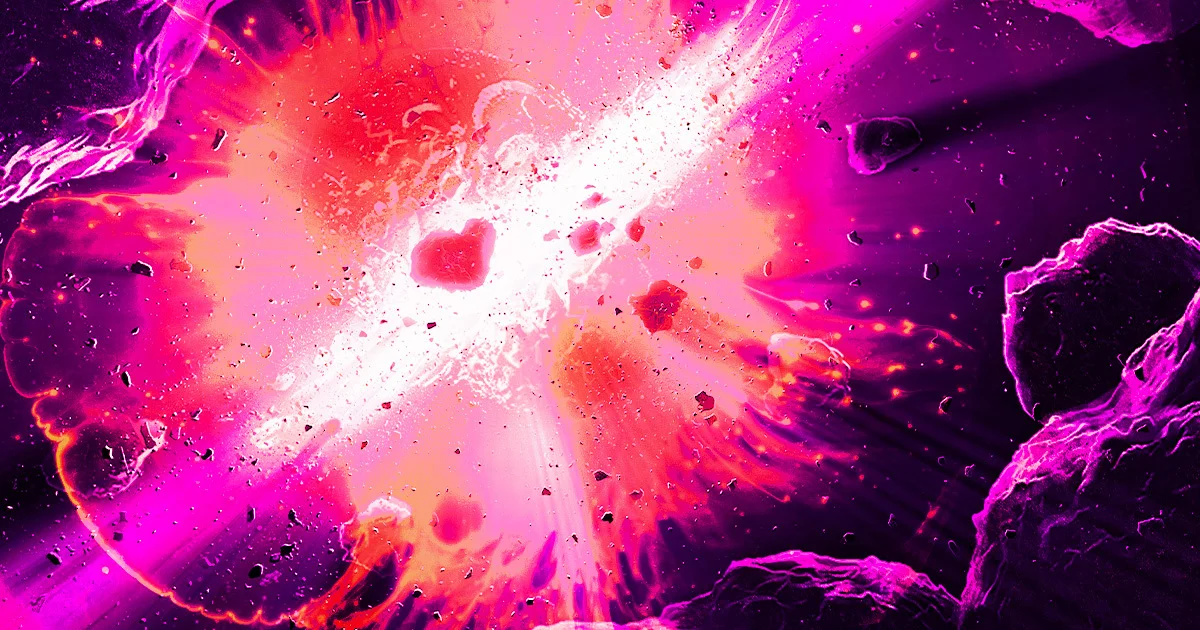
NASA's James Webb Space Telescope captured evidence of a massive collision between two giant asteroids in the Beta Pictoris star system, located 63 light years from Earth. The collision, which produced a vast amount of dust, was initially observed by the Spitzer Space Telescope in 2004-2005. The recent disappearance of this dust suggests a cataclysmic event, providing insights into the early stages of planetary formation and the commonality of such processes in star systems.
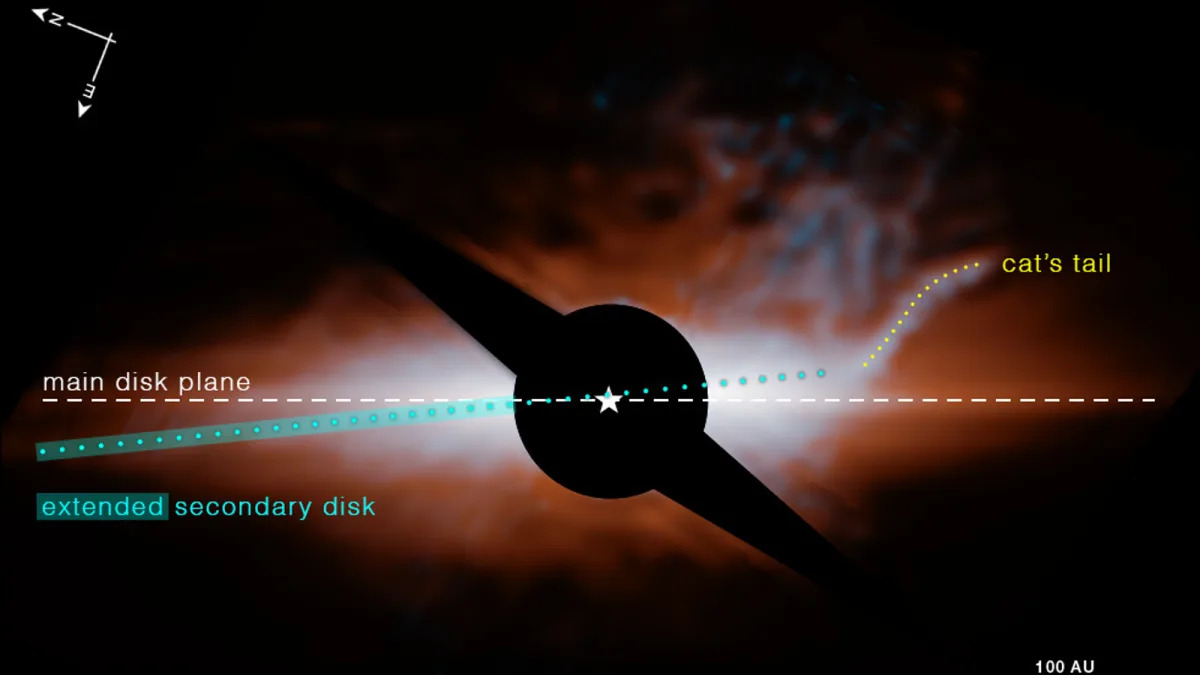
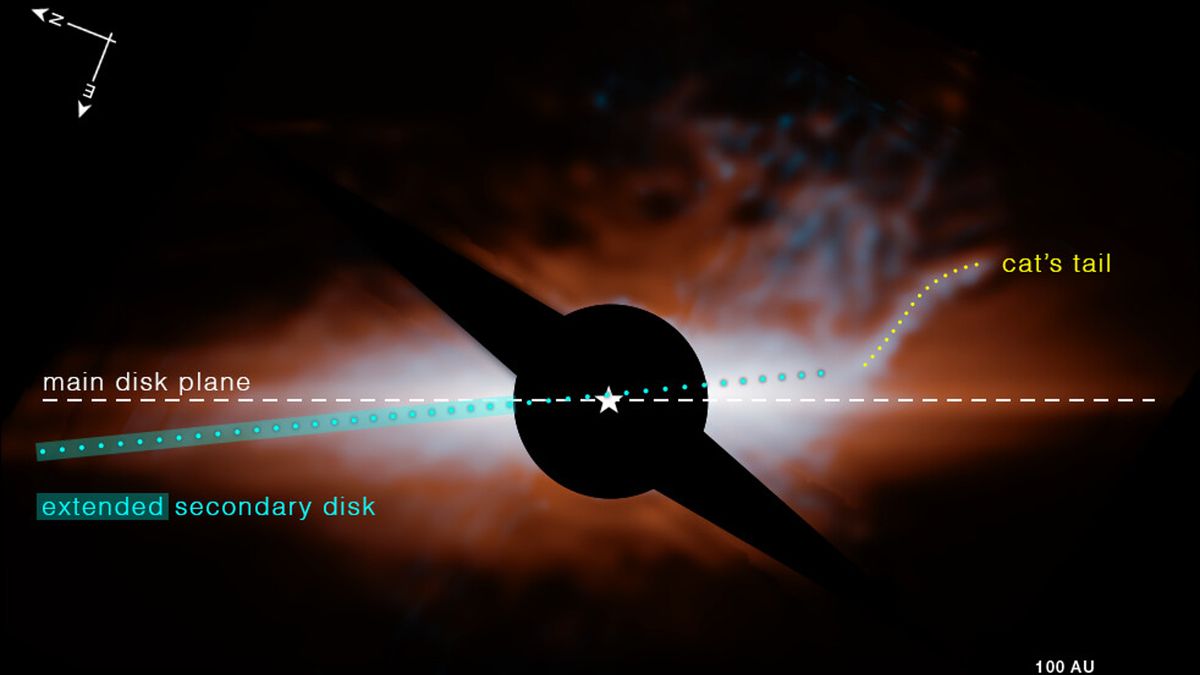
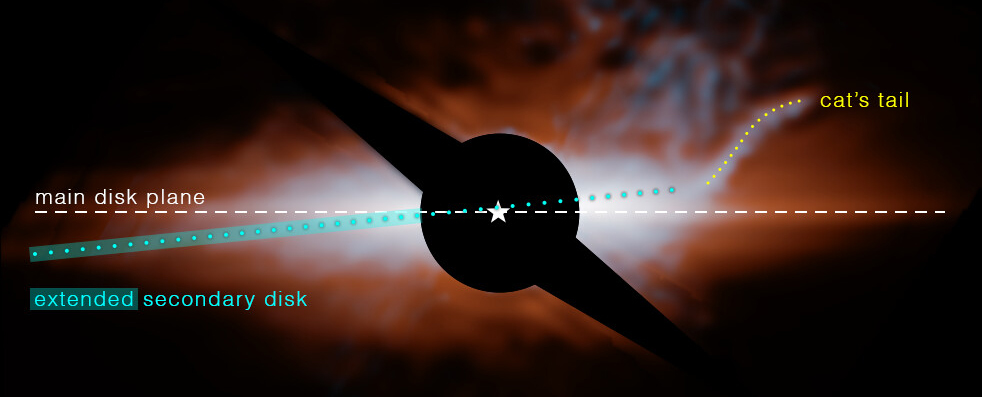
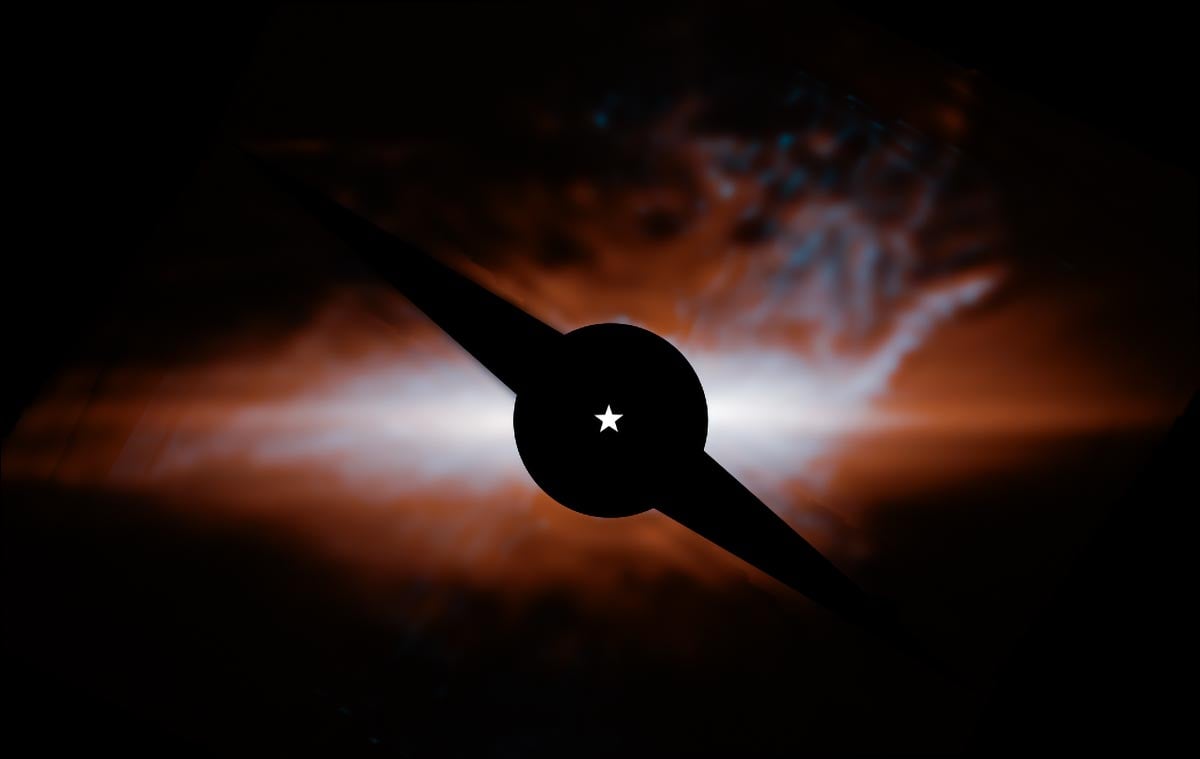
The James Webb Space Telescope has captured images of a peculiar "cat tail" feature extending from the protoplanetary disk of the young star Beta Pictoris, located 63 light-years away. This unusual structure, observed at a slight angle to the main disk, has puzzled scientists and suggests a more active and chaotic system than previously thought. The tail, estimated to be equivalent in mass to some of the largest asteroids in our solar system, may have formed from a collision within the disk, with material being stretched and shaped by the star's light. Additionally, the telescope revealed that Beta Pictoris' two disks are different temperatures, indicating that the secondary disk is likely composed of predominantly dark-hued, organic matter rather than gas.
The James Webb Space Telescope has captured new images of a peculiar "cat's tail" of gas and dust flowing from the Beta Pictoris star's secondary planetary disk, located 63 light-years away. This unusual structure, difficult to explain, suggests a more active and chaotic system than previously thought. Researchers speculate that it may have formed from an asteroid-protoplanet collision, with the star's light shaping the displaced material. Additionally, the telescope revealed that the secondary disk is hotter and likely composed of organic matter, providing new insights into the star's environment.
The James Webb Space Telescope has revealed a surprising second disk around the young star Beta Pictoris, which is different in temperature and composition from the previously known disk. The new structure, dubbed the "Cat's Tail," presents a mystery to scientists, who speculate that it may have been formed by a collision event within the disk. These findings highlight the potential for new discoveries even in well-studied celestial objects and call for further research to understand these unexpected features.
The James Webb Space Telescope has discovered a previously unseen feature in the Beta Pictoris star system, indicating a recent cosmic event within the past 100 years. This finding, made possible by the telescope's infrared vision, suggests that something traumatic happened to the star system, leading to the creation of a dusty tail-like feature. The discovery has sparked interest among astronomers, who are now studying the system to understand the cause of this event and its implications for the Beta Pictoris system's composition and dynamics.
The James Webb Space Telescope has discovered a cat's tail-shaped dust structure within the Beta Pictoris system, indicating recent dust production events and complex interactions within the system's debris disks. This finding expands our understanding of planetary system dynamics and provides new insights into the composition and temperature differences of the debris disks. The structure, estimated to span 10 billion miles, is believed to be the result of a dust production event, possibly a collision, that occurred around a hundred years ago. This discovery highlights the ongoing surprises and complexities within the Beta Pictoris planetary system.
NASA's James Webb Space Telescope has discovered a new, previously unseen structure in the Beta Pictoris system, located 63 light-years away. The structure, shaped like a cat's tail, extends from the secondary debris disk and is composed of highly porous organic refractory material. The team of astronomers also observed differences in temperature between the two disks, indicating different compositions. The team's preferred model suggests that the cat's tail is the result of a recent dust production event, and its unusual curvature is explained as an optical illusion. These findings were presented at the 243rd meeting of the American Astronomical Society and provide new insights into the complex planetary system of Beta Pictoris.
The James Webb Space Telescope (JWST) is revolutionizing our understanding of planetary formation by revealing the delivery of water to rocky planets in protoplanetary disks and uncovering exotic chemistry in these planetary nurseries. JWST's observations have shown that icy pebbles can drift inward from the outer part of the disk, releasing water into the inner disk and providing a raw ingredient for planet formation. Additionally, the telescope has detected a high amount of carbon in the protoplanetary disk surrounding a small star, suggesting the potential for diverse chemistry in the formation of rocky planets. JWST has also captured images of a debris disk around Beta Pictoris, revealing a filament of dust known as the "cat's tail," which is likely the result of a massive collision in the disk. These discoveries highlight the power of JWST in uncovering new insights into the formation of planets.