
Isotopes Trace Interstellar Visitor 3I/ATLAS to Ancient, Metal-Poor Disk
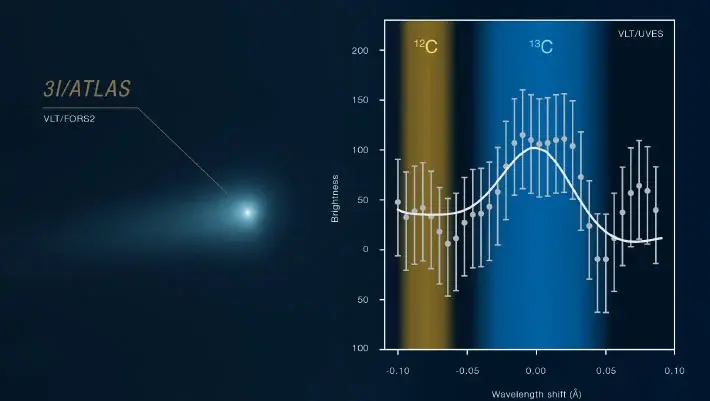
TL;DR
Astronomers using ESO's Very Large Telescope measured carbon and nitrogen isotope ratios in the interstellar comet 3I/ATLAS, finding carbon-12/carbon-13 ~151 and nitrogen-14/nitrogen-15 ~363. These values are higher than typical solar-system comets, suggesting formation in the cold outer disk around an older, metal-poor star, consistent with isotope-selective chemistry in such environments. The results, published online July 6, 2026 in Nature Astronomy, provide a rare glimpse into material from another planetary system and the efficiency of planetesimal formation around ancient stars.
Topics:scienceastronomy#3iatlas#astronomy#interstellar-object#isotopes#metal-poor-star#protoplanetary-disk
- Interstellar Comet 3I/ATLAS Likely Originated in Outskirts of Ancient Planetary System Sci.News
- Older than the Sun: Astronomers find new clues to the origin of interstellar comet 3I/ATLAS EurekAlert!
- Comet may be 12bn-year-old relic from distant star system The Times
- High nitrogen and carbon isotopic ratios in the interstellar comet 3I/ATLAS Nature
- How an interstellar comet sheds light on universe's 'cosmic noon' Phys.org
Want the full story? Read the original reporting
Read on Sci.News