Tag

Isotopes

All articles tagged with #isotopes

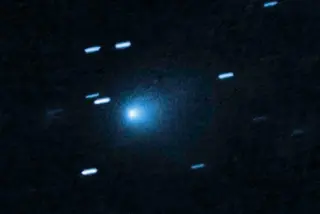
Ancient interstellar visitor 3I/ATLAS could be a 10–12 billion-year relic from the Milky Way
space11 days ago

Ancient interstellar visitor 3I/ATLAS could be a 10–12 billion-year relic from the Milky Way

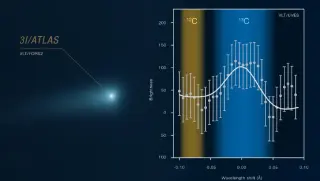
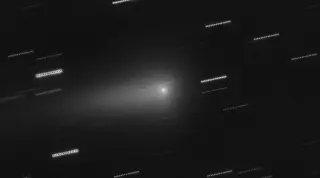
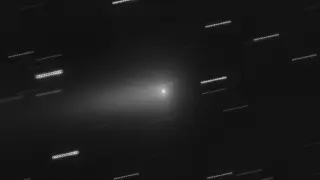
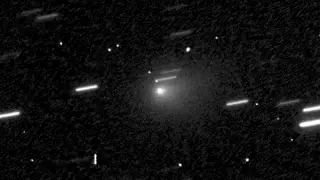
New JWST/NIRSpec analysis of interstellar comet 3I/ATLAS finds an unusually low carbon-13 to carbon-12 ratio and significant deuterium enrichment, implying it formed very early in the Milky Way’s history. Modeling suggests 3I/ATLAS may be 10–12 billion years old, potentially originating from a thick-disk star system, making it one of the oldest interstellar visitors and perhaps a relic from a vanished stellar neighborhood. The age estimate is not yet peer‑reviewed and is available via a preprint, with researchers noting ongoing uncertainty but tantalizing clues about ancient planet formation beyond our galaxy.

Desert Horsetail's Water Distillation Mimics Meteorite Signatures, Revealing Ancient Climate Records
science23 days ago

Desert Horsetail's Water Distillation Mimics Meteorite Signatures, Revealing Ancient Climate Records

A study led by Zachary Sharp shows the prehistoric smooth horsetail (Equisetum laevigatum) distills water so aggressively that its top-water oxygen-isotope signature resembles a meteorite, helping explain puzzling desert data. The researchers also show fossil phytoliths trap these integrated isotopic records, providing a sensitive palaeo-hygrometer to reconstruct Earth’s past humidity and climate millions of years ago, aided by a refined evaporation–isotope model; findings published in PNAS (2025).

JWST Finds Interstellar Comet 3I/ATLAS May Be Among the Galaxy’s Oldest Objects
space29 days ago

JWST Finds Interstellar Comet 3I/ATLAS May Be Among the Galaxy’s Oldest Objects

James Webb Space Telescope analysis of interstellar comet 3I/ATLAS suggests it formed in a cold region of the Milky Way about 10–12 billion years ago, potentially making it older than Earth and possibly as old as the galaxy or even the universe. Its isotopic composition differs from solar-system comets, implying formation in a different stellar environment. The comet is now exiting the solar system after a close approach to Earth, with further travels past the outer planets as researchers continue to refine its origins.

Bennu’s Amino Acids Point to Ice-Driven Origins of Life’s Building Blocks
science1 month ago

Bennu’s Amino Acids Point to Ice-Driven Origins of Life’s Building Blocks

NASA’s OSIRIS-REx samples from the 4.6-billion-year-old asteroid Bennu reveal amino acids, including glycine, can form in space and may arise in icy, radiation-exposed conditions in the early Solar System rather than only in liquid water; this suggests multiple pathways for the building blocks of life and shows Bennu’s isotopic signatures differ from the Murchison meteorite, indicating diverse origins for prebiotic molecules.

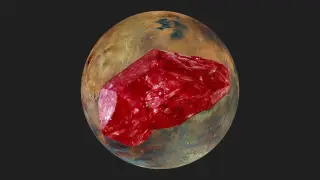
Electric Dust Storms Forge Perchlorates on Mars, Rewriting Surface Chemistry
space2 months ago

Electric Dust Storms Forge Perchlorates on Mars, Rewriting Surface Chemistry

A new study argues that Martian dust storms generate electrostatic discharges that create high-energy electrons, driving reactions between atmospheric CO2 and ground chloride salts to form perchlorates and carbonates without liquid water. This electrochemical pathway also explains the observed isotopic imbalances, with lighter isotopes preferentially involved in these reactions. The research, demonstrated in lab chambers simulating Mars’ environment, suggests electrical processes are a key driver of Mars’ surface chemistry, poses ongoing challenges for future missions (due to perchlorates), and may have parallels on other dusty worlds.

Proton-Neutron Surprises: Island of Inversion Spotted in Symmetric Molybdenum Nuclei
science2 months ago

Proton-Neutron Surprises: Island of Inversion Spotted in Symmetric Molybdenum Nuclei

A Nature Communications study shows Mo-84 and Mo-86 near the proton–neutron balance line (N≈Z) exhibit an island of inversion, with protons and neutrons engaging in particle-hole excitations that deform the nucleus. Using Be targets and Mo-92 beams, gamma rays were detected by GRETINA and TRIPLEX, revealing symmetry-breaking structure in these proton-rich isotopes—a finding that challenges traditional nuclear models and expands where inversions can occur.

Chang'e-6 Dust Reveals the Moon’s Hidden Interior After a Giant Collision
space2 months ago

Chang'e-6 Dust Reveals the Moon’s Hidden Interior After a Giant Collision

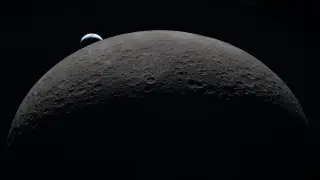
A new analysis of dust from the Moon’s far side collected by China’s Chang’e-6 mission finds heavier potassium isotopes than near-side samples, suggesting the South Pole–Aitken impact heated the Moon so intensely that lighter isotopes vaporized and escaped, reshaping the Moon’s mantle and leaving long-lasting hemispheric chemical differences and possibly triggering deep interior processes.

"Unveiling Secrets of Ancient Supernova Stardust in Meteorite"
space-and-physics2 years ago

"Unveiling Secrets of Ancient Supernova Stardust in Meteorite"

A rare dust particle found in an ancient meteorite has been determined to be older than the Sun, with a composition indicating it originated from an unusual type of supernova. The grain's isotopic ratios suggest it was formed by a hydrogen-burning supernova, a rare type of Type II supernova. This discovery provides valuable insights into the formation of the Solar System and the types of stars that contributed to its composition.

"Discovery of Novel Isotopes Redefines Nuclear Stability"
science2 years ago

"Discovery of Novel Isotopes Redefines Nuclear Stability"

Physicists at the Institute of Modern Physics and collaborators have discovered two new isotopes, osmium-160 and tungsten-156, challenging traditional views on nuclear stability and magic numbers. This breakthrough suggests potential for lead-164 to be a stable, doubly magic nucleus, enhancing the understanding of nuclear physics and the architecture of atomic nuclei. The study, published in Physical Review Letters, indicates a significant step forward in nuclear theory and stability, with implications for the development of nuclear forces and deepening our understanding of nuclear physics.

"Unveiling 5 New Isotopes: Advancing Our Understanding of Cosmic Element Formation"
science2 years ago

"Unveiling 5 New Isotopes: Advancing Our Understanding of Cosmic Element Formation"

Scientists at the Facility for Rare Isotope Beams (FRIB) at Michigan State University have synthesized five new isotopes, including Thulium-182 and ytterbium-187, which have never been found on Earth before. These isotopes could help scientists understand how collisions between neutron stars create heavy elements like gold and silver. The research, published in Physical Review Letters, represents a step towards recreating superheavy elements on Earth to better understand the creation of heavy elements and their implications for nuclear physics.