Tag

Interstellar Object

All articles tagged with #interstellar object

Isotopes Trace Interstellar Visitor 3I/ATLAS to Ancient, Metal-Poor Disk
astronomy3 days ago

Isotopes Trace Interstellar Visitor 3I/ATLAS to Ancient, Metal-Poor Disk

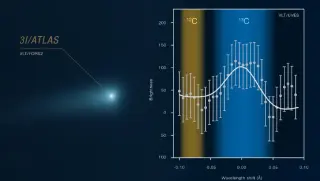
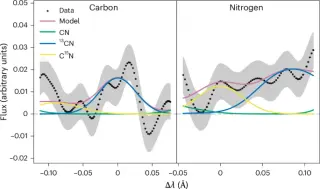
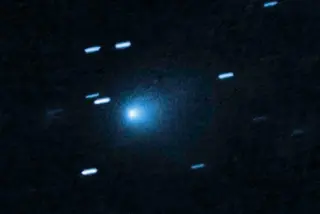
Astronomers using ESO's Very Large Telescope measured carbon and nitrogen isotope ratios in the interstellar comet 3I/ATLAS, finding carbon-12/carbon-13 ~151 and nitrogen-14/nitrogen-15 ~363. These values are higher than typical solar-system comets, suggesting formation in the cold outer disk around an older, metal-poor star, consistent with isotope-selective chemistry in such environments. The results, published online July 6, 2026 in Nature Astronomy, provide a rare glimpse into material from another planetary system and the efficiency of planetesimal formation around ancient stars.

Interstellar comet 3I/ATLAS reveals outer-disk isotopic fingerprints
space4 days ago

Interstellar comet 3I/ATLAS reveals outer-disk isotopic fingerprints

Astronomers measuring CN isotopologues in the interstellar comet 3I/ATLAS find unusually high 12C/13C (~151) and 14N/15N (~363) ratios, higher than Solar System comets and closer to interstellar/outer-disk values, implying 3I formed in the outer disk around an old, low-metallicity star and offering rare clues about planetesimal formation under different stellar environments.

Ancient interstellar comet 3I/Atlas reveals alien chemistry
science8 days ago

Ancient interstellar comet 3I/Atlas reveals alien chemistry

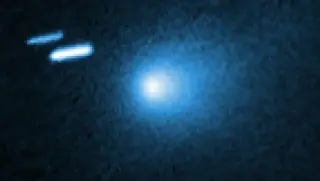
Astronomers using JWST spectroscopy found that interstellar comet 3I/Atlas has a chemical makeup unlike any solar-system object, with high CO2 and low NH3 and distinctive isotope fingerprints (D/H and 12C/13C) indicating formation in a very cold protoplanetary disk around an ancient star roughly 12 billion years ago; as only the third known interstellar object, 3I/Atlas provides a fossil record of planetary systems in the early Milky Way, and upcoming surveys (like NEO Surveyor and the Rubin Observatory) are expected to uncover more such visitors.

Chile’s asteroid-warning telescope spots the Solar System’s third interstellar visitor
science15 days ago

Chile’s asteroid-warning telescope spots the Solar System’s third interstellar visitor

The ATLAS survey telescope in Chile, built to warn about near-Earth asteroids, unexpectedly detected 3I/ATLAS, the third known interstellar object, whose hyperbolic trajectory indicates it is not from the Solar System and, based on motion modelling, may be older than the Solar System; the discovery shows planetary-defense instruments can also capture rare interstellar visitors and inform our understanding of galactic debris.

Ancient Interstellar Comet 3I/ATLAS Traces a 12-Billion-Year-Old Planetary System
science18 days ago

Ancient Interstellar Comet 3I/ATLAS Traces a 12-Billion-Year-Old Planetary System

Isotopic analysis of the interstellar comet 3I/ATLAS suggests it formed in a cold environment about 12 billion years ago, making it older than our Solar System and a preserved fragment of an ancient planetary system; unusual isotope ratios (including deuterium) point to a distant, metal-poor birth environment, and SETI scans found no signs of alien technology.

JWST Uncovers Methane in Interstellar Comet 3I/ATLAS, Hinting at Hidden Chemistry
astronomy1 month ago

JWST Uncovers Methane in Interstellar Comet 3I/ATLAS, Hinting at Hidden Chemistry

Using JWST's MIRI instrument, astronomers directly detected methane in the coma of interstellar comet 3I/ATLAS—the first methane detection in an ISO. The methane-to-water ratio is unusually high, while carbon dioxide remains abundantly released near the nucleus, reinforcing 3I/ATLAS’s CO2-rich chemistry and signaling formation conditions outside our Solar System. Complementary detections from Hubble, ALMA, and SPHEREx show a ranging volatile inventory, including cyanogen, nickel, methanol, and HCN; near-infrared data reveal water, CO2, and CO. Methane likely sublimated from subsurface ice as the comet heated near perihelion, pointing to a formation history unlike typical Solar System comets. The findings appear in ApJL 2026 by Belyakov et al.

Ancient Interstellar Visitor 3I/ATLAS Carries CO2-Rich Coma Through Our Solar System
space1 month ago

Ancient Interstellar Visitor 3I/ATLAS Carries CO2-Rich Coma Through Our Solar System

3I/ATLAS is the third confirmed interstellar visitor to our solar system, on a hyperbolic trajectory that brought it to about 1.4 AU from the Sun in Oct 2025 and a close Earth approach in Dec 2025; Webb’s near-infrared spectra reveal a carbon dioxide–rich coma—with CO2 outweighing water by about eight to one—along with other volatiles, suggesting a nucleus intrinsically rich in CO2 and an origin well before the Sun. Isotopic and motion analyses hint at a formation roughly 10–12 billion years ago, making it possibly older than the Sun; SETI searches found no technosignatures, and the object is now outbound and fading. The event foreshadows more interstellar visitors detectable by future surveys like the Vera C. Rubin Observatory.

Oumuamua: The First Interstellar Visitor Still Defying Explanation
space1 month ago

Oumuamua: The First Interstellar Visitor Still Defying Explanation

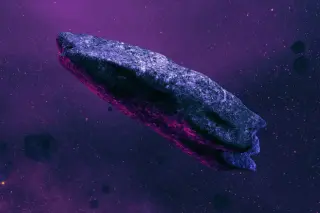
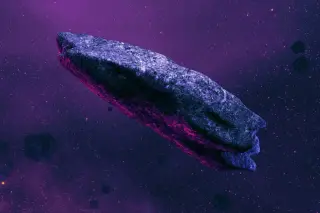
In 2017, the first confirmed interstellar object, Oumuamua, passed through the Solar System on a hyperbolic path and showed a tiny non-gravitational push without a visible tail. Natural explanations (e.g., venting hydrogen or nitrogen ices) exist, and Avi Loeb's artificial-origin idea remains controversial; since then Borisov and ATLAS behaved like comets, but Oumuamua remains an unresolved puzzle, underscoring data limits and the hope that Rubin Observatory will help settle what it could not.

3I/ATLAS as a Cosmic Seeder: Loeb Proposes Directed Panspermia
science1 month ago

3I/ATLAS as a Cosmic Seeder: Loeb Proposes Directed Panspermia

Harvard astronomer Avi Loeb suggests the interstellar visitor 3I/ATLAS could have seeded life across the Solar System via natural panspermia or even directed panspermia; while controversial, he argues that ice-encased life might survive transit and proposes intercepting future interstellar objects to test for extrasolar biology and compare it with Earth life.

Interstellar Seed? Loeb Suggests 3I/ATLAS Might Have Seeded Life Here
science1 month ago

Interstellar Seed? Loeb Suggests 3I/ATLAS Might Have Seeded Life Here

Harvard astronomer Avi Loeb proposes that the interstellar visitor 3I/ATLAS could have seeded life in the Solar System, either by ice-embedded life released as it traveled or through directed panspermia by an advanced civilization; while the idea is controversial and debated, Loeb argues that intercepting such objects could help determine if extrasolar life resembles Earth life, a notion that would have profound implications for our understanding of life's origins.

Interstellar Comet 3I/ATLAS Highlights Solar System Uniqueness
science2 months ago

Interstellar Comet 3I/ATLAS Highlights Solar System Uniqueness

ALMA and JWST observations of interstellar comet 3I/ATLAS reveal a striking excess of heavy water, indicating it formed in a much colder environment and likely experienced limited thermal processing. This enrichment suggests its origin differs markedly from our solar system’s history, underscoring that our solar system may be unusual and pointing to rich future discoveries of interstellar material with upcoming telescopes.

Deuterium Signals in 3I/ATLAS Spur Fusion Talk, Not Alien Proof
science3 months ago

Deuterium Signals in 3I/ATLAS Spur Fusion Talk, Not Alien Proof

New JWST analyses of the interstellar visitor 3I/ATLAS reveal unusually high deuterium in its gases, suggesting formation in extremely cold, metal-poor regions billions of years ago. Two Nature Astronomy papers argue the isotope pattern could be a natural relic rather than evidence of alien technology, while Avi Loeb questions the interpretation and notes deuterium as potential fusion fuel. Overall, the findings point to a natural origin and do not prove extraterrestrial engineering.

NASA Opens Public Archives to Interstellar Comet 3I/ATLAS Data, Accelerating Discovery
science3 months ago

NASA Opens Public Archives to Interstellar Comet 3I/ATLAS Data, Accelerating Discovery

NASA has opened public access to observations of the interstellar comet 3I/ATLAS, with data from more than a dozen missions (including TESS, MAVEN, JWST, SPHEREx, and PUNCH) stored in archives such as MAST, IRSA, and the Planetary Data System. By combining cross-mission data, researchers can study 3I/ATLAS’s unique composition and behavior, illustrating how open data accelerates discovery and will help scientists compare interstellar objects in the future.

Interstellar Visitor 3I/ATLAS Exhibits Methanol-Rich Comet Chemistry
space4 months ago

Interstellar Visitor 3I/ATLAS Exhibits Methanol-Rich Comet Chemistry

ALMA observations of the interstellar object 3I/ATLAS reveal an unusually high methanol abundance in its coma and core—among the highest seen in comets—paired with a high methanol-to-hydrogen cyanide ratio, indicating distinctive formation conditions in that distant system. The methanol appears to come from both the core and the coma, and future observations with advanced telescopes could help explain the object’s origin as it exits the solar system.

Solar Oberth Route Could Intercept Interstellar Visitor 3I/ATLAS by 2035
space4 months ago

Solar Oberth Route Could Intercept Interstellar Visitor 3I/ATLAS by 2035

Researchers from the Initiative for Interstellar Studies propose an indirect mission to intercept interstellar object 3I/ATLAS using a Solar Oberth maneuver and their Optimised Interplanetary Trajectory Software (OITS); a 2035 launch could align Earth, Jupiter, and the Sun to enable a high‑speed flyby, since a direct Earth‑launched rendezvous is unlikely due to late detection and the object’s high velocity. Leveraging gravity assists and a Sun-centric burn with current tech, the mission would take about 50 years, offering revolutionary insights into another star system; directed-energy propulsion remains a long‑term possibility.