
James Webb telescope reveals ancient galaxies with surprising star power.
TL;DR Summary
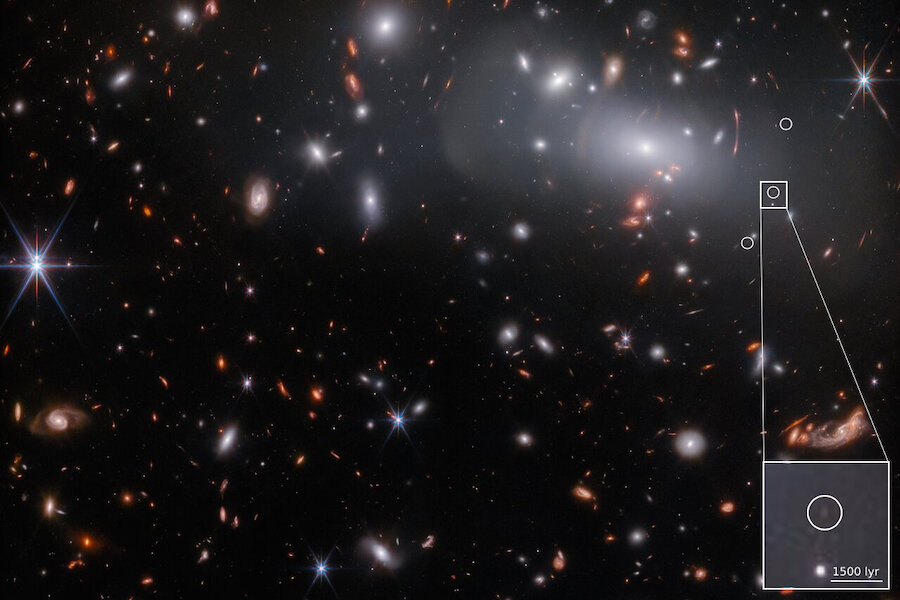
Using the James Webb Space Telescope, researchers from the University of Minnesota have discovered a unique, tiny galaxy that generated new stars at an extremely high rate for its size. The galaxy is one of the smallest ever discovered at this distance, around 500 million years after the Big Bang, and could help astronomers learn more about galaxies that were present shortly after the universe came into existence. The James Webb telescope can observe a wide enough field to image an entire galaxy cluster at once, and its sensitivity allows scientists to access an entirely new window of data.
- Researchers discover tiny galaxy with big star power using James Webb telescope Phys.org
- Cosmic Time Travel: Webb Unveils Physical Properties of Compact Galaxy From the Early Universe SciTechDaily
- JWST’s Newfound Galaxies Are the Oldest Ever Seen Scientific American
- James Webb Space Telescope images challenge theories of how universe evolved Phys.org
- What the Discovery of Massive Early Galaxies Could Mean for Cosmology Sky & Telescope
Reading Insights
Total Reads
0
Unique Readers
10
Time Saved
3 min
vs 4 min read
Condensed
85%
643 → 99 words
Want the full story? Read the original article
Read on Phys.org