Tag

Big Bang

All articles tagged with #big bang

One of Physics’ Biggest Surveys Finds Almost No Consensus
physics-and-chemistry12 days ago

One of Physics’ Biggest Surveys Finds Almost No Consensus

APS’s large survey of about 1,660 participants—ranging from researchers to science enthusiasts—reveals widespread disagreement on core physics questions, from the Big Bang to quantum gravity. The Big Bang is widely seen as a hot, dense state (68%), not necessarily the absolute beginning (25%). Quantum interpretations are not universally accepted: Copenhagen leads at around 36%, with many opting for other theories or 'no opinion.' About half agree on cosmic inflation, while dark energy and ΛCDM show no clear majority, with evolving dark energy edging ahead slightly. Only a minority subscribe to specific quantum gravity views, with string theory leading among them. The results underscore that physics frontiers remain active and data and theory must advance to resolve these debates.

Cosmic bounce inside a black hole may rewrite the Big Bang story
science1 month ago

Cosmic bounce inside a black hole may rewrite the Big Bang story

A growing group of physicists argues the universe may have arisen from a rebound inside a black hole rather than a traditional Big Bang. The Black Hole Universe theory suggests matter compressed to quantum limits hits a wall inside a black hole and bounces outward, potentially spawning new universes. Proponents trace the idea to Raj Kumar Pathria (1970s) and cite renewed interest from researchers like Juliano Cesar Silva Neves, with James Webb Space Telescope data cited as hinting at spin-direction imbalances in ancient galaxies that could signal a birth from a rotating black hole.

Cosmic rebound: a black-hole past could have sparked our universe's birth
science1 month ago

Cosmic rebound: a black-hole past could have sparked our universe's birth

A team from the University of Portsmouth and the Institute of Space Sciences proposes a 'black hole universe' theory in which our cosmos rebounded from a prior collapse, rather than arising solely from a Big Bang singularity. The model suggests remnants like black holes could survive as cosmic fossils, potentially shaping the current universe and addressing mysteries such as the nature of dark matter, what triggered the Big Bang, and how galaxies formed. Published in Physical Review D, the theory outlines tests such as relic gravitational waves or patterns in the cosmic microwave background to identify evidence of a prior collapsing universe.

Cosmic fossils from a pre‑Big Bang black hole bounce may sculpt the universe
science1 month ago

Cosmic fossils from a pre‑Big Bang black hole bounce may sculpt the universe

A new theory suggests our universe may have emerged from a rebound after an earlier cosmic contraction, with remnants like primordial black holes and other relics surviving the bounce to influence galaxy formation and dark matter; scientists propose tests such as searching for relic gravitational waves and pre‑Big Bang patterns in the cosmic microwave background to validate the idea.

Lab recreates the Big Bang’s first millisecond, revealing a soupy primordial plasma
physics-and-mathematics3 months ago

Lab recreates the Big Bang’s first millisecond, revealing a soupy primordial plasma

Physicists at the LHC's CMS collaboration watched a high-energy quark traverse quark-gluon plasma by using Z bosons as a clean directional tag. They observed a subtle less-than-1% dip in backward-produced hadrons, consistent with a wake in the primordial soup and offering new insight into the liquid-like properties of the early-universe plasma.

Memories in the vacuum: are we living as Boltzmann Brains?
science3 months ago

Memories in the vacuum: are we living as Boltzmann Brains?

Physicists propose the Boltzmann Brain hypothesis: given enough time, random fluctuations could create a brain with all your memories, making our recollections potentially illusory. In a paper in Entropy, lead author David Wolpert and co-authors Carlo Rovelli and Jordan Scharnhorst argue this is a plausible consequence of physics, though there’s no rigorous way to prove or disprove it. They connect the idea to thermodynamics and argue that grounding our sense of time still rests on the Big Bang, concluding we shouldn’t panic, but the notion challenges the reliability of memory as a reflection of past reality.

Einstein–Rosen Bridges: Time Mirrors, Not Tunnels
space4 months ago

Einstein–Rosen Bridges: Time Mirrors, Not Tunnels

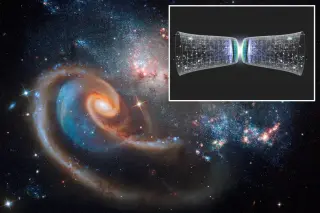
A new study reframes the Einstein–Rosen bridge from a travel conduit to a time-symmetric link that preserves unitarity in curved spacetime, suggesting wormholes aren’t cosmic tunnels, potentially resolves the black hole information paradox, and portrays the Big Bang as a quantum bounce between opposing arrows of time with possible connections to dark matter.

Theories on the Universe's Final Fate
science5 months ago

Theories on the Universe's Final Fate

The universe, originating from the Big Bang about 14 billion years ago, is expected to continue expanding, with star formation ceasing and galaxies merging into larger elliptical galaxies over trillions of years. Ultimately, the universe may fade into darkness, driven by dark energy, but its exact future remains uncertain and open to new discoveries.

Potential Clues to the Pre-Big Bang Universe
science6 months ago

Potential Clues to the Pre-Big Bang Universe

Recent cosmological research suggests that understanding the universe's ultimate fate—whether it will end in a Big Crunch, Big Freeze, or a cyclical Big Bounce—could provide insights into what preceded the Big Bang, especially with new evidence indicating that dark energy may not be constant but evolving over time, possibly involving particles called axions that influence cosmic expansion.

Why the Universe's Expansion Had Limits
science7 months ago

Why the Universe's Expansion Had Limits

The article explains that the universe could not have expanded forever into the past due to the implications of the Borde-Guth-Vilenkin theorem, which shows that inflationary spacetimes are past-timelike-incomplete, meaning they cannot be eternal and must have had some initial state, possibly a singularity or a different pre-inflationary condition.