
JWST Detects Water and Oxygen-Rich Dust in Star Near Milky Way's Black Hole
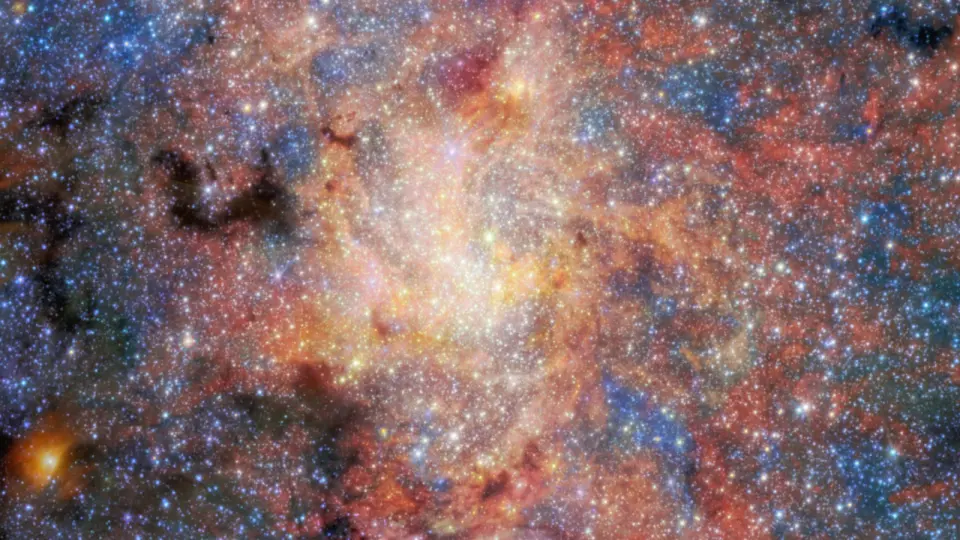
The James Webb Space Telescope has identified water and oxygen-rich dust surrounding the star IRS 3, located just 0.55 light-years from the supermassive black hole Sagittarius A* at the center of the Milky Way. This marks the first detection of water in this extreme environment, demonstrating that stars can maintain chemical envelopes despite intense gravitational forces.
Key points
- JWST's Mid-Infrared Instrument (MIRI) captured detailed mid-infrared images of the star IRS 3, which is situated 0.55 light-years from Sagittarius A*.
- Researchers detected oxygen-rich dust and water in the gas and dust envelope surrounding IRS 3, a finding described as the first of its kind near the galactic center.
- The star IRS 3 is nearing the end of its life, characterized by puffing up, cooling, and shedding gas into space.
- Lead author Florian Peißker of the University of Cologne noted that dust production remains resilient in these extreme conditions, offering insights into stellar behavior near supermassive black holes.
Background
This discovery follows recent JWST findings regarding 'black hole stars' and complex multi-black-hole systems in the early universe, which have reshaped understanding of how supermassive black holes form and grow. While previous studies focused on distant, ancient objects, this new observation provides direct evidence of chemical processes occurring in the immediate vicinity of our galaxy's central black hole.
Why it matters
This finding challenges assumptions about the harshness of galactic centers by showing that stars can retain volatile compounds like water despite proximity to a supermassive black hole. It provides a new benchmark for understanding how stellar evolution and chemical enrichment proceed in the most extreme gravitational environments in the Milky Way.
What to watch
Astronomers will likely use JWST to further analyze the composition and dynamics of the gas envelope around IRS 3, potentially revealing how such stars contribute to the interstellar medium near Sagittarius A* and whether similar chemical resilience exists in other stars orbiting close to the black hole.
Want the full story? Read the original reporting
Read on Space