Tag

Sagittarius A

All articles tagged with #sagittarius a

Hidden Filaments in Milky Way Core Trace Ancient Black Hole Outflow
astronomy25 days ago

Hidden Filaments in Milky Way Core Trace Ancient Black Hole Outflow

Astronomers using the MeerKAT radio telescope found a new population of horizontal, 5–10 light-year filaments near the Galactic Center that point toward Sagittarius A*. Their thermal emissions and alignment along the galactic plane differ from previously known vertical filaments, suggesting a past energetic outflow from the Milky Way’s central black hole and offering clues about its accretion disk orientation and history.

Milky Way’s Core May Be a Dense Dark Matter Core, Not a Black Hole
space3 months ago

Milky Way’s Core May Be a Dense Dark Matter Core, Not a Black Hole

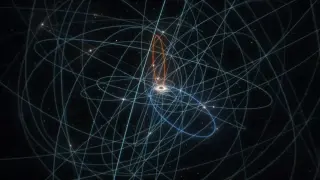
A new study proposes the Milky Way’s central mass could be a dense fermionic dark matter core rather than Sagittarius A*, capable of reproducing the observed fast S-star orbits and the galaxy’s Keplerian rotation decline, and it might even mimic the black hole shadow seen by the Event Horizon Telescope; while provocative, the idea isn’t yet proven and future observations are needed to confirm or refute it.

Could Dark Matter Rule the Milky Way's Core?
astronomy3 months ago

Could Dark Matter Rule the Milky Way's Core?

New research suggests the Milky Way’s central mass, traditionally attributed to the black hole Sagittarius A*, could instead be a dense fermionic dark matter core. The observed orbits of stars like S2 and Gaia rotation curves fit both a black hole and this dark-matter model, meaning current data cannot distinguish them. If the dark matter interpretation holds, it would imply a continuous dark-matter structure linking the galactic center to the halo, reshaping our view of the Milky Way’s mass distribution. Future observations, including higher-resolution EHT data and longer-term stellar monitoring, could resolve the true nature of Sgr A*.

Dark Matter Core Emerges as Challenger to the Galactic Center’s Black Hole
space-and-spaceflight3 months ago

Dark Matter Core Emerges as Challenger to the Galactic Center’s Black Hole

Simulations show a dense dark matter core at the Milky Way’s center could mimic Sagittarius A*’s gravity, matching observed orbital data as well as a black hole and aligning with Gaia DR3, but the model isn’t decisively better yet; next-gen instruments will test whether dark matter could truly dominate the Galactic Center.

Chandra Expands X-ray Universe With 400k-Source Catalog and Sonic Map
science4 months ago

Chandra Expands X-ray Universe With 400k-Source Catalog and Sonic Map

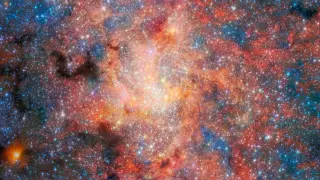
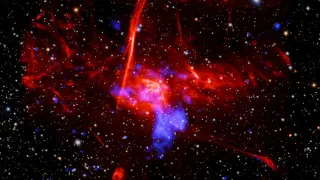
NASA's Chandra X-ray Observatory released CSC 2.1, a vastly expanded catalog with more than 400,000 X-ray sources and 1.3 million detections up to 2020, plus new imagery of the Galactic Center around Sagittarius A* and a 22-year sonification of Chandra data—demonstrating cross-mission science with JWST and Hubble and that Chandra continues observing beyond 2021.

"Unveiling the Mysteries Beyond Black Holes"
science-and-space1 year ago

"Unveiling the Mysteries Beyond Black Holes"

Over the past 25 years, black hole research has made significant strides, including capturing the first image of a black hole, measuring the mass of the Milky Way's black hole, detecting gravitational waves from black hole mergers, and discovering intermediate-mass black holes. The James Webb Space Telescope has also found ancient supermassive black holes, challenging existing growth theories. These advancements have transformed our understanding of these cosmic phenomena.

"Revealing Magnetic Fields: Event Horizon Telescope's Discovery at Milky Way's Central Black Hole"
astronomy2 years ago

"Revealing Magnetic Fields: Event Horizon Telescope's Discovery at Milky Way's Central Black Hole"

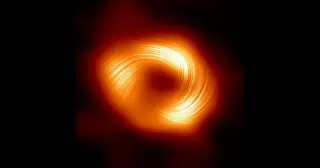
The Event Horizon Telescope (EHT) collaboration has discovered strong magnetic fields spiraling around the supermassive black hole at the center of the Milky Way, named Sagittarius A* (Sgr A*). By studying Sgr A* in polarized light, astronomers have found similarities with the much larger black hole at the center of the Messier 87 galaxy (M87*), suggesting universal processes among supermassive black holes. The findings, reported in two papers, provide insights into the interaction of black holes with surrounding matter and will refine theoretical models. The EHT is scheduled to observe Sgr A* again with more telescopes participating, allowing for observations in more frequencies.