
JWST Maps Lopsided Atmosphere of 'Super-Puff' Exoplanet WASP-17b
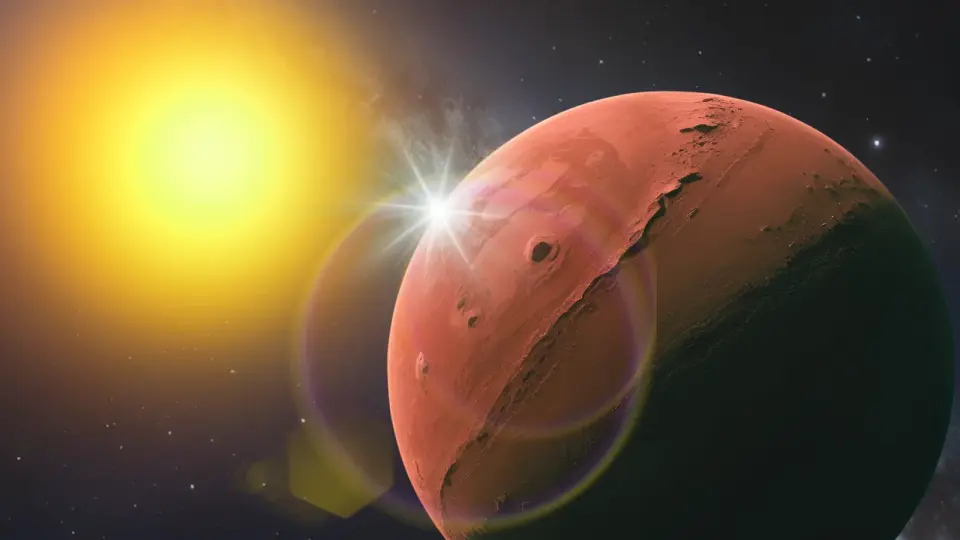
Astronomers used the James Webb Space Telescope to map the 3D structure of the atmosphere of the hot Jupiter WASP-17b, revealing a lopsided shape caused by extreme winds and temperature differences between its day and night sides.
Key points
- Researchers applied a new technique called 'transmission strings' to analyze light passing through the atmosphere of WASP-17b, located 1,300 light-years away.
- The planet, which has a mass of 0.8 times Jupiter but is twice as wide, exhibits a 'super-puff' consistency with an atmosphere that bulges on the evening side.
- Measurements show a temperature difference of approximately 650 K between the cooler morning limb and the hotter evening limb, confirming theoretical models of heat redistribution.
- The study, published in Nature Astronomy, provides the first comprehensive 3D view of an exoplanet's atmospheric limb, distinguishing conditions across latitudes and hemispheres.
Background
Recent JWST observations have advanced exoplanet atmospheric studies, including the detection of helium on LHS 1140b and weather patterns on brown dwarfs. This new study builds on those efforts by moving from averaged spectra to detailed spatial mapping.
How outlets are covering it
Space.com emphasizes the 'gemstone' analogy for the atmospheric bulges and highlights the planet's marshmallow-like density. Nature and ScienceDaily focus on the technical breakthrough of the 'transmission strings' method, noting how it resolves asymmetries that traditional averaging methods miss. Astrobiology Web underscores the significance of confirming 3D atmospheric dynamics, moving beyond computational models to direct observational evidence.
Why it matters
This technique allows scientists to map weather patterns and chemical compositions across different latitudes and hemispheres of distant planets, offering a new benchmark for studying the over 6,000 confirmed exoplanets and understanding atmospheric dynamics in extreme environments.
What to watch
Researchers plan to apply the transmission strings method to other exoplanets to map atmospheric structures at smaller scales, potentially revealing detailed weather patterns and climate dynamics on worlds far beyond our solar system.
- Scientists find 'gemstones' in atmosphere of bizarre, scorching-hot 'marshmallow' exoplanet Space
- A spatial map of the atmospheric limb of a hot Jupiter Nature
- James Webb reveals a strange bulge in an alien planet's atmosphere Science Daily
- Webb Maps the Lopsided Atmosphere of WASP-17b Technology Org
- Trailblazing Technique Uncovers The Real Shape Of Scorching-hot Exoplanet Atmospheres Astrobiology Web
Want the full story? Read the original reporting
Read on Space