
Webb Telescope Reveals 'Treasure Chest' of 70 Newborn Stars in Carina Nebula
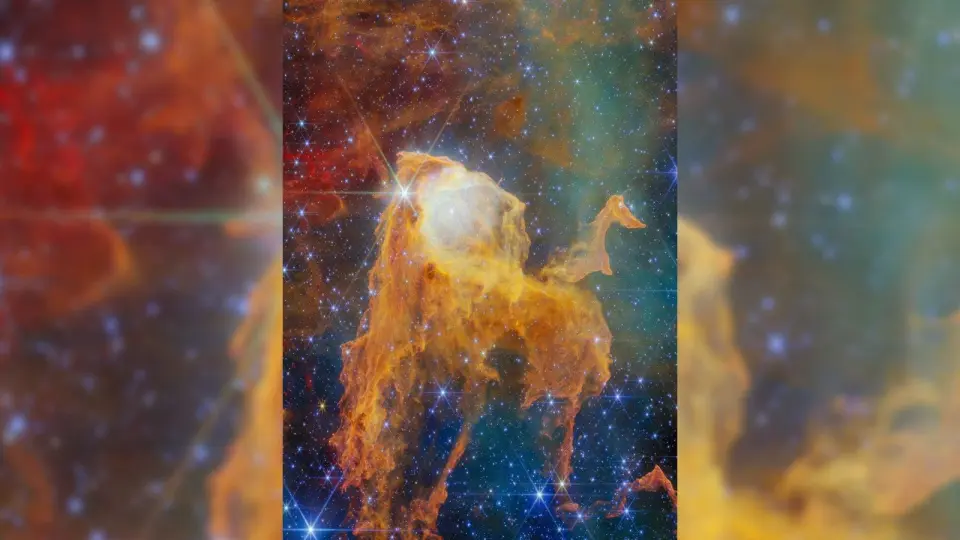
The James Webb Space Telescope has captured a new image of the Carina Nebula, highlighting a cometary globule nicknamed the 'Treasure Chest.' This feature contains a cluster of approximately 70 young stars, the most massive of which is 19 times the mass of the Sun. The cluster is estimated to be 1.3 million years old, though some earlier estimates suggested it could be as young as 100,000 years. The distinctive shape of the globule is sculpted by intense radiation and winds from nearby massive stars, including Eta Carinae and the Trumpler 16 cluster. Webb's Near-Infrared Camera (NIRCam) allows astronomers to see through the dust, revealing the glow of these newborn stars and the circumstellar discs surrounding them, which may eventually form planets.
Key points
- The 'Treasure Chest' is a cometary globule in the Carina Nebula, located 7,500 light-years away in the constellation Carina.
- The globule contains a cluster of about 70 young stars, with the most massive being an O-type star roughly 19 times the mass of the Sun.
- The star cluster is estimated to be 1.3 million years old, though some earlier estimates placed its age at just 100,000 years.
- The shape of the globule is sculpted by radiation and winds from nearby massive stars, including Eta Carinae and the Trumpler 16 cluster.
- Webb's NIRCam reveals the glow of the newborn stars and the circumstellar discs surrounding them, which may eventually form planets.
Background
The Carina Nebula has been a subject of interest for the James Webb Space Telescope since its first image release, known as 'Cosmic Cliffs.' The nebula is the nearest high-mass star-forming region, allowing astronomers to study the full range of star formation. The 'Treasure Chest' is a specific feature within the nebula that has been highlighted in recent observations.
How outlets are covering it
Space.com and the European Space Agency (ESA) both emphasize the beauty and scientific significance of the 'Treasure Chest' image, highlighting the cluster of young stars and the sculpting effect of nearby massive stars. TechEBlog provides additional details on the observing program led by Megan Reiter of Rice University, which aims to study how young stars collect and expel gas. All sources agree on the age of the cluster and the mass of the most massive star, but TechEBlog provides more detail on the specific filters used by Webb's NIRCam and the potential for planet formation.
Why it matters
The 'Treasure Chest' image provides valuable insights into the process of star formation and the impact of nearby massive stars on the development of young stars and their circumstellar discs. The observations will help astronomers understand how stars shape their neighborhoods and whether these young stars will have the opportunity to form planets.
What to watch
Astronomers will continue to study the 'Treasure Chest' and other features in the Carina Nebula using Webb's NIRCam. The observing program led by Megan Reiter aims to create comprehensive maps of over 100 new jets across the Carina region, providing a deeper understanding of how young stars collect and expel gas.
- Cosmic treasure chest explodes with baby stars photo of the day for Aug. 7, 2026 Space
- Webb opens a Treasure Chest filled with stars European Space Agency
- Treasure Chest from JWST The Planetary Society
- Webb Images Planet-Forming Disks Inside Carina Cluster Being Erased by Same UV That Shaped It Tech Times
- Webb’s Latest Capture Showcases a Glowing Chest of Newborn Stars in the Carina Nebula TechEBlog -
Want the full story? Read the original reporting
Read on Space