
JWST's Stunning Discoveries: Distant Galaxies, Cosmic Filaments, and Ancient Quasars
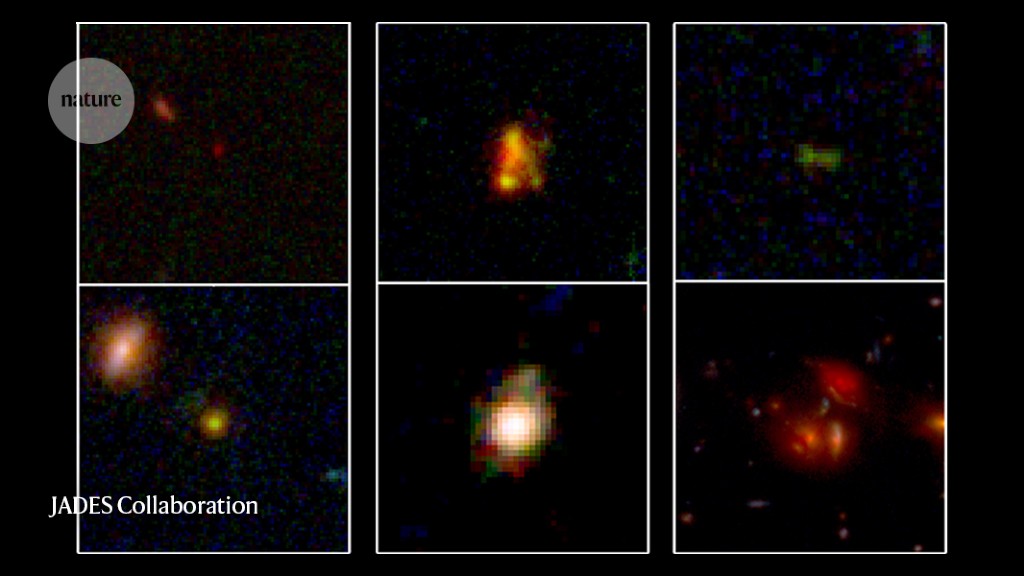
The James Webb Space Telescope (JWST) has conducted one of the largest and deepest surveys of the night sky, revealing some of the earliest galaxies ever seen, dating back to within 650 million years after the Big Bang. The findings have astonished astronomers, showing that stars and galaxies were forming and evolving much earlier than previously thought. JWST's infrared capabilities have allowed it to spot extremely distant galaxies, with a record-breaking galaxy discovered at a redshift of 13.2, just 320 million years after the Big Bang. Other notable discoveries include a dog-bone-shaped object representing two merging galaxies, a galaxy potentially containing the first stars, a clumpy galaxy indicating early dynamism, a small galaxy with inside-out growth, and a gathering of dusty, red galaxies known as the cosmic rose.
- These six distant galaxies captured by JWST are wowing astronomers Nature.com
- NASA's Webb detects 3 million light-year-long cosmic filament Interesting Engineering
- Carnegie Mellon Scientists Unearth Dual Quasars Aided by TACC's Frontera Supercomputer HPCwire
- 860 Million-Year-Old Quasar Had Already Amassed 1.4 Billion Times the Mass of the Sun Universe Today
- Webb detects starlight around early galaxies with bright quasars Interesting Engineering
Reading Insights
0
10
5 min
vs 6 min read
89%
1,151 → 128 words
Want the full story? Read the original article
Read on Nature.com