
Comet 220P/McNaught's Second Eruption Reveals Heterogeneous Nucleus Chemistry
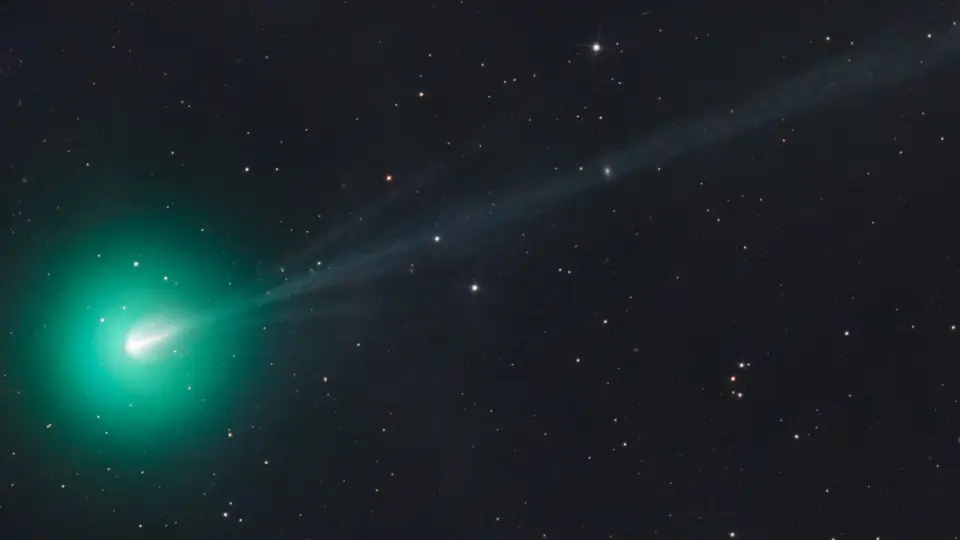
Comet 220P/McNaught experienced a second major outburst in August 2026, brightening by approximately 600 times to magnitude 6-7. While astrophotographers in Namibia captured striking green images of the event, professional data from Bulgaria's Rozhen Observatory indicates the second eruption was dust-dominated, contrasting with the gas-rich signature of the May outburst. This chemical divergence suggests the comet's nucleus contains distinct compositional pockets, offering rare insight into its internal structure.
Key points
- The comet brightened by roughly 600 times in early August, reaching magnitude 6-7, making it visible in binoculars.
- Astrophotographers Gerald Rhemann and Michael Jäger captured images of the green coma over Namibia on August 8, 2026.
- Rozhen Observatory data shows the August outburst was dust-dominated, unlike the molecular-gas enrichment seen in May.
- The differing chemical signatures imply the nucleus has heterogeneous internal zones rather than a uniform composition.
- The comet is currently in the constellation Cetus and is expected to fade over the coming weeks.
Background
Comet 220P/McNaught, discovered in 2004 by Robert H. McNaught, follows a 5.5-year orbit and reached perihelion on June 14, 2026. It had previously undergone a massive outburst in late May 2026, brightening by up to 8,000 times. This current event is the second major eruption in less than three months.
How outlets are covering it
Space.com emphasizes the visual spectacle of the green coma captured by astrophotographers in Namibia. Tech Times highlights the scientific significance of the Rozhen Observatory data, noting the shift from molecular gas to dust dominance. Mashable provides a general overview of the brightness surge and visibility. Yahoo's source was inaccessible due to technical errors, offering no additional perspective.
Why it matters
The distinct chemical signatures of the two outbursts provide rare evidence for the 'heterogeneous nucleus' model, suggesting comets contain separate pockets of different materials. This helps scientists understand the internal architecture and evolution of Jupiter-family comets.
What to watch
The comet is expected to fade steadily over the coming days and weeks. No third outburst has been reported, but monitoring programs are watching for further activity as the nucleus continues to lose volatile material.
- Green comet caught soaring over Namibia photo of the day for Aug. 12, 2026 Space
- Comet 220P/McNaught Erupts Twice: Rozhen Data Show Different Chemistry Each Time Tech Times
- Comet 220P/McNaught In Pics: Catch A Glimpse Of The Cheese Burst In Sky From Around The World in.mashable.com
- Green comet caught soaring over Namibia | Space photo of the day for Aug. 12, 2026 Yahoo
Want the full story? Read the original reporting
Read on Space