
S301: The Milky Way's Fastest Star Offers a Decade-Long Path to Measuring Black Hole Spin
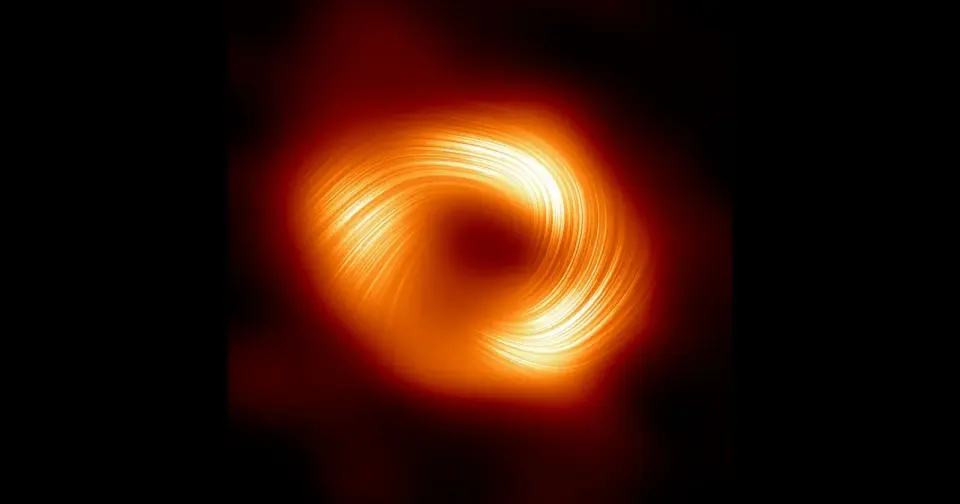
Astronomers have identified S301, a faint star on the shortest known orbit around the Milky Way's central black hole, Sagittarius A*. With an 8.7-year period and pericentre speed exceeding 8% of light speed, S301 passes roughly ten times closer to the black hole than the previously known record holder, S2. While current data confirm general relativistic precession, the star's extreme proximity offers a unique opportunity to measure the black hole's spin within the next decade, provided future instruments achieve the required precision.
Key points
- S301 was discovered in 2023 using the GRAVITY instrument at the Very Large Telescope Interferometer, with archival data extending back to 2017.
- The star completes an orbit every 8.7 years, reaching speeds of approximately 25,000 km/s (8.3-8.5% of light speed) at its closest approach.
- Its pericentre distance is 136-142 Schwarzschild radii, roughly ten times closer to Sagittarius A* than the star S2.
- Current observations show relativistic precession consistent with general relativity but lack the precision to confirm it definitively or measure spin.
- Researchers propose that S301 likely originated from a disrupted binary system via the Hills process, where tidal forces separated the pair.
Background
Previous coverage in our archive highlighted S301 as a critical test for general relativity, noting its potential to probe extreme gravitational fields. Earlier reports emphasized its role in validating Einstein's theory through orbital precession and gravitational redshift, setting the stage for the current focus on measuring the black hole's spin.
How outlets are covering it
Outlets like Smithsonian Magazine and EarthSky emphasize S301 as the 'fastest star' in the Milky Way, highlighting its speed and proximity as record-breaking achievements. In contrast, Space Daily and ZME Science focus more on the technical implications, specifically the potential to measure the black hole's spin within a decade. While all sources agree on the orbital parameters, Space Daily notes that the spin measurement relies on future instrument upgrades and simulated data, whereas popular outlets present it as a near-certain outcome. The discovery method also differs in emphasis: Space Daily details how S301 was found through image reconstruction rather than standard fitting codes, a nuance less prominent in other reports.
Why it matters
Measuring the spin of Sagittarius A* would be a landmark achievement in astrophysics, providing a direct test of general relativity in extreme gravitational environments. S301's orbit offers a unique laboratory for observing frame-dragging effects, which could reveal fundamental properties of spacetime and the history of the Milky Way's central region.
What to watch
Astronomers plan to use the upgraded GRAVITY+ instrument and the Extremely Large Telescope to collect more precise astrometric and spectroscopic data between 2026 and 2035. This data is expected to resolve the ambiguity in S301's orbital orientation and potentially measure the black hole's spin with high confidence.
- A newly found star circles the Milky Way's central black hole every 8.7 years and passes it at about 25,000 kilometres a second, more than 8 percent of the speed of light, and the pass is so close that its discoverers say there is a fair chance of measuring the hol Space Daily
- This Star Orbits Our Galaxy's Heart at a Record-Breaking Speed—and Could Help Uncover Secrets About the Behemoth Black Hole There Smithsonian Magazine
- The Fastest Star in the Milky Way Races Around the Milky Way’s Black Hole at 8% the Speed of Light zmescience.com
- Fastest star in the galaxy could unlock black hole secrets EarthSky
- A star moving at high speed could test the rotation of the black hole at the center of the Milky Way yourweather.co.uk
Want the full story? Read the original reporting
Read on Space Daily