
Rogue Black Holes May Preserve Galactic Histories as Cosmic Wanderers
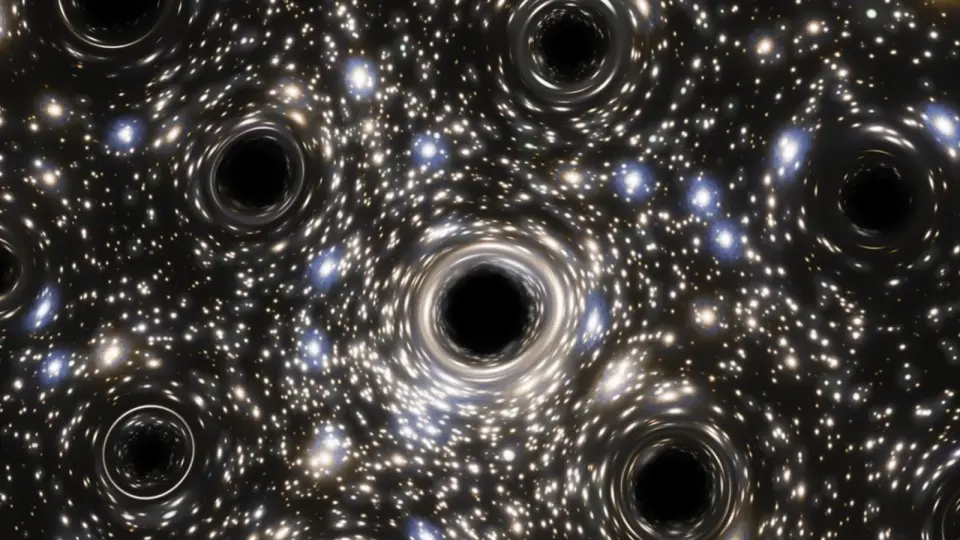
New research suggests that black holes ejected from their home galaxies during mergers act as 'cosmic archivists,' retaining records of their origin. These 'rogue' black holes, which can travel for billions of years, may help resolve debates about whether early black holes formed from collapsing stars or dense gas clouds. The findings indicate that studying wandering black holes is crucial for understanding the formation and dynamics of massive black holes in the early universe.
Key points
- Rogue black holes are displaced from their host galaxies during collision and merger events, embarking on journeys lasting billions of years.
- Smaller galaxies, with weaker gravitational influence, are more likely to release black holes that are not strongly bound to the galactic center.
- These wandering black holes may carry historical data about their birth, potentially resolving the 'light seed' versus 'heavy seed' debate regarding early black hole formation.
- Team leader Emma Jane Weller of Yale University stated that considering wandering black holes is essential for understanding the origins of massive black holes and their host galaxies.
- The research highlights that while centered black holes strongly influence galaxy evolution, rogue black holes serve as important witnesses to the processes shaping galaxies.
Background
Recent studies have focused on the rapid growth of supermassive black holes in the early universe. For instance, astronomers using the James Webb Space Telescope identified triple black hole systems in distant galaxies, suggesting rapid growth via mergers. Additionally, research on 'little red dots' indicated that black holes may grow most of their mass before their host galaxies form significant stellar populations. These findings align with the current study's emphasis on understanding the co-evolution of black holes and galaxies, particularly through the lens of wandering black holes that may preserve records of early cosmic conditions.
Why it matters
Understanding the fate and history of rogue black holes provides critical insights into the formation of the first massive black holes in the universe. By analyzing these wandering objects, scientists can better comprehend the mechanisms that drive galaxy evolution and the role of black holes in shaping the cosmic landscape. This research bridges the gap between theoretical models of black hole seeds and observational data, offering a new avenue for studying the early universe's dynamics.
What to watch
Future research will likely focus on detecting and analyzing the signatures of rogue black holes to determine their origin and history. This could involve using advanced telescopes and gravitational wave detectors to identify these wandering objects and trace their paths through the cosmos. Additionally, further studies may explore the impact of rogue black holes on the evolution of galaxies they pass through, providing a more comprehensive understanding of black hole-galaxy co-evolution.
Want the full story? Read the original reporting
Read on Space