
Hubble reveals new 10-sided atmospheric wave at Saturn's south pole
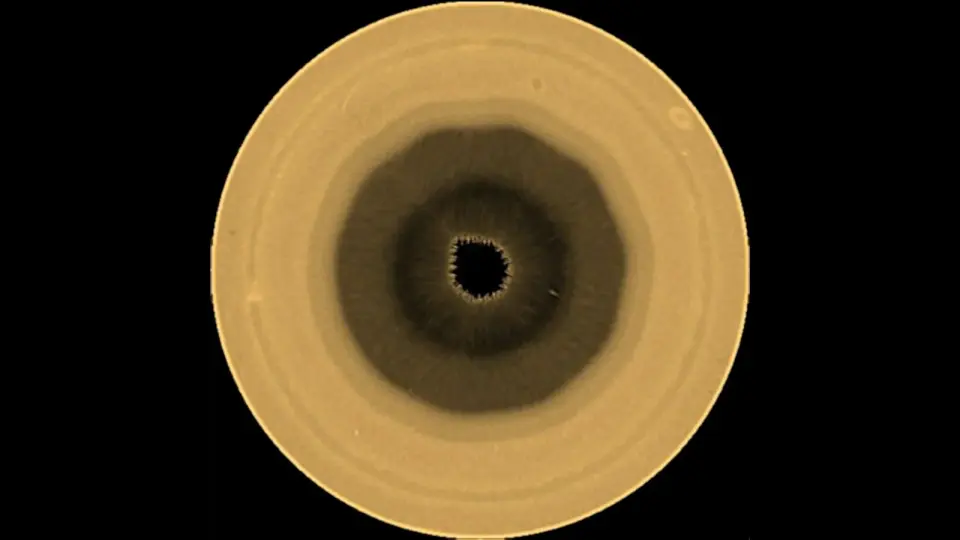
NASA’s Hubble Space Telescope has confirmed a massive, 10-sided cloud pattern, or 'decagon,' encircling Saturn’s south pole. This newly identified structure, which spans approximately 13,000 to 167,820 kilometers depending on the measurement method, is distinct from the long-standing hexagonal storm at the north pole. Discovered through years of data from the Outer Planet Atmospheres Legacy (OPAL) program, the decagon appears to be a recently formed, evolving atmospheric wave rather than a permanent feature. While the northern hexagon has persisted for over 40 years, this southern counterpart was first hinted at in 2023 and confirmed in 2025, offering scientists a rare opportunity to observe the formation and potential lifespan of a giant planetary weather system.
Key points
- The decagon is a 10-sided atmospheric wave located at Saturn's south pole, distinct from the northern hexagon.
- Hubble data from 2023 to 2025 confirmed the structure, which was first spotted by amateur astronomers in 2024.
- The feature extends through multiple layers of Saturn's atmosphere, indicating it is a deep atmospheric phenomenon.
- Scientists are uncertain about the decagon's longevity, as it appears to be a newly formed and evolving pattern.
- The discovery challenges the previous assumption that the northern hexagon was a unique, singular atmospheric feature.
Background
Saturn’s north pole has been home to a persistent hexagonal cloud pattern since its discovery in 1988 via Voyager data. For decades, this shape was considered unique, with no similar structures observed elsewhere on the planet. Recent archive coverage from September 2026 noted early reports of a decagonal storm, but the current findings confirm the structure's existence through Hubble’s long-term monitoring. Unlike the stable northern hexagon, this southern feature appears transient, highlighting the dynamic nature of Saturn’s atmosphere.
How outlets are covering it
Space.com emphasizes the surprise nature of the discovery, noting that scientists had searched for a southern counterpart to the northern hexagon since 1990 without success. NASA highlights the role of the OPAL program in tracking this evolving phenomenon over several years, suggesting the decagon may be strengthening. New Scientist points out that the decagon is slightly wider than Earth and may be linked to a nearby large storm, though the exact cause remains unclear. While Space.com cites a width of 167,820 km, New Scientist reports a diameter of 13,000 km, reflecting different measurement approaches or aspects of the wave structure. All sources agree that the feature is vertically extended and not just a surface cloud pattern.
Why it matters
This discovery provides a rare real-time look at the formation of a large-scale atmospheric pattern on a gas giant. Understanding how the decagon forms and evolves helps scientists refine models of planetary meteorology and fluid dynamics. It also demonstrates that Saturn’s atmosphere is more dynamic than previously thought, with new features emerging in response to seasonal changes and jet stream interactions.
What to watch
Researchers plan to use the James Webb Space Telescope and continued Hubble observations to monitor the decagon’s evolution. The goal is to determine if it will stabilize into a long-lived feature like the northern hexagon or dissipate. Further analysis will help identify the specific atmospheric mechanisms driving the wave and its potential connection to deeper planetary dynamics.
- Astronomers discover mysterious 10-sided cloud structure at Saturn's south pole Space
- NASA’s Hubble Tracks New Decagon Encircling Saturn’s South Pole science.nasa.gov
- Saturn has a big, weird decagon around its south pole New Scientist
- Hubble Images Uncover Massive 10-Sided Wave Brewing at Saturn's South Pole Discover Magazine
- Scientists find a huge 10-sided wave pattern swirling in the clouds over Saturn's south pole Henry Herald
Want the full story? Read the original reporting
Read on Space