
Hubble reveals NGC 4698’s perpendicular bulge and active black hole
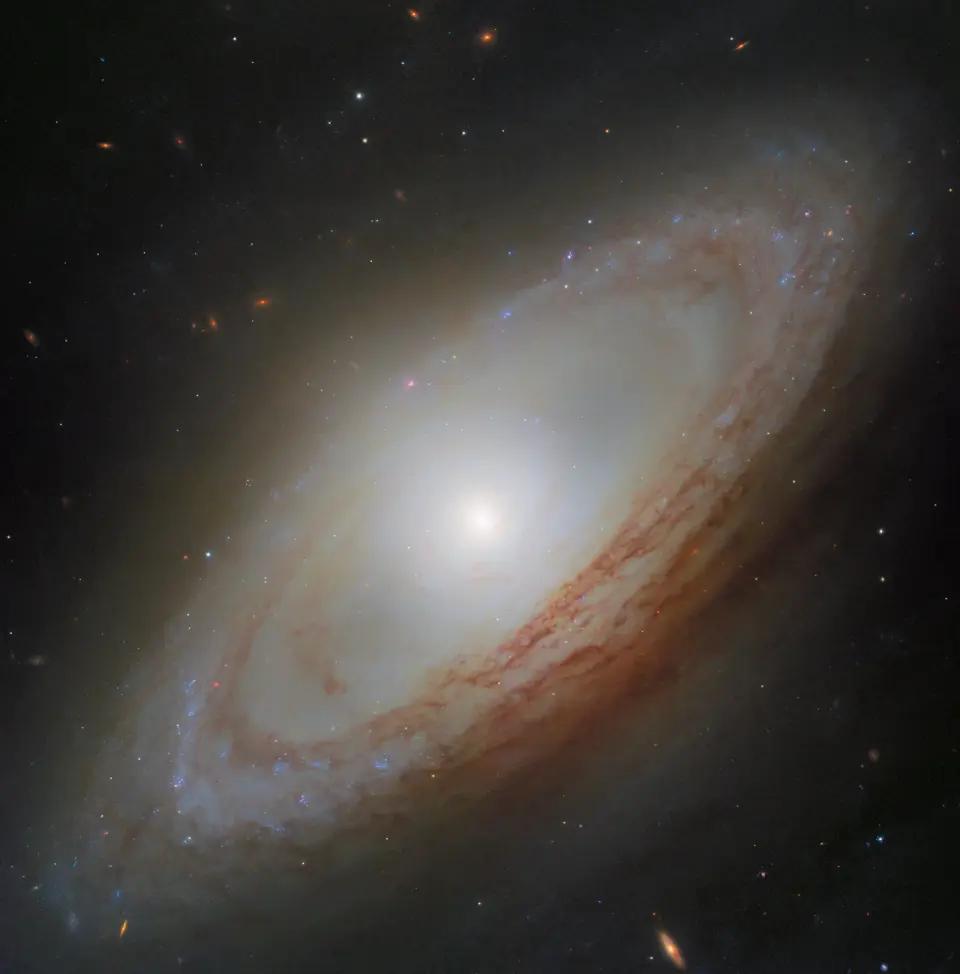
Hubble imaging of NGC 4698, a spiral galaxy in the Virgo Cluster, reveals a rare structural anomaly: its central bulge extends perpendicular to its main disk. This misalignment, along with evidence of a minor merger and an actively growing supermassive black hole, suggests the galaxy absorbed external gas, disrupting its rotational symmetry.
Key points
- NGC 4698 is located approximately 55 million light-years away in the Virgo Cluster, the nearest large galaxy cluster to the Milky Way.
- The galaxy features a central bulge that extends at a right angle to its flat, starry disk, a configuration found in very few known spiral galaxies.
- Stars and gas near the center rotate perpendicular to the rest of the disk, indicating a significant structural misalignment.
- The central supermassive black hole, with a mass millions of times that of the Sun, is actively accreting gas, suggesting ongoing growth.
- A short hydrogen tail observed on one side of the galaxy provides evidence of a past minor galactic merger, which likely introduced external gas that formed the misaligned central disk.
Background
The Virgo Cluster contains over 1,000 galaxies and is the nearest large cluster bound by gravity to the Milky Way. NGC 4698 is a spiral galaxy similar in structure to the Milky Way, featuring spiral arms, a central bulge, and a supermassive black hole. The current observations are part of a broader Hubble program (PI: Thilker) focused on studying galaxies in the Virgo Cluster to understand how their evolution is influenced by their cluster environment.
How outlets are covering it
Both the European Space Agency and NASA Science highlight the same core findings from the Hubble image: the perpendicular orientation of NGC 4698’s bulge and the active growth of its central black hole. The ESA release emphasizes the visual 'chaotic secret' hidden within the galaxy’s serene appearance, while the NASA article provides additional context on the observing program’s goals, noting that researchers are using these data to study how a galaxy’s journey through a cluster affects its evolution and star formation. Both sources agree that a minor merger, evidenced by a hydrogen tail, is the likely cause of the structural anomaly.
Why it matters
This observation provides a concrete example of how external interactions, such as minor mergers, can significantly alter the internal structure and dynamics of spiral galaxies. It helps astronomers understand the processes that lead to misaligned galactic components and the role of supermassive black holes in galaxy evolution, particularly within dense environments like the Virgo Cluster.
What to watch
Researchers will continue to analyze the data from the Hubble observing program to further investigate the history of NGC 4698 and other galaxies in the Virgo Cluster. The focus will be on understanding how the merger event and subsequent gas accretion influenced the galaxy’s current structure and its ability to form new stars.
- A galaxy spinning out of sync European Space Agency
- NASA’s Hubble Spots an Out-of-Sync Galaxy NASA Science (.gov)
- 55 million light-years away, scientists spot something unusual: A strange galactic collision may have left The Economic Times
Want the full story? Read the original reporting
Read on European Space Agency