astronomy25 days ago
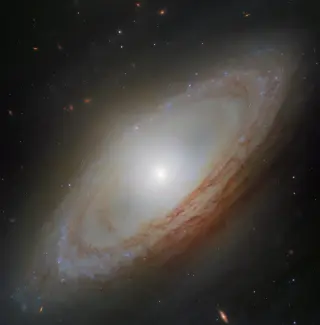
Hubble reveals NGC 4698’s perpendicular bulge and active black hole
Hubble imaging of NGC 4698, a spiral galaxy in the Virgo Cluster, reveals a rare structural anomaly: its central bulge extends perpendicular to its main disk. This misalignment, along with evidence of a minor merger and an actively growing supermassive black hole, suggests the galaxy absorbed external gas, disrupting its rotational symmetry.