
Unveiling the Universe's Expansion: Black Hole Collisions, Gravitational Waves, and Gravitational Lensing
TL;DR Summary
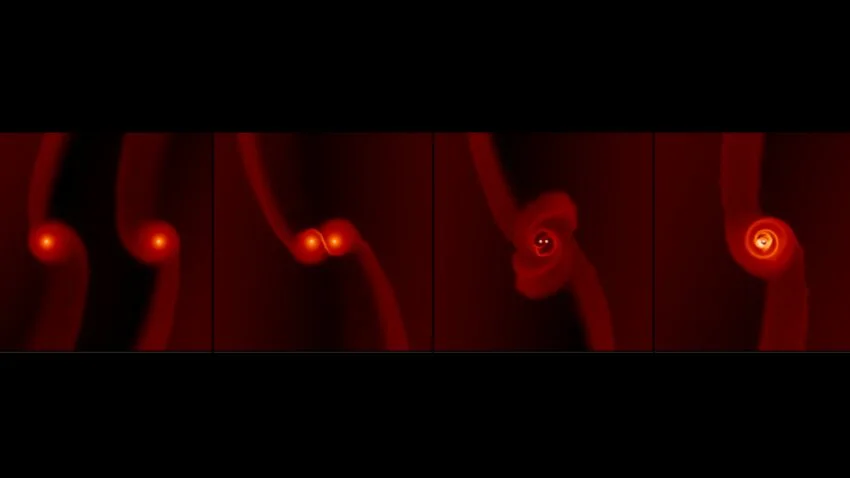
New research suggests that black hole mergers, which produce gravitational waves, could occur in the dense gas disks surrounding quasars. Computer simulations show that stellar-mass black holes can be dragged into these gas disks and forced into binary systems through gravitational interactions. The simulations also reveal that the gas reduces the speed of the black holes, allowing them to remain gravitationally bound and potentially merge. If a significant number of observed gravitational wave events are caused by this phenomenon, it could provide a direct association between quasars and gravitational wave sources in the sky.
- Quasar disks could host black hole collision events Phys.org
- Gravitational waves could help us find out how fast the universe's expansion is accelerating Yahoo! Voices
- Black Hole Echoes Could Help Resolve Tension Around How Fast The Universe Is Expanding IFLScience
- Black hole ripples could help pin down expansion of universe Phys.org
- Gravitational Waves Can Be Gravitationally Lensed, and This Could Provide Another Way to Measure the Expansion of the Universe Universe Today
Reading Insights
Total Reads
0
Unique Readers
10
Time Saved
4 min
vs 5 min read
Condensed
89%
882 → 94 words
Want the full story? Read the original article
Read on Phys.org