
Bruniquel Cave Stalagmite Walls Redated to 176,000 Years Ago, Confirming Neanderthal Authorship
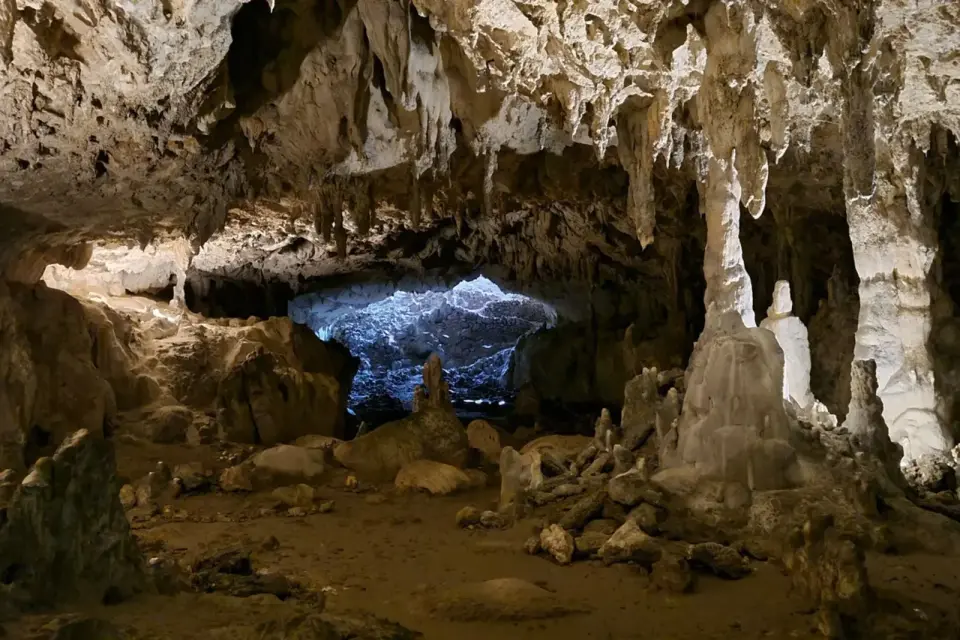
New uranium series dating of mineral crusts on stacked stalagmites in Bruniquel Cave, France, pushes the construction date of two stone circles back to approximately 176,500 years ago. This revision supersedes earlier radiocarbon estimates of 47,000 years, confirming that Neanderthals, not early modern humans, built the structures. The discovery highlights advanced Neanderthal capabilities in coordinated labor, fire management, and spatial organization deep underground.
Key points
- In 1990, cavers discovered two stone circles 1,100 feet underground in Bruniquel Cave, southwestern France.
- Neanderthals broke approximately 400 stalagmites from the cave floor, trimmed them to 12-inch fragments, and stacked them into walls up to four layers high.
- The large ring measures 22 by 15 feet, while the small ring measures 7 by 7 feet, totaling 368 feet of stacked material weighing roughly 2.2 tons.
- Initial radiocarbon dating of burned bone suggested an age of 47,000 years, placing the construction in the era of early modern humans.
- In 2016, archaeologist Jacques Jaubert’s team used uranium series dating on mineral crusts, revising the date to approximately 176,500 years ago.
- This timeline predates the arrival of Homo sapiens in Europe by more than 100,000 years, confirming Neanderthal authorship.
Background
Recent studies have expanded the known geographic range of Neanderthals, including evidence of occupation in Saudi Arabia around 55,000 years ago, suggesting greater adaptability to varied environments. The Bruniquel findings complement this by demonstrating complex social and technical skills in a different context, reinforcing the view that Neanderthals possessed sophisticated cognitive abilities long before modern humans arrived in Europe.
Why it matters
The redating of Bruniquel Cave structures fundamentally shifts the timeline of Neanderthal cognitive and social complexity. By confirming that these sophisticated underground constructions predate modern human presence in Europe by over 100,000 years, the findings challenge previous assumptions about Neanderthal capabilities. The evidence of coordinated labor, fire management, and spatial organization in a dark, deep cave environment suggests a level of planning and communication previously attributed primarily to Homo sapiens. This reinforces the narrative of Neanderthals as highly intelligent and adaptable, capable of complex social organization and symbolic or functional space creation, rather than merely surviving in marginal environments.
What to watch
Researchers will likely continue to examine other deep cave sites across Europe for similar evidence of Neanderthal activity, potentially uncovering more examples of complex underground construction or symbolic behavior. Further analysis of the thermal traces and material composition at Bruniquel may provide deeper insights into the specific purposes of the structures, whether for shelter, defense, or social gathering. The debate over the functional purpose of the rings may also drive new interdisciplinary studies combining archaeology, anthropology, and environmental science to better understand Neanderthal daily life and social structures.
Want the full story? Read the original reporting
Read on Futura, le média qui explore le monde